12,000 to 14,000 color samples per year, very small material quantities, and frequent color changes: AW Kunststoff Farbkonzentrate relies on six Boy 35 E machines. How the long-standing partnership with Dr. Boy, automated cleaning processes, and modern injection molding technology support color development and quality assurance.
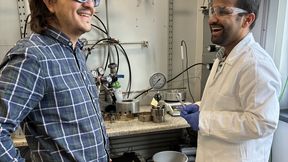
The production of test plates at AW is a key component of the development and quality assurance process.
(Bild: PlastXnow)
About 12,000 to 14,000 color samples per year, test runs of just 200 grams, and more time spent on cleaning than on production: At AW Kunststoff Farbkonzentrate, injection molding must meet different requirements than in mass production. The company has been working with Dr. Boy for decades. Six new Boy 35 E machines and a jointly developed cleaning function demonstrate what matters most in the production of reproducible color test specimens.
When cleaning takes longer than injection molding
AW Kunststoff Farbkonzentrate needs about 200 seconds to produce ten injection-molded test plates for color evaluation. This is followed by about 250 seconds of cleaning. What may seem unusual in an injection molding production line designed for high-volume output is part of the daily routine in the laboratory of the masterbatch manufacturer is part of daily operations. Here, the process is not driven by maximizing output, but rather by frequent switching between different color shades and materials.
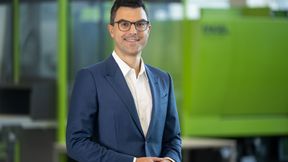
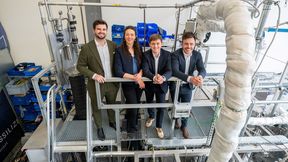
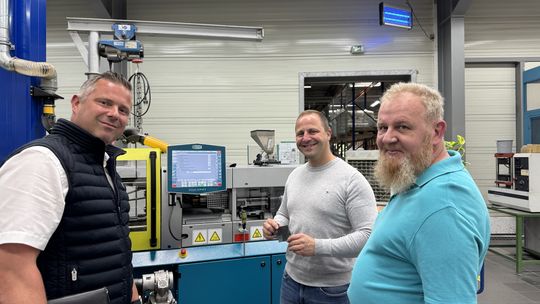
For Sebastian Hänig, Technical Consultant and Sales Representative at Dr. Boy; Sebastian Wolf, Head of Purchasing and Sales at AW; and Steffen Sagert, Laboratory Manager at AW, personal contact plays an important role, which is why they regularly communicate directly with one another (from left to right).
(Bild: PlastXnow)
“Our machines aren’t production machines,” explains Steffen Sagert, laboratory manager at AW. Rather, the injection molding machines must be able to handle very small amounts of material and produce meaningful color samples in rapid succession. At the same time, residues from previous tests must not affect the results.
For this specific application, AW has relied on machines from Dr. Boy. In 2025, the existing machine fleet was replaced by six identical Boy 35 E machines. With this replacement, AW is continuing a partnership that goes far beyond the mere supply of injection molding machines.
Small Quantities as a Business Model
AW GmbH was founded in October 1989. The business concept at the time was relatively simple: to offer color concentrates even in quantities that were rarely available from established manufacturers. While minimum order quantities of 25 kg were common, AW initially focused on the segment between 1 and 25 kg.
What began in a former shoe factory has grown into a company that now employs about 85 people. After moving to the Lichtenfels/Schney industrial park in 1999, the company underwent several expansions. Production now operates on a three-shift schedule, while color development operates on a two-shift schedule.
The original business model remains relevant. “Service is still the top priority,” emphasizes Sebastian Wolf, Head of Purchasing and Sales. Especially in the packaging sector—a key market for AW—custom color shades and frequently changing product designs are typical. Requirements range from small seasonal runs to long-established brand colors.
According to the company, it serves approximately 300 customers. Its role is not to set color trends itself. Rather, AW translates the ideas of brand manufacturers and their marketing departments into technically feasible plastic formulations. A particular challenge arises when the same color shade needs to be achieved on different materials and packaging components.
Why the color only becomes visible in the molded part
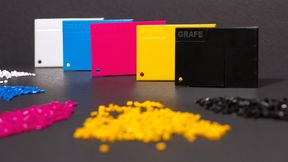
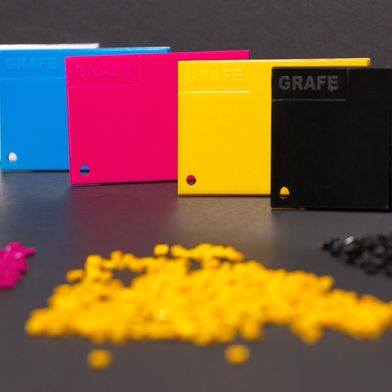
A masterbatch can only be evaluated to a limited extent based on the color of its pellets. What matters most is how the concentrate behaves in the respective carrier plastic after dosing and processing. AW therefore tests every color development using finished, colored plastic samples.
The concentrates are added to the carrier material in varying proportions, typically ranging from about one to five percent, and in exceptional cases even higher. Only about 200 g of material is estimated to be needed for a single experiment.
The production of test plates is therefore a central part of the development process. In addition to visual inspection, they serve as a binding reference for subsequent production batches. AW uses an approved master sample for this purpose, against which quality assurance compares subsequent productions. “Every subsequent production run must match this color sample,” explains Sagert.
Date: 08.12.2025
Naturally, we always handle your personal data responsibly. Any personal data we receive from you is processed in accordance with applicable data protection legislation. For detailed information please see our privacy policy.
Consent to the use of data for promotional purposes
I hereby consent to Vogel Communications Group GmbH & Co. KG, Max-Planck-Str. 7-9, 97082 Würzburg including any affiliated companies according to §§ 15 et seq. AktG (hereafter: Vogel Communications Group) using my e-mail address to send editorial newsletters. A list of all affiliated companies can be found here
Newsletter content may include all products and services of any companies mentioned above, including for example specialist journals and books, events and fairs as well as event-related products and services, print and digital media offers and services such as additional (editorial) newsletters, raffles, lead campaigns, market research both online and offline, specialist webportals and e-learning offers. In case my personal telephone number has also been collected, it may be used for offers of aforementioned products, for services of the companies mentioned above, and market research purposes.
Additionally, my consent also includes the processing of my email address and telephone number for data matching for marketing purposes with select advertising partners such as LinkedIn, Google, and Meta. For this, Vogel Communications Group may transmit said data in hashed form to the advertising partners who then use said data to determine whether I am also a member of the mentioned advertising partner portals. Vogel Communications Group uses this feature for the purposes of re-targeting (up-selling, cross-selling, and customer loyalty), generating so-called look-alike audiences for acquisition of new customers, and as basis for exclusion for on-going advertising campaigns. Further information can be found in section “data matching for marketing purposes”.
In case I access protected data on Internet portals of Vogel Communications Group including any affiliated companies according to §§ 15 et seq. AktG, I need to provide further data in order to register for the access to such content. In return for this free access to editorial content, my data may be used in accordance with this consent for the purposes stated here. This does not apply to data matching for marketing purposes.
Right of revocation
I understand that I can revoke my consent at will. My revocation does not change the lawfulness of data processing that was conducted based on my consent leading up to my revocation. One option to declare my revocation is to use the contact form found at https://contact.vogel.de. In case I no longer wish to receive certain newsletters, I have subscribed to, I can also click on the unsubscribe link included at the end of a newsletter. Further information regarding my right of revocation and the implementation of it as well as the consequences of my revocation can be found in the data protection declaration, section editorial newsletter.
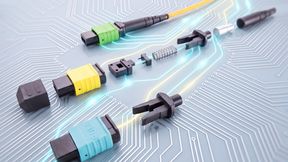
However, a simple color swatch is not always sufficient for customer evaluation. That is why AW also provides sample parts such as replica closures, bottles, or tubes. These allow customers to evaluate a color shade on the actual product under conditions that are as realistic as possible. Nevertheless, each master sample is accompanied by standardized test chips that serve as an internal reference.
The difference is significant: While the sample parts primarily serve as a decision-making aid during product development, the color chips ensure the reproducibility of the approved color shade.
Thousands of color samples and a tight deadline
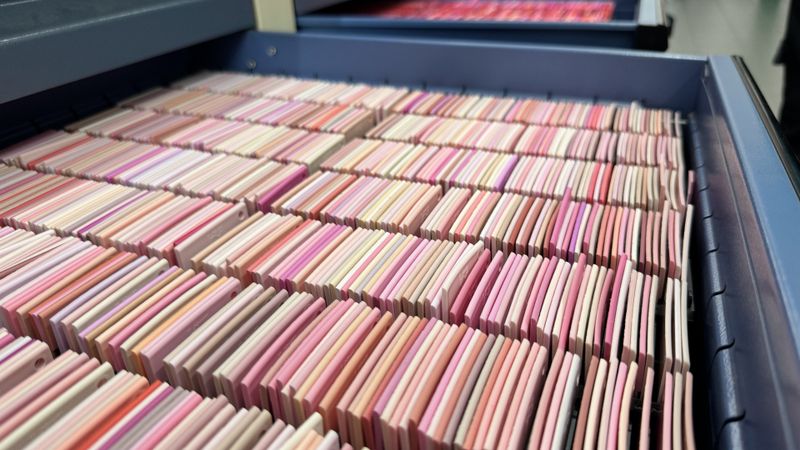
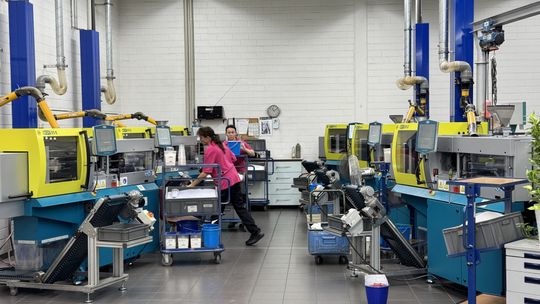
The figures from the lab illustrate just how extensively injection molding technology is used. AW produces between 12,000 and 14,000 color samples annually. Of these, approximately 8,000 are for relevant new formulations, each of which, according to Sagert, requires two to five trials.
The figures from the lab illustrate just how extensively injection molding is used. AW produces between 12,000 and 14,000 color samples annually.
(Bild: PlastXnow)
In addition, there are approximately 35,000 individual production orders, the quality of which is also checked using injection-molded samples. The machines thus support both the development of new formulations and ongoing masterbatch production.
With cycle times of about 20 seconds, the ten molded parts required are produced relatively quickly. The subsequent cleaning, however, takes longer than the actual injection molding process. Consequently, the requirements for a straightforward cleaning process that requires as little staff as possible are correspondingly high.
At the same time, the machines must be able to handle the small test quantities. With a shot weight of about eight grams, there is hardly any leeway to establish stable processing conditions over numerous cycles. For AW, it is therefore crucial to achieve meaningful results within the limited amount of material used.
Jointly Developed Cleaning Function
A particularly telling example of our collaboration with Dr. Boy dates back to the early 2000s. When AW purchased a machine with a Procan control system around 2002, we worked with the manufacturer to develop a solution for the recurring cleaning cycles.
Previously, operators had to manually initiate the cleaning process over and over again: wind up the screw, flush it out, wind it up again, and flush it out once more. Given the high number of color changes, this resulted in a significant amount of repetitive strain.
AW therefore approached Dr. Boy with a request to automate these steps via the control system.
“We were able to establish successful cleaning programs there,” Sagert recalls. The jointly implemented feature made the work considerably easier. Employees no longer had to manually trigger each individual cleaning step and were able to take on other tasks in the meantime.
Screw configurations have also been extensively studied over the years. Among other things, AW experimented with different L/D ratios, barrier screws, and static mixers. The goal was to find a configuration that would provide an appropriate balance between processing results and the available time window when working with small quantities of material.
This experience was incorporated into the further development of the machinery. In the mid-2000s, AW purchased additional machines with comparable control technology.
For Sagert, it is precisely this willingness to work together to find solutions that is an essential part of the collaboration. The manufacturer supplied standard machines but also addressed the user’s specific requirements.
Six new Boy 35 E machines with a unified control system
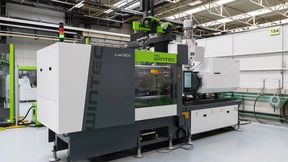
The most recent major investment took place in 2025. AW replaced its existing machines with six identical Boy 35 E models.
This decision was not due to a lack of reliability on the part of the previous machines. “The machines were still running flawlessly,” emphasizes Sebastian Wolf. Rather, the decision to replace them was driven by technological advances in the control systems, the long-term availability of replacement parts, and the desire for a uniform generation of machines.
Employees will find the same technology at all six workstations on the Boy 35 E. This eliminates the need for different generations of control systems and operating concepts. This is a practical advantage, especially in a laboratory where employees regularly switch between machines.
(Bild: PlastXnow)
This ensures that employees find the same technology at all six workstations. It avoids having to deal with different generations of control systems and operating concepts. This is a practical advantage, especially in a laboratory where employees regularly switch between workstations.
The Boy 35 E is a compact injection molding machine with a clamping force of 350 kN. The “E” stands for the servo drive used. Sebastian Hänig, Technical Consulting and Sales at Dr. Boy, explains how it works: “The motor only needs to run when energy is required.”
This largely eliminates the typical continuous hydraulic humming noise that can occur in conventional systems. Employees at AW explicitly view the low noise level as a positive feature.
Its compact design also makes it well-suited for laboratory applications where multiple machines are operated in a limited space.
However, energy efficiency is not the only deciding factor. AW operates nearly 20 extrusion lines, whose continuous energy requirements significantly exceed the consumption of the comparatively small injection molding machines. Therefore, the selection process focuses primarily on ease of use, reliability, and suitability for frequent changes in colors and materials.
Recycled materials increase development costs
Additional requirements arise from the increasing use of post-consumer recycled materials (PCR). AW develops color concentrates for a wide range of plastics, including PE, PP, polystyrene, ABS, SAN, and PET. PVC and certain high-temperature plastics, however, are not processed. The specified upper limit is a processing temperature of approximately 300 °C.
When it comes to recycled materials, achieving the right color is particularly challenging. “Every PCR material has its own base color,” explains Sagert. Even materials with comparable technical specifications can differ significantly in color.
Once a formulation has been developed, it is therefore often not easily transferable to another recycled material. Added to this are variations in material batches, as well as the desire to combine the highest possible proportion of recycled material with specified brand colors.
For AW, this means additional testing and a significant logistical effort. In some cases, different mixing ratios must be tested before it is possible to determine whether a particular color shade is even achievable.
Injection molding parameters cannot be applied across the board either. Processing conditions must be adjusted depending on the type of recycled material. The machines therefore continue to serve as an important tool for testing formulations under real-world conditions.
Collaboration Across Generations of Machines
The partnership between AW and Dr. Boy dates back at least to the 1990s. When Steffen Sagert joined the company in 1998, the lab already had three injection molding machines from that manufacturer.
Sebastian Wolf attributes AW’s continued loyalty to the brand across various machine generations primarily to its operational reliability and technical support. He notes that when problems arise, he can quickly reach contacts who are familiar with the operation and its specific requirements.
Personal contact also plays a role. According to Wolf, the technical managers are in direct contact with the relevant service personnel. The cleaning function they developed together is a concrete result of this collaboration.
For AW, the machines are an indispensable part of color development and quality assurance. For Dr. Boy, their use serves as an example of how compact injection molding technology performs under specific laboratory conditions.
With the six new Boy 35 E machines, AW is relying on a uniform technical foundation for these tasks. The fundamental challenge remains the same: to produce reproducible color samples from small quantities of material, despite varying formulations and plastics.
The fact that the cleaning process takes longer than the actual production of the parts illustrates what matters most in this field of application. What matters is not the number of parts per hour, but a reliable and controllable process—from color change to the approved test specimen.