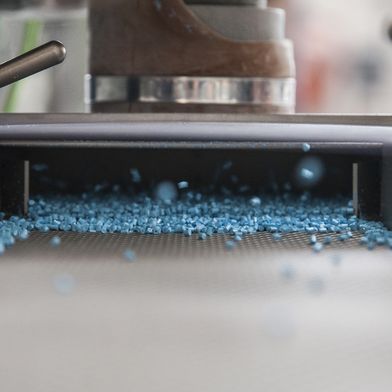
Grafe applies the CMYK principle used in color printing to PLA and PETG masterbatches for filaments: Cyan, magenta, yellow, black, and white are sufficient to produce a wide range of solid and pastel shades in 3D printing. A strategic alternation of CMYK colors in the layer structure results in optical color mixing.
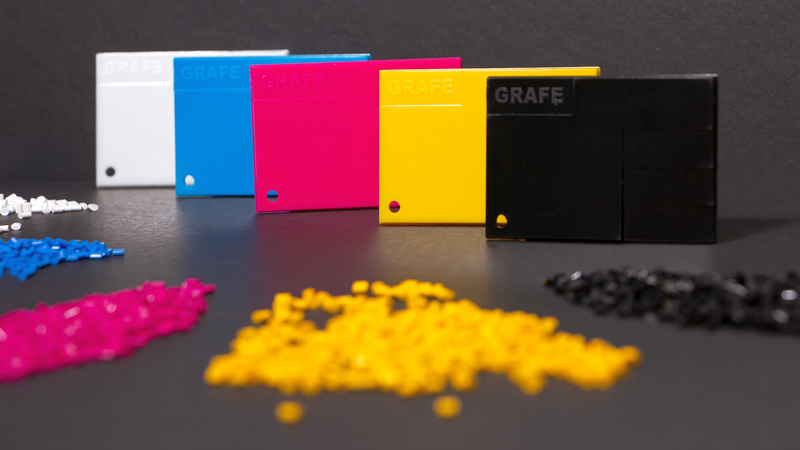
Five base colors for additive manufacturing: masterbatch granules and color sample tiles in white, cyan, magenta, yellow, and black. The masterbatches form the basis for colored PLA and PETG filaments. In multicolor 3D printing, thin, superimposed layers create numerous color nuances.
(Bild: Count)
Anyone who produces multicolored parts using filament-based 3D printing quickly runs into economic constraints when it comes to color selection. Until now, the range of available standard filaments has dictated the final appearance, meaning that manufacturers and users have had to produce or stock separate rolls of material for every shade.
A color concept developed by masterbatch manufacturer Grafe now applies the principle of classic four-color printing to additive manufacturing. Using just five primary colors—cyan, magenta, yellow, black, and white—multicolor printers generate a wide range of intermediate shades directly during the printing process.
Optical color mixing instead of uniform coloring
Unlike offset printing, which places finely screened ink dots side by side, 3D printing relies on the controlled layering of thin plastic layers. The individual color filaments do not melt together into a uniform mass in the extruder, but are deposited one after another, layer by layer. When viewed from a specific distance, these successive layers blend together to create new color nuances visible to the human eye. Depending on the layer thickness, color sequence, and viewing angle, surfaces with subtle color gradients and unique textures are created. As a result, the visible layering transforms from a typical characteristic of the process into a deliberate design element.
“Color is increasingly becoming a design factor in its own right in 3D printing,” explains Lars Schulze, Head of Color Development and Material Sciences at Grafe. The targeted combination of different color layers creates visual effects that go beyond traditional, uniform coloring. The company sees potential in this for new surface designs in additive manufacturing for both series production and individual parts. “While geometric freedom and rapid prototyping were the main priorities in the early years of additive manufacturing, color design is now taking center stage with the use of 3D-printed parts for end-use and visible components,” says Schulze.
Five masterbatches for PLA and PETG
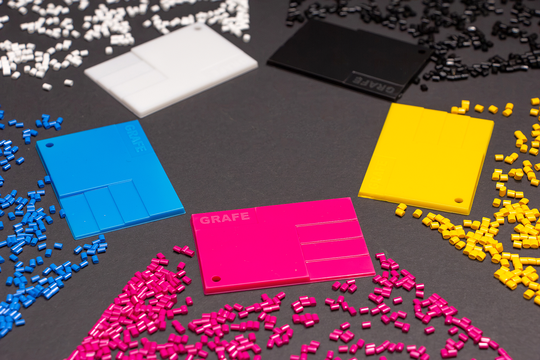
From granules to color: The masterbatch systems are designed for the extrusion of PLA and PETG filaments. The graduated plates allow you to assess transparency at various layer thicknesses—a key factor for optical color mixing in 3D printing.
(Bild: Count)
For the production of these filaments, Grafe supplies specially formulated masterbatch systems in the primary colors cyan, magenta, yellow, black, and white. White visually brightens bold base colors and enables soft pastel shades in the layered structure. Black complements the spectrum with deep, high-contrast shades as well as nuanced dark tones. The breadth of the achievable color palette depends largely on the pigmentation, the transparency of the polymers, and the selected layer sequence.
At launch, masterbatches are available for the two established 3D printing thermoplastics, PLA and PETG. Both product lines are designed for the process conditions of filament extrusion and can be integrated directly into existing production lines. Depending on the desired color intensity and application, the manufacturer recommends a usage concentration of 5 to 7%. Standard formulations are already available, so filament manufacturers can request samples at short notice and begin their own test runs.
Reduced Product Line Complexity in Logistics
In addition to offering design flexibility, the system is primarily aimed at improving cost-effectiveness throughout the supply chain. “Instead of having to maintain numerous individual color formulations, filament manufacturers can tap into a wide range of design possibilities with just a few coordinated masterbatches,” Schulze emphasizes. This reduces product range complexity, simplifies inventory management, and facilitates material planning for both filament producers and processors. At the same time, Grafe is already working on adapting the CMYK concept to other polymer classes in order to open up additional technical applications in filament-based 3D printing. (mg)
Date: 08.12.2025
Naturally, we always handle your personal data responsibly. Any personal data we receive from you is processed in accordance with applicable data protection legislation. For detailed information please see our privacy policy.
Consent to the use of data for promotional purposes
I hereby consent to Vogel Communications Group GmbH & Co. KG, Max-Planck-Str. 7-9, 97082 Würzburg including any affiliated companies according to §§ 15 et seq. AktG (hereafter: Vogel Communications Group) using my e-mail address to send editorial newsletters. A list of all affiliated companies can be found here
Newsletter content may include all products and services of any companies mentioned above, including for example specialist journals and books, events and fairs as well as event-related products and services, print and digital media offers and services such as additional (editorial) newsletters, raffles, lead campaigns, market research both online and offline, specialist webportals and e-learning offers. In case my personal telephone number has also been collected, it may be used for offers of aforementioned products, for services of the companies mentioned above, and market research purposes.
Additionally, my consent also includes the processing of my email address and telephone number for data matching for marketing purposes with select advertising partners such as LinkedIn, Google, and Meta. For this, Vogel Communications Group may transmit said data in hashed form to the advertising partners who then use said data to determine whether I am also a member of the mentioned advertising partner portals. Vogel Communications Group uses this feature for the purposes of re-targeting (up-selling, cross-selling, and customer loyalty), generating so-called look-alike audiences for acquisition of new customers, and as basis for exclusion for on-going advertising campaigns. Further information can be found in section “data matching for marketing purposes”.
In case I access protected data on Internet portals of Vogel Communications Group including any affiliated companies according to §§ 15 et seq. AktG, I need to provide further data in order to register for the access to such content. In return for this free access to editorial content, my data may be used in accordance with this consent for the purposes stated here. This does not apply to data matching for marketing purposes.
Right of revocation
I understand that I can revoke my consent at will. My revocation does not change the lawfulness of data processing that was conducted based on my consent leading up to my revocation. One option to declare my revocation is to use the contact form found at https://contact.vogel.de. In case I no longer wish to receive certain newsletters, I have subscribed to, I can also click on the unsubscribe link included at the end of a newsletter. Further information regarding my right of revocation and the implementation of it as well as the consequences of my revocation can be found in the data protection declaration, section editorial newsletter.
AdditivX | January 26, 2027
Additive Manufacturing as a Tool for Supply Chain, Production, and Service
(Source: Vogel Communications Group / WIN Publishing)
The conference aims to demonstrate how 3D printing with plastics and metals can be used as a strategic tool for spare parts—regardless of the industry. The focus will be on materials, processes, cost-effectiveness, and integration into existing production and maintenance structures, including those from other areas of additive manufacturing.