A roll of plastic film is not just a form used for transportation or storage. It is an intermediate product whose quality affects the performance of the entire value chain—from extrusion through printing, lamination, and coating all the way to further processing.
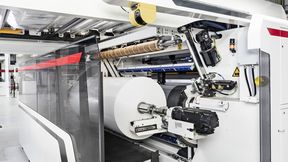
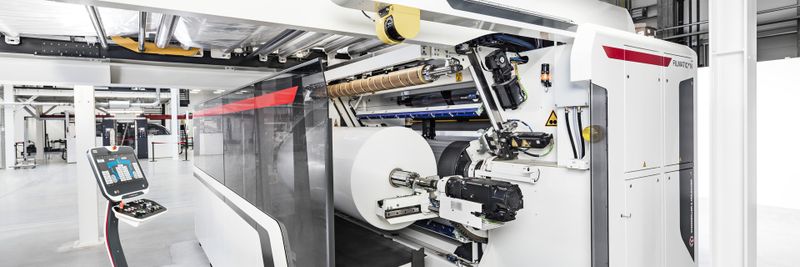
Filmatic II N Single-Winder
(Bild: W&H)
In film processing, the winder is often viewed as the final station in a production line. The film has been extruded, coated, or printed; the web runs smoothly; and the end result is a roll of material.
From a technical standpoint, however, this view is too narrow. This is because the winding process plays a crucial role in determining whether the produced material can be reliably processed in downstream operations. That is why Windmöller & Hölscher (W&H) does not view winding as a peripheral function, but rather as a distinct process engineering discipline.
The role determines the success of the subsequent processes
A high-quality roll is much more than just neatly wound material. Web tension, contact pressure, winding firmness, cut quality, and edge guidance determine whether a roll can later be processed at high speed with consistent quality. Even minor deviations can cause downstream equipment to run more slowly, require additional control measures, or result in scrap.
Typical quality issues often do not become apparent during the initial production process, but only during further processing. Defects in the web pattern caused by recrystallization, localized overstretching of the material web, so-called “tin-canning” effects, or insufficient edge straightness often do not become apparent until the material roll is already being processed on another machine.
The causes of such errors often lie not solely in the winding process itself. In film extrusion, for example, upstream process steps such as edge trimming, pretreatment, or stretching influence how a material web can be wound later on. The winder thus becomes a hub for various process steps, where the effects of many previous parameters and influences converge. An optimally engineered winding solution therefore takes into account the entire material handling process, both before and after the roll is wound.
Winding means mastering the physics of materials
At first glance, winding seems like a simple process: a web is wound onto a winding core. In reality, however, numerous physical factors interact in this process. Web tension, winding speed, contact forces, material elasticity, surface properties, and roll geometry all influence one another.
A roll that is wound too loosely can become unstable. A roll that is wound too tightly can build up internal stress, which can later lead, for example, to flatness issues or, in the worst case, to telescoping (shifting of material layers on the roll), turning the entire roll into scrap. The optimal setting always depends on the material and its intended use. This is precisely why there is no universal winding strategy that works for all products.
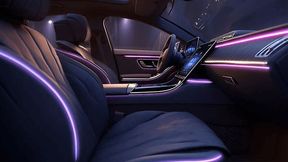
Modern specialty films are particularly challenging. MDO-stretched materials, high-tack stretch films, pressure-sensitive surface protection films, and multilayer decorative films (interior and exterior films made of PVC, PMMA, or PET composites) each place entirely different demands on the roll construction.
Glossary
MDO = Machine Direction Orientation
PVC = Polyvinyl chloride
PMMA = polymethyl methacrylate
PET = polyethylene terephthalate
This can be illustrated, for example, by surface protection films for the electronics industry. In this industry, films are used that are later applied to displays or electronic components. Even the smallest wrinkles, creases, or localized material defects can result in high-quality end products no longer meeting quality requirements. In such applications, it is not enough to simply manufacture the film to a high standard. The roll configuration must also fully preserve the product’s properties.
The start of the roll affects the entire roll
A critical but often underestimated factor is the start of the roll. Even the very first windings on the core affect the quality of the entire roll.
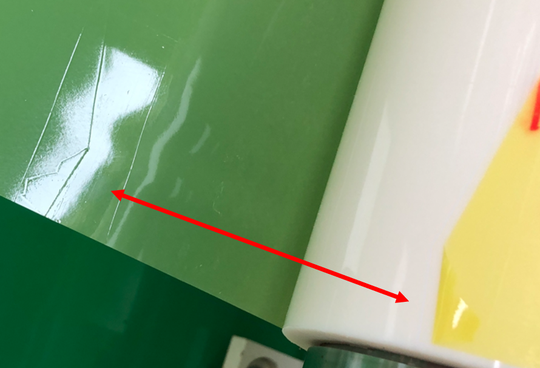
Example of a roll problem caused by improper winding: The wrap pushes through for about 100 m
(Bild: W&H)
If the material web flips over during winding and wrinkles or localized material buildup occur, these can show through multiple layers of film. What begins near the winding core may later be visible even far away from the center of the roll.
Date: 08.12.2025
Naturally, we always handle your personal data responsibly. Any personal data we receive from you is processed in accordance with applicable data protection legislation. For detailed information please see our privacy policy.
Consent to the use of data for promotional purposes
I hereby consent to Vogel Communications Group GmbH & Co. KG, Max-Planck-Str. 7-9, 97082 Würzburg including any affiliated companies according to §§ 15 et seq. AktG (hereafter: Vogel Communications Group) using my e-mail address to send editorial newsletters. A list of all affiliated companies can be found here
Newsletter content may include all products and services of any companies mentioned above, including for example specialist journals and books, events and fairs as well as event-related products and services, print and digital media offers and services such as additional (editorial) newsletters, raffles, lead campaigns, market research both online and offline, specialist webportals and e-learning offers. In case my personal telephone number has also been collected, it may be used for offers of aforementioned products, for services of the companies mentioned above, and market research purposes.
Additionally, my consent also includes the processing of my email address and telephone number for data matching for marketing purposes with select advertising partners such as LinkedIn, Google, and Meta. For this, Vogel Communications Group may transmit said data in hashed form to the advertising partners who then use said data to determine whether I am also a member of the mentioned advertising partner portals. Vogel Communications Group uses this feature for the purposes of re-targeting (up-selling, cross-selling, and customer loyalty), generating so-called look-alike audiences for acquisition of new customers, and as basis for exclusion for on-going advertising campaigns. Further information can be found in section “data matching for marketing purposes”.
In case I access protected data on Internet portals of Vogel Communications Group including any affiliated companies according to §§ 15 et seq. AktG, I need to provide further data in order to register for the access to such content. In return for this free access to editorial content, my data may be used in accordance with this consent for the purposes stated here. This does not apply to data matching for marketing purposes.
Right of revocation
I understand that I can revoke my consent at will. My revocation does not change the lawfulness of data processing that was conducted based on my consent leading up to my revocation. One option to declare my revocation is to use the contact form found at https://contact.vogel.de. In case I no longer wish to receive certain newsletters, I have subscribed to, I can also click on the unsubscribe link included at the end of a newsletter. Further information regarding my right of revocation and the implementation of it as well as the consequences of my revocation can be found in the data protection declaration, section editorial newsletter.
An example from the surface protection industry illustrates just how significant this effect can be. In this industry, protective films as thin as 25 µm and highly pressure-sensitive are processed. A folded film edge at the start of the roll remains visible even after hundreds of meters of winding length. Although the film itself is produced flawlessly, the high product quality is compromised by poor roll formation.
Why Winding Technology Begins as Early as the Product Development Stage
In many development projects, the initial focus is on producing a film with specific product properties. The question of how well this material can be wound, however, is often not considered until later. Yet this is precisely where there is significant potential for optimization.
Experience shows that involving winding experts early on helps lay the groundwork for stable further processing as early as the product development stage. For this reason, sample rolls from W&H are often tested by converters as early as the development phase. This process evaluates not only whether the film possesses the desired material properties, but also whether it can be processed consistently in roll form.
Prospective buyers of winders can still take advantage of the opportunity to test the winding and cutting performance of their own rolls, as well as the roll-change process, at the company’s technical center and receive comprehensive advice. This is done independently of extrusion or printing tests when W&H winders are to be integrated into existing third-party systems at a later date.
From a simple winder to a process engineering solution
Not every material has the same requirements. Thin stretch films, specialty technical films, and thick material webs all require different winding approaches. That is why a successful solution does not start with the parameters, but rather with the selection of the appropriate winding principle and the correct machine configuration.
Depending on the application, different drives, web tension zones, contact pressure systems, or special roller surfaces may be required. Some products require a particularly soft roller design, while others require specifically high contact pressures to ensure stable winding. In addition, factors such as shaft deflection, roller mass, contact pressure distribution, and web tension play a decisive role. The wider the web and the larger the roll, the greater the impact these factors have on the winding result.
Where does this expertise in swaddling come from?
The machinery and equipment manufacturer has experience gained from more than 4,000 winding stations installed worldwide. The range of applications extends from thin stretch films under 10 µm to technical films with thicknesses exceeding one millimeter.
This experience is not derived solely from installed machinery. W&H regularly participates in product qualifications, supports customers with challenging applications, and contributes process engineering expertise directly to development and optimization projects. Often, the focus is not merely on commissioning machinery, but on optimizing products to meet specific quality requirements.
Wrapping expertise that goes far beyond flexible packaging
The basics of winding remain the same regardless of whether it involves packaging film, hygiene film, or a technical substrate. Accordingly, W&H winding technology is used today in a wide range of applications that go beyond flexible packaging. These include agricultural and stretch films, surface protection films for the electronics industry, decorative films for interior and exterior applications, and materials from coating and painting processes.
The requirements can vary considerably in some cases. While packaging films often range from 20 to 120 µm, decorative films for flooring, facades, or architectural applications can have thicknesses exceeding one millimeter. Added to this are textured surfaces, various composite materials, and differing quality requirements.
Technology Highlights from Real-World Applications
The true strength of the right winding technology lies in the fact that different winding principles are specifically designed for certain application profiles. The key consideration is which winding concept best supports the physical requirements of a material.
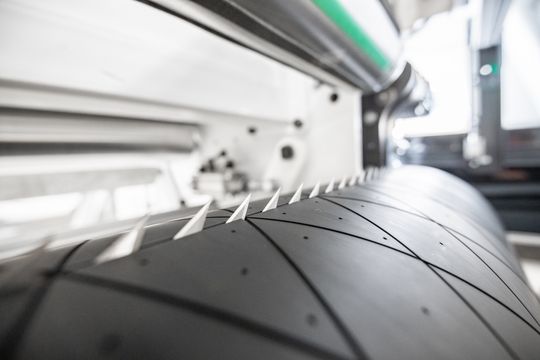
Vacuum-cutting contact roller with blades that cut out of the roll
(Bild: W&H)
One example of this is the start of the roll. As previously described, even the smallest errors in the area of the winding core can affect the quality of the entire roll. To achieve the most precise roll start possible, W&H uses a vacuum-cutting contact roller for certain applications. Unlike conventional solutions, the material web is cut at a right angle directly on the roll by a blade that extends from the contact roller and is then transferred in a controlled manner to a new core. This creates particularly uniform starting conditions during roll formation, which significantly reduces the risk of wraps or defects in the core area.
The requirements for contact forces during the winding process are just as varied as the materials themselves. To ensure particularly uniform contact forces across a wide web width, the Filmatic II N winder utilizes gravity. Thanks to swiveling support rails, the weight of the roll can be specifically harnessed to generate high and evenly distributed contact forces without causing uneven deflection of the winding core. This allows contact forces of up to 2,500 N to be generated, even with small winding cores. This design offers advantages for roll quality, particularly with sticky materials. For sensitive film, the additional pressure roller enables extremely low contact forces, allowing even pressure-sensitive film to be processed.
Another challenge arises as the web width and roll size increase. The larger a roll of material becomes, the greater the impact that the deflection of the winding shaft has on the distribution of contact pressure across the web width. With wide parent rolls and large diameters, this can directly affect the uniformity of the wind. For such applications, W&H relies, among other things, on the Filmatic-TC concept. A special dual-bearing system reduces the deflection of the winding shaft, ensuring a uniform contact pressure even at working widths of up to 4.3 meters. This helps meet high-quality requirements for heavy rolls and high production speeds.
These two examples from the winding portfolio illustrate just how closely mechanical engineering and process engineering are intertwined. The focus is always on how specific physical challenges can be overcome using the right technology in the winding process.
Long-Term Guaranteed Machine Availability
However, winding technology does not end with the commissioning of a machine. Many winders remain in productive use for over 20 years and must adapt during that time to new products, changing production requirements, and current safety standards (such as the new Machinery Directive or the Cyber Resilience Act).
Thanks to the modular design of many winding machines, safety features, automation solutions, or individual technology packages can be retrofitted as needed. Through these retrofit solutions, W&H helps customers keep their existing systems up to date with the latest technology, thereby ensuring their long-term operational readiness.
Info
Text
Fabian Sunder is Director of R&D Winding Technology at Windmöller & Windmöller & Hölscher SE & Co. KG.
Profile
Founded in 1869, Windmöller & Hölscher is today a leading global manufacturer of machinery and equipment for the production of flexible packaging. Its product portfolio includes machines for film extrusion, printing, and finishing.
Windmöller & Hölscher machines are in use in over 130 countries and by more than 5,000 customers. The group, headquartered in Lengerich, Germany, employs approximately 3,400 people and generated over 1 billion EUR in revenue in 2025.