Applications in FocusEssential Materials: Plastics in Medicine
From
Melanie Ehrhardt (in charge)
| Translated by AI
8 min Reading Time
Modern medicine can hardly function without plastics anymore. What sounds to many like an everyday material is, in reality, a key to the future of health care: malleable, adaptable, hygienic, and increasingly sustainable.
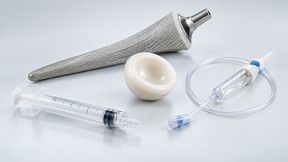
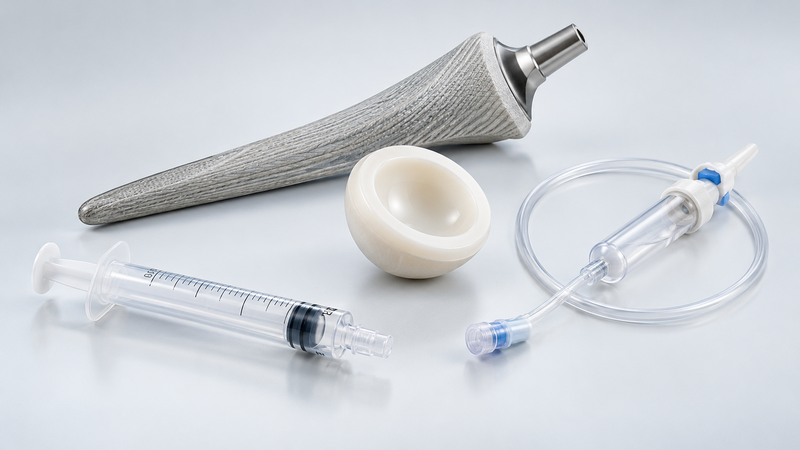
Orthopedic implants and infusion accessories made of plastic
(Bild: KI-generiert / Dall-E)
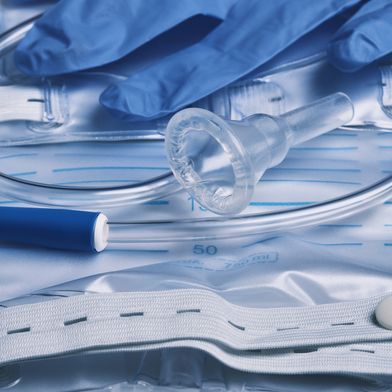
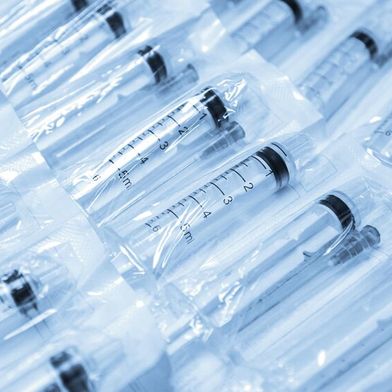
Whether it’s a disposable syringe, an IV tubing, or a heart-lung machine: Plastics are everywhere in medicine. They are lightweight, highly malleable, and can be used hygienically in many applications. As a result, they provide essential prerequisites for modern treatment methods—from simple bandages to highly complex medical technology.
The following article provides an overview of the applications, properties, advantages, and future trends of medical polymers. For anyone interested in delving deeper into current practices, we recommend our e-magazine “PlastXnow Medical,” which was created in collaboration with our sister company Vogel, Devicedmed, and has recently become available.
Why are plastics used in medicine?
Plastics are used in medicine because they are versatile, lightweight, malleable, and adaptable to various medical requirements. Depending on the type of plastic, specific properties such as sterilizability, flexibility, transparency, or chemical resistance can be tailored.
The main reasons are:
Lightweight: Plastic products are significantly lighter than many products made of metal or glass.
Good formability: Plastics can be molded into virtually any shape—which is important for syringes, catheters, prostheses, implants, and medical housings.
Versatile Properties: By selecting different plastics and additives, properties such as hardness, elasticity, transparency, friction, and temperature resistance can be adjusted.
Chemical resistance: Many plastics are resistant to bodily fluids, medications, and cleaning and disinfecting agents.
Sterilizability: Suitable plastics can be sterilized using methods such as steam, radiation, or ethylene oxide.
Hygiene and Single-Use Applications: Plastics enable cost-effective sterile single-use products, which reduce the risk of cross-contamination.
Biocompatibility: Certain plastics can be selected and processed in such a way that they are suitable for contact with tissue, blood, or bodily fluids.
Cost-effectiveness: Plastic products can often be manufactured economically in large quantities.
In short: In the medical field, plastics combine functionality, design flexibility, light weight, and, in some cases, excellent biocompatibility. That is why they are used in everything from simple disposable products to highly sophisticated implants and medical devices.
A Brief Explanation: Biocompatibility
In medicine, biocompatibility refers to the property of materials to elicit an appropriate biological response when in direct contact with living tissues, and in particular, not to have a negative effect on their metabolism.
Source: Doccheck
What types of plastics are used in medicine?
A wide variety of plastics are used in medicine. The type of plastic used depends on whether it needs to be, for example, flexible, mechanically strong, transparent, sterilizable, or particularly biocompatible.
Polytetrafluoroethylene for High-Performance Applications
In the medical field, fluoropolymers are characterized above all by their stability: they are virtually ideal for a wide range of applications. For example, polytetrafluoroethylene (PTFE), also known by the trade name Teflon.
The range of medical applications for PTFE includes simple uses such as coatings for stoppers on medicine vials. More complex examples include durable, single-use tubing that offers some resistance to biofilm formation.
Because the surfaces of these plastics are very smooth, they are also suitable for use in injections or implants. For example, stents for heart surgery and catheter shafts for use in the cardiovascular system are made of PTFE or related fluoropolymers.
Polyethylene for Implants
Polyethylene (PE) is not only the most widely used plastic overall, but also plays a major role in medical applications. This thermoplastic is primarily used in packaging for clinical and pharmaceutical products, including bottles and films, as well as syringes, for example.
High-density polyethylene (HDPE), in particular, is characterized by high dimensional stability and chemical resistance. The material is therefore also used for implants, such as hip sockets in orthopedics. Furthermore, the use of PE containers helps prevent the effects of migrating additives.
Polyvinyl chloride for disposable medical products
The second plastic most commonly used in medicine is polyvinyl chloride (PVC). The main advantages of this material are its low cost—even compared to other plastics—and its ease of processing. The material is also highly biocompatible and well-tolerated by the body. Because of these properties, PVC is primarily used in disposable products such as blood bags, gloves, and catheters, as well as for tubing and sterilizable covers for medical devices.
Polystyrene for Medical Packaging
In the medical field, polystyrene (PS) is used for all types of packaging. Due to its high transparency, thermoplastic is primarily used in applications where glass would otherwise be used. Examples include containers for infectious or toxic materials, or, in laboratory settings, Petri dishes and similar items. PS is also used, for example, as film in medication blister packs.
Date: 08.12.2025
Naturally, we always handle your personal data responsibly. Any personal data we receive from you is processed in accordance with applicable data protection legislation. For detailed information please see our privacy policy.
Consent to the use of data for promotional purposes
I hereby consent to Vogel Communications Group GmbH & Co. KG, Max-Planck-Str. 7-9, 97082 Würzburg including any affiliated companies according to §§ 15 et seq. AktG (hereafter: Vogel Communications Group) using my e-mail address to send editorial newsletters. A list of all affiliated companies can be found here
Newsletter content may include all products and services of any companies mentioned above, including for example specialist journals and books, events and fairs as well as event-related products and services, print and digital media offers and services such as additional (editorial) newsletters, raffles, lead campaigns, market research both online and offline, specialist webportals and e-learning offers. In case my personal telephone number has also been collected, it may be used for offers of aforementioned products, for services of the companies mentioned above, and market research purposes.
Additionally, my consent also includes the processing of my email address and telephone number for data matching for marketing purposes with select advertising partners such as LinkedIn, Google, and Meta. For this, Vogel Communications Group may transmit said data in hashed form to the advertising partners who then use said data to determine whether I am also a member of the mentioned advertising partner portals. Vogel Communications Group uses this feature for the purposes of re-targeting (up-selling, cross-selling, and customer loyalty), generating so-called look-alike audiences for acquisition of new customers, and as basis for exclusion for on-going advertising campaigns. Further information can be found in section “data matching for marketing purposes”.
In case I access protected data on Internet portals of Vogel Communications Group including any affiliated companies according to §§ 15 et seq. AktG, I need to provide further data in order to register for the access to such content. In return for this free access to editorial content, my data may be used in accordance with this consent for the purposes stated here. This does not apply to data matching for marketing purposes.
Right of revocation
I understand that I can revoke my consent at will. My revocation does not change the lawfulness of data processing that was conducted based on my consent leading up to my revocation. One option to declare my revocation is to use the contact form found at https://contact.vogel.de. In case I no longer wish to receive certain newsletters, I have subscribed to, I can also click on the unsubscribe link included at the end of a newsletter. Further information regarding my right of revocation and the implementation of it as well as the consequences of my revocation can be found in the data protection declaration, section editorial newsletter.
Expanded polystyrene (EPS), widely known by the trade name Styrofoam, is used as a foam material to protect delicate products. In addition, thanks to its thermal insulation properties, the material is used in the cold chain for the transport of medications.
Polypropylene as Surgical Suture Material
Also polypropylene (PP) is primarily used for packaging, for example in medication blister packs, but also for disposable syringes and IV sets. Heat-stabilized polypropylene grades are also easy to sterilize. In addition, PP is used in implants and, thanks to its smooth surface, plays a major role as suture material.
(Source: PXN)
Why don't you ask Plasti?
Which plastics are most commonly used in medicine?
PE, PVC, PS, and PP are by far the most common polymers in medical applications and together account for 80 to 90 percent of the plastics used in that sector.
Polyetheretherketone for Surgical Applications
Polyetheretherketone (PEEK) is primarily used in the medical field for implants and medical components that require high mechanical strength, low weight, and good resistance to bodily fluids. PEEK is particularly common in orthopedics and spinal surgery, for example in intervertebral disc and spinal implants, bone replacement components, or cages for spinal stabilization.
The material is also used in traumatology and for custom-made implants. A key advantage of PEEK is that its elasticity is similar to that of bone, making it more suitable for certain applications than very rigid metals. In addition, PEEK is radiolucent, meaning the implant is barely visible on X-ray and CT images, which facilitates the assessment of the surrounding tissue.
Other Plastics
In addition, there are a number of other plastics used in medical technology:
Polyethylene terephthalate (PET): medical packaging, certain implant and textile applications
Polycarbonate (PC): Injection molding components, housings, laboratory and diagnostic equipment
Polyamides (PA): Catheters, surgical sutures, components of medical devices
Polyurethane (PUR): Catheters, tubing, wound dressings, components for implants
Polymethyl methacrylate (PMMA): bone cement, contact lenses, prosthetics
Sterilization and Reprocessing
In the medical field, plastics are sterilized—depending on the material and product—using methods such as steam, ethylene oxide (EO), radiation, or low-temperature processes. The appropriate method depends primarily on the plastic’s temperature resistance and chemical stability.
Steam sterilization in an autoclave typically involves temperatures ranging from 121 to 134 °C. Suitable plastics, such as PP or PEEK, can withstand these conditions, while temperature-sensitive plastics may deform or experience changes in their mechanical properties.
Ethylene oxide sterilization is performed at relatively low temperatures and is therefore also suitable for many temperature-sensitive plastic products. However, it is important to ensure that residues of the sterilant are adequately removed afterward.
In radiation sterilization—for example, using gamma or electron radiation—plastics can be sterilized directly in their packaging. However, the radiation can cause changes in the polymer structure, such as embrittlement, discoloration, or changes in mechanical properties.
Low-temperature methods, such as hydrogen peroxide plasma sterilization, are also suitable for certain sensitive medical devices.
In general, plastics must not only be sterile but also remain functional and biocompatible after sterilization. The choice of plastic and the sterilization method must therefore be coordinated.
Future Trends: Where Is Medicine Headed?
Several important future trends are emerging in the field of medical plastics. A key trend is the development of even more biocompatible materials that are well tolerated by the body and can interact specifically with the surrounding tissue.
At the same time, biodegradable plastics are gaining importance; these degrade in a controlled manner after fulfilling their function in the body, which can, for example, eliminate the need for later removal in the case of certain implants.
additive manufacturing is opening up new possibilities: Implants and prostheses can increasingly be customized to a patient’s anatomy.
In addition, research is being conducted on smart polymers that can, for example, respond to temperature, pressure, pH, or other biological changes and release active ingredients in a targeted manner.
Another key focus is sustainability. This involves, among other things, recyclable materials, reduced material consumption, and the development of plastics that have a lower environmental impact throughout their entire life cycle. Finally, high-performance plastics such as PEEK are playing an increasingly important role, as they are mechanically robust, lightweight, and well-suited for certain medical applications.
E-Magazine: PlastXnow Medical 2026
A Look Inside the Magazine
(Source: WIN Publishing)
Plastics: A Material for Safe Medical Care
Glucose Monitoring: Ultrasonic Joining Process Developed for Innovative Medical Device
Additive Manufacturing: How Micro 3D Printing Is Transforming Innovation in Medical Devices
Sterile Barrier Systems: Polypropylene Blisters and Validated System Films
Service
You can find the e-magazine "PlastXnow Medical 2026" here.
Conclusion & Outlook
Plastics have become indispensable in modern medicine (+). Their versatile properties—ranging from low weight and high moldability to chemical resistance and good biocompatibility—enable their use in a wide range of applications, such as syringes, catheters, tubing, packaging, and implants.
Depending on the medical requirements, various plastics such as PE, PP, PVC, silicones, or high-performance plastics like PEEK are used. A particular challenge lies in selecting and processing the materials in such a way that they retain their properties even after the required sterilization and can be used safely in medical applications.
At the same time, the field is constantly evolving. Future trends such as biodegradable and smart plastics, patient-specific 3D-printed implants, and more sustainable materials are opening up new possibilities. As a result, plastics remain a key component of medical innovation—with the potential to make treatments safer, more personalized, and more efficient.