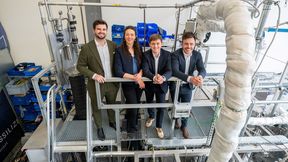
ETH researchers have developed a new method for breaking down PMMA into its constituent parts in an energy-efficient and cost-effective manner. The recycled material is extremely pure, making it suitable for use in high-quality products. What’s exciting for the industry is that it could adopt the process immediately.
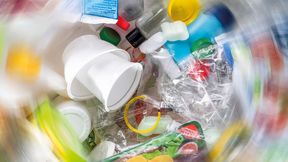
Researchers are developing a process to completely break down PMMA into its constituent parts and reuse them.
(Bild: Adobe Stock/Generated with AI)
Polymethyl methacrylate (PMMA, also known as acrylic glass or Plexiglas) is used in large quantities worldwide for a wide variety of applications—from “glass panes” to car taillights to furniture. All too often, acrylic glass ends up in the trash. Yet it could easily be recycled.
Materials scientist and ETH professor Athina Anastasaki has been working for years on efficiently breaking down acrylic glass into its basic building blocks and reusing them. In earlier work, her team showed that so-called depolymerization is possible in principle, but that it required specific conditions: For example, the ETH researchers previously had to chemically modify the polymer chains to incorporate “predetermined breaking points.” Other approaches required large amounts of solvents, catalysts, or UV light to initiate or sustain the depolymerization process.
New Approach Saves Energy and Money
Now, the ETH professor and her team are presenting a new, much simpler approach to PMMA recycling. They published it in the journal Nature Chemistry.
Using the new method, the researchers are able to break down the polymer almost completely into its building blocks, the monomers: the monomer yield is as high as 98 percent. The recycled material is also extremely pure, even when the source material contains dyes or impurities. New polymers of the same quality as those produced during the initial processing can be manufactured from the recovered monomers.
The process also requires significantly less energy than other methods. Depolymerization begins at just over 200 degrees Celsius. Previously, a temperature of at least 400 degrees was required. Last but not least, the process requires no solvents at all. “What makes our new approach so exciting is its simplicity,” says Richard Whitfield, first author of the study and a former research associate in Anastasakis’s research group.
One substance is enough
At the heart of the new process is a single chemical compound from the class of substances known as N-hydroxyimides, a commercially available and inexpensive reagent. It attacks the acrylic polymer chains, breaks them apart, and releases the monomers. Once this substance is added, the reaction proceeds on its own.
The choice of reagent was no accident. “We searched systematically until we came across this substance,” explains Anastasaki. This single substance is now sufficient to initiate depolymerization.
Patent Filed, Licensees Sought
Other methods for chemical recycling are based on a process known as pyrolysis. In this process, plastic polymers are broken down into their constituent building blocks at high temperatures, usually exceeding 400 degrees. Furthermore, the purity of the recovered monomers is often low—they contain up to three percent impurities. This can compromise the quality of the plastic produced from them.
ETH Zurich has filed a patent application for the new method and is now seeking licensees. “Competition in the field of chemical plastics recycling is fierce, especially in the U.S., where large, well-funded research groups are working in this area,” says Anastasaki. Thanks to solid core funding from ETH Zurich, however, the materials scientist is able to keep up and is even one step ahead of her American competitors this time around.
The industry could adopt this approach immediately
The chemical industry is showing interest in the new method. This is because a key advantage is that the industry could implement this method using existing infrastructure and standard processes. “Our earlier approaches had the drawback that companies would have had to change their processes and equipment to implement them. That’s too expensive for most,” explains Anastasaki.
In the next steps, she plans to scale up the method and gain a detailed understanding of the reaction mechanisms. Based on this, the ETH researchers hope to develop substances that will further accelerate polymer degradation and optimize the monomer yield.
Date: 08.12.2025
Naturally, we always handle your personal data responsibly. Any personal data we receive from you is processed in accordance with applicable data protection legislation. For detailed information please see our privacy policy.
Consent to the use of data for promotional purposes
I hereby consent to Vogel Communications Group GmbH & Co. KG, Max-Planck-Str. 7-9, 97082 Würzburg including any affiliated companies according to §§ 15 et seq. AktG (hereafter: Vogel Communications Group) using my e-mail address to send editorial newsletters. A list of all affiliated companies can be found here
Newsletter content may include all products and services of any companies mentioned above, including for example specialist journals and books, events and fairs as well as event-related products and services, print and digital media offers and services such as additional (editorial) newsletters, raffles, lead campaigns, market research both online and offline, specialist webportals and e-learning offers. In case my personal telephone number has also been collected, it may be used for offers of aforementioned products, for services of the companies mentioned above, and market research purposes.
Additionally, my consent also includes the processing of my email address and telephone number for data matching for marketing purposes with select advertising partners such as LinkedIn, Google, and Meta. For this, Vogel Communications Group may transmit said data in hashed form to the advertising partners who then use said data to determine whether I am also a member of the mentioned advertising partner portals. Vogel Communications Group uses this feature for the purposes of re-targeting (up-selling, cross-selling, and customer loyalty), generating so-called look-alike audiences for acquisition of new customers, and as basis for exclusion for on-going advertising campaigns. Further information can be found in section “data matching for marketing purposes”.
In case I access protected data on Internet portals of Vogel Communications Group including any affiliated companies according to §§ 15 et seq. AktG, I need to provide further data in order to register for the access to such content. In return for this free access to editorial content, my data may be used in accordance with this consent for the purposes stated here. This does not apply to data matching for marketing purposes.
Right of revocation
I understand that I can revoke my consent at will. My revocation does not change the lawfulness of data processing that was conducted based on my consent leading up to my revocation. One option to declare my revocation is to use the contact form found at https://contact.vogel.de. In case I no longer wish to receive certain newsletters, I have subscribed to, I can also click on the unsubscribe link included at the end of a newsletter. Further information regarding my right of revocation and the implementation of it as well as the consequences of my revocation can be found in the data protection declaration, section editorial newsletter.
There is one small catch, however: The process works only for acrylic glass. To break down other plastics into their basic building blocks, different approaches are needed. Nevertheless, the materials researcher remains optimistic: “We will try to apply this principle to polystyrene, one of the most widely used plastics in the world,” says Anastasaki.