IKV: Research for Practical ApplicationPrecise Simulation, Clean Films: Three IKV Projects to Reduce Scrap
A guest post by
Prof. Christian Hopmann (IKV Director), Sebastian Schwan (Injection Molding), Clemens Körver (Recycled Films), Dominik Rieder (Flat Film Extrusion)
| Translated by AI
5 min Reading Time
Inaccurate material data in the simulation, gels in recycled film, and deposits on cooling rolls compromise quality and waste time. In three IGF projects, the IKV in Aachen is developing practical methods to specifically reduce scrap.
Researchers at the Institute for Plastics Processing (IKV) in Industry and Trade at RWTH Aachen University provide exclusive coverage of current topics for PlastXnow.
(Bild: stock.adobe.com / nevodka.com)
Injection Molding: Intelligent Material Card Adaptation for Precise Deformation Simulation
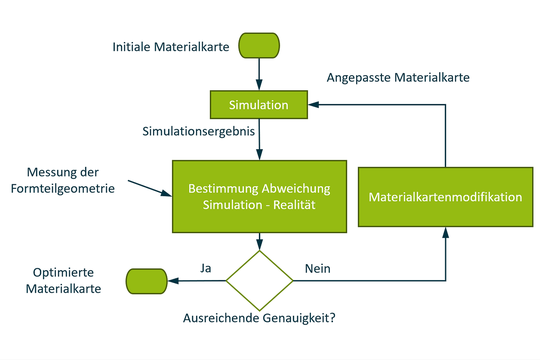
The quality of simulation results in process simulation depends largely on the quality of the input data, particularly the material data. In the IGF project I-MapS, a material map adjustment was investigated for the deformation simulation of thermoplastics to improve the agreement between simulation and reality. Based on optical geometric measurements of manufactured shrinkage plates, the material parameters of the material maps used in the simulation program were automatically adjusted. The adjustment was performed using a reverse engineering approach. Various process points were taken into account to ensure a process-point-independent adjustment of the material data. Furthermore, the material map can be optimized independently of geometry by using different geometries to adjust the material data (Figure 1).
Figure 1: Procedure for modifying the material card.
(Bild: IKV)
The material data is adjusted automatically. To do this, pvT data, linear thermal expansion coefficients, and moduli of elasticity are adjusted using the simulation program’s programming interface. Physical relationships defined in the adaptation script ensure that the material data is adjusted in a physically meaningful way. Subsequently, the relationships between the parameters and the simulation results are modeled using Gaussian process regression, and the material data is adapted using Bayesian optimization. First, a simulation-generated training dataset is used for the initial modeling. The model is then iteratively optimized by using the generated material maps for new simulations. The optimization objective is to minimize the deviation between the results of the deformation simulation and the molded part dimensions. The material maps optimized in this way successfully improve the agreement between the deformation simulation results and reality.
This work is supported by the Federal Ministry for Economic Affairs and Energy (BMWE) as part of IGF Project 23482 N.
Recycled Film: Reducing Gel Formation
When recycled polyethylene is used in film products, defects—known as gels—often form in the extrudate as a result of degradation, contamination, or cross-linking caused by thermo-oxidative reactions. Gel formation is strongly influenced by the compound composition. Gels quickly lead to scrap or film tears and impair subsequent processing steps (e.g., printing, lamination). Given the importance of melt filtration technology for recycling, knowledge regarding the influence of melt filters on the production process (e.g., pressure loss or pressure fluctuations) as well as their efficiency in reducing gels—particularly in PCR processing—remains limited.
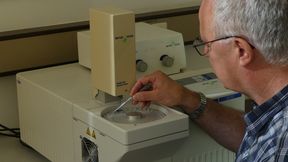
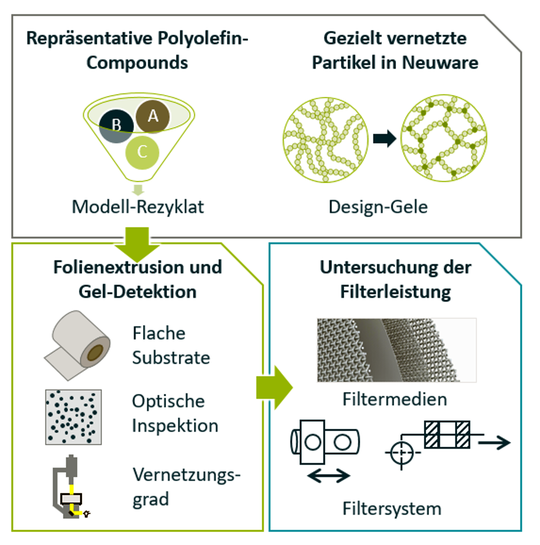
The goal of the IGF research project “Gel Reduction” is to reduce the proportion of gels in polyolefin (PO) compounds through an optimized filtration strategy in order to improve the quality of post-consumer recycled (PCR) material for film applications. To this end, various filtration configurations and relevant process parameters are being investigated. To conduct the filtration tests, various “model recyclates” are produced by first cross-linking PE films and then grinding them into defined gel sizes. The cross-linked gel particles are compounded with virgin material to produce model recyclates characterized by a defined gel size distribution and gel count. The polyolefins specifically contaminated with gels, as well as representative model recyclates that have undergone multiple extrusion cycles, are purified using various filter media and configurations and subsequently analyzed for gel count and size (Figure 2).
Figure 2: To develop an understanding of the materials and processes involved in gel filtration, materials specifically contaminated with gels and model recyclates that have been extruded multiple times are purified using various filtration strategies and then analyzed.
(Bild: IKV)
The filtration tests are conducted on a laboratory blown film line equipped with one or two screen changers. To investigate the influence of various filter and process parameters on the filtration performance, filter media and mesh sizes, as well as mass flow rate and the degree of melt contamination, are systematically varied. The effect of various parameters on the filtration process itself is recorded by monitoring pressure and temperature profiles upstream and downstream of the filter using integrated sensors during the filtration process. The filtration efficiency is determined through optical analyses (light microscopy and image analysis software) of the gel content and gel size distribution before and after the filtration tests.
Date: 08.12.2025
Naturally, we always handle your personal data responsibly. Any personal data we receive from you is processed in accordance with applicable data protection legislation. For detailed information please see our privacy policy.
Consent to the use of data for promotional purposes
I hereby consent to Vogel Communications Group GmbH & Co. KG, Max-Planck-Str. 7-9, 97082 Würzburg including any affiliated companies according to §§ 15 et seq. AktG (hereafter: Vogel Communications Group) using my e-mail address to send editorial newsletters. A list of all affiliated companies can be found here
Newsletter content may include all products and services of any companies mentioned above, including for example specialist journals and books, events and fairs as well as event-related products and services, print and digital media offers and services such as additional (editorial) newsletters, raffles, lead campaigns, market research both online and offline, specialist webportals and e-learning offers. In case my personal telephone number has also been collected, it may be used for offers of aforementioned products, for services of the companies mentioned above, and market research purposes.
Additionally, my consent also includes the processing of my email address and telephone number for data matching for marketing purposes with select advertising partners such as LinkedIn, Google, and Meta. For this, Vogel Communications Group may transmit said data in hashed form to the advertising partners who then use said data to determine whether I am also a member of the mentioned advertising partner portals. Vogel Communications Group uses this feature for the purposes of re-targeting (up-selling, cross-selling, and customer loyalty), generating so-called look-alike audiences for acquisition of new customers, and as basis for exclusion for on-going advertising campaigns. Further information can be found in section “data matching for marketing purposes”.
In case I access protected data on Internet portals of Vogel Communications Group including any affiliated companies according to §§ 15 et seq. AktG, I need to provide further data in order to register for the access to such content. In return for this free access to editorial content, my data may be used in accordance with this consent for the purposes stated here. This does not apply to data matching for marketing purposes.
Right of revocation
I understand that I can revoke my consent at will. My revocation does not change the lawfulness of data processing that was conducted based on my consent leading up to my revocation. One option to declare my revocation is to use the contact form found at https://contact.vogel.de. In case I no longer wish to receive certain newsletters, I have subscribed to, I can also click on the unsubscribe link included at the end of a newsletter. Further information regarding my right of revocation and the implementation of it as well as the consequences of my revocation can be found in the data protection declaration, section editorial newsletter.
For validation purposes, the results will be applied to industrial filtration systems using commercially available recycled materials, and design guidelines for the optimized configuration of filtration processes will be derived from this. This will identify suitable filtration strategies for processing recycled materials and build a deeper understanding of the materials and processes involved in filtration.
This work is supported by the Federal Ministry for Economic Affairs and Energy (BMWE) as part of IGF Project 24658 N.
Flat Film Extrusion: The Effect of Material and Roll Properties on Coating Formation
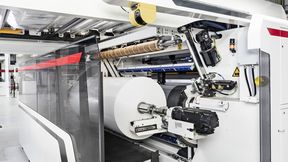
In flat film extrusion, deposits on the cooling rolls affect the surface quality of the films and lead to process instabilities. In the IGF project “Roll Coating,” which the IKV presented at K2025 in Düsseldorf, a detection system was developed that allows for the monitoring and quantification of coating formation during the ongoing process. In the follow-up project “Roll Coating II,” the aim is to investigate the influence and interaction of factors such as material drying and degassing, as well as roll material and surface roughness, on coating formation. An initial research question is how deposits of low-molecular-weight components in the granulate can be influenced by targeted drying and degassing of the material. In addition, the study will examine whether the interaction between the plastic and the metal surface promotes the formation of compounds consisting of polymer and metal ions, thereby further facilitating deposit growth.
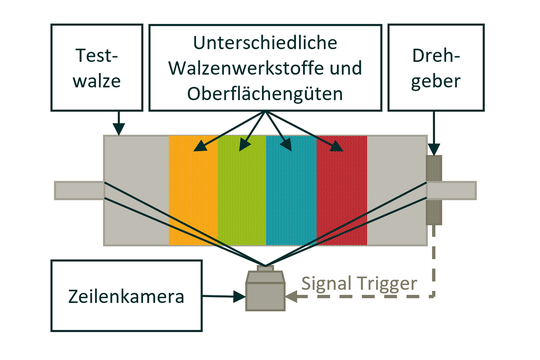
Figure 3: A modular test roller with interchangeable segments allows for a direct comparison of different roller materials and surface structures.
(Bild: IKV)
The material and surface roughness of the rollers determine how deposits form and how quickly they detach under given process conditions. To quantify these differences, the project uses a modular test roller with interchangeable segments (Figure 3). This allows for a direct comparison of different roller materials and surface structures. Deposition is continuously monitored during operation using an optical camera system, enabling changes and growth rates to be documented.
By systematically varying melt and roll temperatures, as well as drying and degassing methods, the aim is to gain a clear understanding of the interactions between process control, material properties, and roll surfaces. This will enable plastics processing companies to better assess in the future which adjustments to material preparation, process control, or roll surface will contribute to a noticeable reduction in roll buildup, extend cleaning intervals, reduce scrap, and increase operational reliability.
This work is supported by the Federal Ministry for Economic Affairs and Energy (BMWE) as part of IGF Project 24512 N.
Autoren: Prof. Dr.-Ing. Christian Hopmann (Leiter IKV), Sebastian Schwan, M.Sc. (Spritzgießen), Clemens Körver, M.Sc. (Folienrezyklate), Dominik Rieder, M.Sc. (Flachfolienextrusion)