Now that BASF has definitively shelved its plans to acquire Evonik, attention is turning to the practical implications for the plastics industry. The continued existence of two independent chemical companies provides buyers with important pricing flexibility, but also poses new risks for niche product lines.
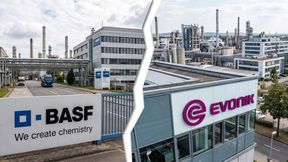
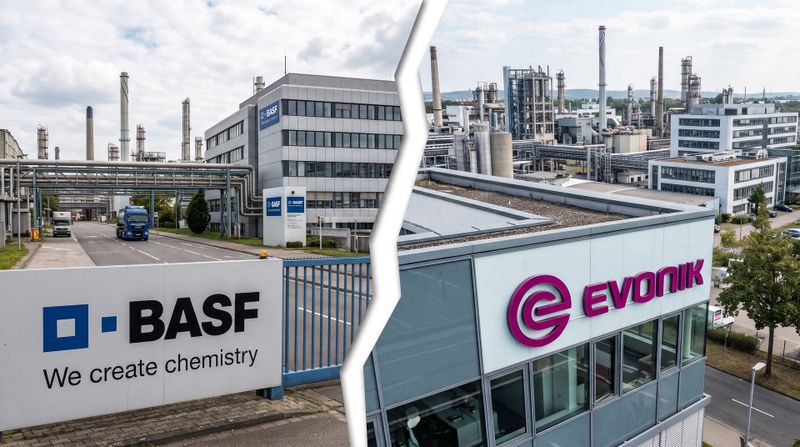
Parting Ways in Specialty Chemicals: Following the collapse of the planned takeover by BASF, Evonik will remain an independent company—ensuring competition in polymers and additives for plastics processors.
(Bild: BASF / Evonik / KI-generiert / Gemini)
The planned mega-merger in the chemical industry is now a thing of the past: After Evonik rejected two non-binding cash offers, BASF SE called off its takeover plans. In Ludwigshafen, the Executive Board cited strict capital discipline as part of its “Winning Ways” strategy, as well as risks to the standalone business outlook of Essen-based Evonik, as reasons for the withdrawal announced on November 19, 2026.
“We are convinced that BASF’s cash offer of 24 euros per share would have represented significant additional and secure value for Evonik’s shareholders,” says Dr. Markus Kamieth, Chairman of the Executive Board of BASF. For plastics processors, compounders, and masterbatch manufacturers, it is now time to take stock: What specific advantages does continued competition bring—and what new risks arise from the deal’s failure?
Advantage 1: There is still room for material substitutions
For injection molders and extruders, the collapse of the takeover prevents a dangerous concentration of power in the field of engineering materials. While BASF covers various levels of the materials pyramid with engineering plastics such as PA (Ultramid), PBT (Ultradur), POM (Ultraform), and Evonik with high-performance polymers such as PA12 (Vestamid) or PEEK (Vestakeep) cover different levels of the materials pyramid, but in key borderline areas, both portfolios compete directly with one another.
When it comes to media lines in thermal management, application engineers regularly weigh the options between BASF’s PA610 and PPA grades (Ultramid S Balance, Ultramid Advanced) and Evonik’s PA12 or PA612 to design components more cost-effectively. Similarly, in medical technology and electromobility, BASF’s polyarylsulfones (Ultrason) serve as a cost-effective alternative to Evonik’s PEEK, while for flexible components, TPU (Elastollan) and PEBA (Vestamid E) compete against each other. Since the two companies remain separate, buyers and developers retain two independent negotiating partners and avoid bundled framework agreements from a single source.
Benefit 2: No single-source pricing power for additives
Compounders and masterbatch manufacturers stand to benefit even more from the two chemical companies remaining separate. In the additives business, their product portfolios complement each other almost seamlessly: While BASF sets the pace in antioxidants, stabilizers, and UV blockers (such as Irganox and Tinuvin), Evonik dominates global niches in polyurethane catalysts, dispersants, surfactants, and silanes (including TEGO and Dynasylan). A merger would have enabled a single company to set prices for both the base resin and key processing aids from a single source. Processors are now spared the risk that bundled pricing or tied sales could drive up formulation costs. Existing multi-sourcing strategies for stabilization and modification packages remain fully functional.
Benefit 3: Protection against painful portfolio adjustments
Another advantage lies in the preservation of established material catalogs. In major chemical industry mergers, management regularly eliminates overlapping product lines and low-margin specialty compounds to reduce inventory and production costs. For processors, such discontinuations trigger costly chain reactions because substitute materials must be re-sampled, tools must be adapted, and strict customer approvals—such as those required in medical technology or electric mobility—must be repeated. Since the synergy-driven consolidation of the two catalogs has not yet taken place, the variety of product types remains unchanged for the time being. Ongoing production projects thus benefit from reliable specifications without the rush to switch over caused by the merger.
Disadvantage 1: Missed synergies in system solutions and R&D
At the same time, the failure of the merger means that the plastics processing industry is missing out on potential gains in efficiency and innovation. “We continue to believe that the merger under BASF’s ownership would create a stronger chemical company that would deliver additional value to shareholders as well as benefits for the employees and customers of the combined company,” explains Dr. Markus Kamieth.
A joint venture with the clout of the BASF Verbund could have pooled massive research budgets for sustainable monomers, bio-based polymers, and recycled material additives. Especially when it comes to complex recycled material formulations, in which stabilizers, compatibilizers, and base polymers must interact precisely, this separation costs valuable development time.
Date: 08.12.2025
Naturally, we always handle your personal data responsibly. Any personal data we receive from you is processed in accordance with applicable data protection legislation. For detailed information please see our privacy policy.
Consent to the use of data for promotional purposes
I hereby consent to Vogel Communications Group GmbH & Co. KG, Max-Planck-Str. 7-9, 97082 Würzburg including any affiliated companies according to §§ 15 et seq. AktG (hereafter: Vogel Communications Group) using my e-mail address to send editorial newsletters. A list of all affiliated companies can be found here
Newsletter content may include all products and services of any companies mentioned above, including for example specialist journals and books, events and fairs as well as event-related products and services, print and digital media offers and services such as additional (editorial) newsletters, raffles, lead campaigns, market research both online and offline, specialist webportals and e-learning offers. In case my personal telephone number has also been collected, it may be used for offers of aforementioned products, for services of the companies mentioned above, and market research purposes.
Additionally, my consent also includes the processing of my email address and telephone number for data matching for marketing purposes with select advertising partners such as LinkedIn, Google, and Meta. For this, Vogel Communications Group may transmit said data in hashed form to the advertising partners who then use said data to determine whether I am also a member of the mentioned advertising partner portals. Vogel Communications Group uses this feature for the purposes of re-targeting (up-selling, cross-selling, and customer loyalty), generating so-called look-alike audiences for acquisition of new customers, and as basis for exclusion for on-going advertising campaigns. Further information can be found in section “data matching for marketing purposes”.
In case I access protected data on Internet portals of Vogel Communications Group including any affiliated companies according to §§ 15 et seq. AktG, I need to provide further data in order to register for the access to such content. In return for this free access to editorial content, my data may be used in accordance with this consent for the purposes stated here. This does not apply to data matching for marketing purposes.
Right of revocation
I understand that I can revoke my consent at will. My revocation does not change the lawfulness of data processing that was conducted based on my consent leading up to my revocation. One option to declare my revocation is to use the contact form found at https://contact.vogel.de. In case I no longer wish to receive certain newsletters, I have subscribed to, I can also click on the unsubscribe link included at the end of a newsletter. Further information regarding my right of revocation and the implementation of it as well as the consequences of my revocation can be found in the data protection declaration, section editorial newsletter.
Disadvantage 2: Evonik's cost-cutting measures pose new risks
Anyone who believes that Evonik’s independence automatically guarantees stability in the supply chains is overlooking the ongoing restructuring of the group in Essen. BASF explicitly cited as the reason for its withdrawal the fact that Evonik’s independent business outlook and the associated risks did not justify a higher valuation.
Although Evonik officially defines its high-performance polymers and crosslinking systems as structural growth drivers, as part of its cost-cutting measures, the company is systematically withdrawing from unprofitable peripheral areas such as the polyester business at its Witten site and the C4 chemicals business. For plastics processors, this paints a mixed picture: While core products such as specialty polyamides and PEEK are being further strengthened, the high cost pressure in Essen means there remains a risk that Evonik will independently streamline its product portfolio in low-margin niche grades.
Disadvantage 3: Slowing investment momentum in Europe
From a structural perspective, too, the collapsed deal sends a sobering signal to the European plastics value chain. Instead of forming powerful production alliances through consolidation to counter growing competition from Asia and North America, BASF is now increasingly focusing on disciplined capital allocation and attractive dividends for its own shareholders.
While acquisitions in core businesses such as the Materials segment remain possible in principle under the Group’s strategy, large-scale European infrastructure projects are becoming a distant prospect. For local processors, this means that structural location disadvantages regarding energy and raw material costs in the European chemical industry remain unresolved. In the long term, the domestic industry faces the risk of reduced investment momentum in new local polymer capacities.
What Processors Should Do Specifically
All in all, the end of the takeover saga gives plastics processors some breathing room in the short term, but requires procurement and engineering departments to conduct a targeted risk analysis. While reliable supply structures are expected for BASF’s engineering plastics and Evonik’s strategic high-performance polymers, buyers of polyesters, C4 derivatives, or small-batch specialty compounds should review their sources of supply. Purchasers and application engineers would be wise to sample alternative materials early on for critical components and to qualify secondary suppliers. Those who also secure ongoing framework agreements in a timely manner and closely monitor further restructuring steps in Essen will protect their production from sudden product portfolio decisions.