Engel expects sales growth of 10 percent, while European plastics processors remain cautious about making investments. In an interview with PlastXnow, CEO Stefan Engleder explains why the total cost of an injection molding machine is becoming increasingly important, how Engel is positioning itself in competition with Chinese manufacturers, and why he is calling for swift action in European industrial policy.
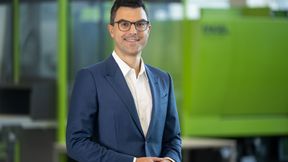
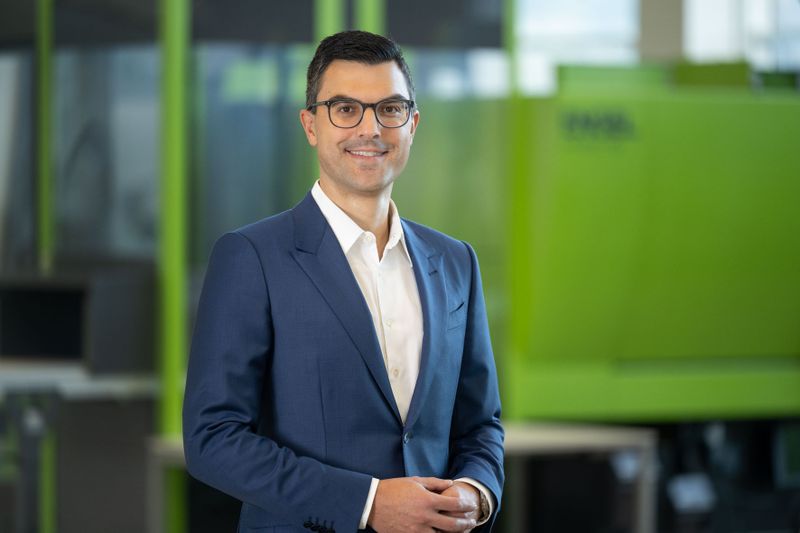
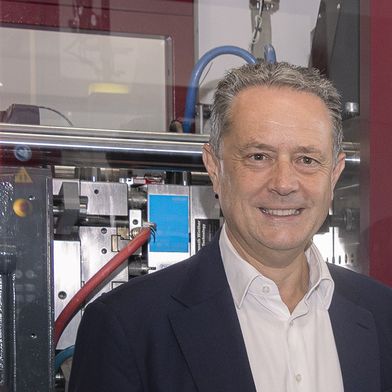
Stefan Engleder, CEO of the Engel Group. “The structural changes in our industry are still underway, and we are responding to them consistently.”
(Bild: Angels)
Economic trends in the international markets for plastic processing machinery vary. While new projects are driving growth in the U.S., Europe has yet to work through its investment backlog. At the same time, competition from Chinese machine manufacturers is intensifying. Stefan Engleder, CEO of Engel Austria GmbH, speaks with Stefan Lenz, editor-in-chief of PlastXnow, about plastics processors’ willingness to invest, the cost-effectiveness of new injection molding technologies, and the industrial policy challenges facing the European machine-building industry.
Engel expects revenue growth of 10 percent. To what extent is this growth driven by rising demand, and what role do catch-up effects play?
This growth is driven by specific new projects. In Europe, however, we still expect to see catch-up effects. At the K trade show, I mentioned that we were observing a certain degree of caution. Since the K, demand has picked up significantly. In the U.S., there were also catch-up effects related to the tariff debate. However, these have since been worked through. We are currently seeing new projects in the U.S. Consumer spending remains high despite high inflation—a trend we’re clearly noticing. At the same time, the recent turmoil surrounding the AI sector is causing uncertainty. No one can reliably predict at this point how this will affect investments.
We receive many project inquiries in Europe, but there is still a lack of decisiveness.
What is the situation in Europe? Are there already reliable signs that plastics processors are becoming more willing to invest again?
We are receiving many project inquiries in Europe. However, customers are still hesitant when it comes to making investment decisions. We are cautiously optimistic that these inquiries will turn into orders in the coming weeks and months and that the willingness to invest will increase again.
What key performance indicators must a new injection molding machine improve upon today so that customers are willing to invest in more technologically advanced machines despite the challenging economic environment?
Many customers today pay very close attention to the total cost of ownership. The most critical factors here are the reliability and availability of the equipment, the lowest possible scrap rate, and energy efficiency. The biggest cost driver for an injection-molded part is the material. By comparison, the cost of the injection molding machine itself accounts for a significantly smaller portion. The less scrap we produce, the lower the total cost per part. Therefore, the initial purchase cost plays a comparatively minor role in the overall picture.
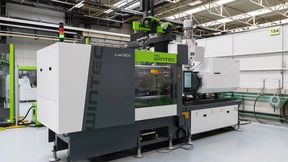
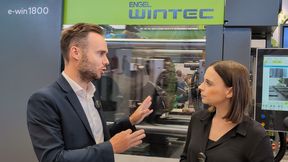
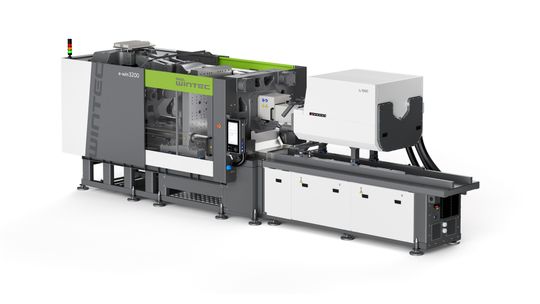
The fully electric Wintec e-win injection molding machines are synonymous with precise, energy-efficient injection molding production. Molding companies benefit from stable processes, high part quality, and low unit costs.
(Bild: Angels)
However, a financially compelling total cost analysis does not necessarily mean that a company can actually finance the investment.How does Engel address this tension?
Many customers would like to invest, but are limited by their investment budgets or lack the necessary credit line or liquidity. That is why, through Wintec, we also offer machines that combine strong performance and energy efficiency with a lower initial investment.
The less scrap we produce, the lower the total cost per component. That is why the pure acquisition costs play a comparatively minor role in the overall picture.
Engel estimates that the new e-motion 380 achieves energy savings of about 30 percent. What applications and machine comparisons does this figure are based on?
We base our comparisons on two applications. One of them is the production of margarine cups. For this, we have acquired a production tool that allows us to conduct tests under real production conditions. The second application is in the Caps & Closures sector. In both cases, we compare energy consumption with that of a comparable application. We are increasingly convincing customers to forego the purchase of a hydraulic machine and instead rely on the performance of our all-electric e-motion series. This enables energy savings of around 30 percent.
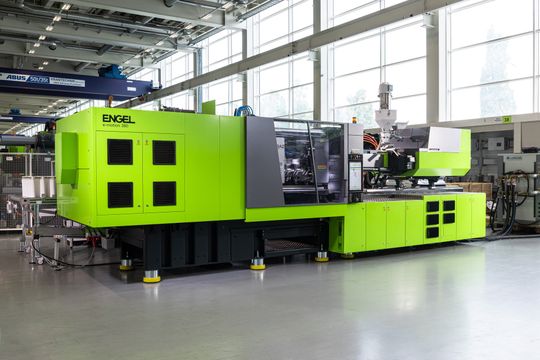
The e-motion 380 is the first machine in the new generation and, with its injection unit, achieves injection speeds of up to 500 mm per second.
(Bild: Angels)
What is the key technological advancement in these applications compared to previous all-electric injection molding machines?
The key breakthrough is that, with the new high-performance electric injection units—most notably the 2465 injection unit—we are achieving injection speeds of more than 500 millimeters per second. This makes it possible, for the first time, to implement fully electric applications that—due to their wall thickness-to-flow path length ratio—were previously reserved for hydraulic machines with injection via accumulators. The key factor here is the interaction of the entire system with the new high-performance injection units. In my view, this is a game-changer for the industry.
Chinese injection molding machine manufacturers are increasing competitive and price pressure. How can Engel maintain its technological edge under these conditions?
I stand by my statement regarding the total cost of ownership analysis. When considering total costs, Engel solutions are still very often the deciding factor. One aspect that is often overlooked is our expertise in complete production lines. We implement many production cells with a high degree of automation. This is all about reliability, service, and comprehensive system expertise. That’s why, especially when it comes to large machines, customers often choose Engel again. Of course, a customer can also purchase an Asian injection molding machine and have an integrator turn it into a production system. However, Engel generates approximately 170 million euros in revenue from automation technology and holds a strong position in the plastics industry when it comes to developing and implementing complex production cells.
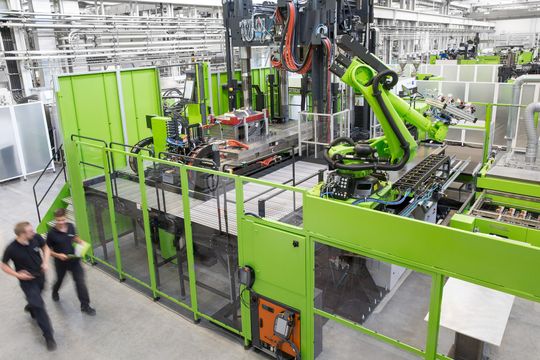
One aspect that, according to Stefan Engleder, is often overlooked is Engel’s expertise in the field of complete production lines. The company builds many production cells with a high degree of automation.
(Bild: Angels)
Nevertheless, the presence of Chinese machine manufacturers is growing. Against this backdrop, how do you assess Engel’s competitiveness—including in these suppliers’ home market of China?
We are seeing that customers in China—whom we served for many years but had since lost to Chinese competitors—are now returning to Engel. We continue to offer an attractive price-performance ratio and are also very well positioned when it comes to processing sophisticated materials, multi-component machines, and rotary cube technology.
During our last conversation in Schwertberg, we discussed the political and regulatory framework for the European machinery manufacturing industry. Has your assessment changed since then?
What we are currently witnessing is a wake-up call for the European Union, spurred by the automotive industry, which is now increasingly calling for action. Over the past two quarters, the European automotive industry has experienced a significant drop in earnings in China. Previously, the attitude was different because European automakers had been making good money there. That has changed fundamentally in recent weeks. Calls for action are now growing louder from both the automotive industry and the mechanical engineering sector. We, too, have been in discussions with the European Commission on this matter; these discussions will continue.
What tools does the European Union already have at its disposal to address distortions of competition and a growing foreign trade deficit?
The European Union already has trade defense instruments at its disposal. These include, in particular, safeguard measures—that is, protective measures that also encompass protective tariffs. In addition, there are antidumping and antisubsidy measures, although these are more difficult to apply in practice. Creating new instruments would require additional legislation and further ratifications. That takes too long—we must act now. In my view, safeguard measures would be particularly effective. What is crucial is that the political will exists to actually implement them.
In your view, what needs to happen now for the EU to make effective use of these instruments?
We must examine whether and how we can use safeguards or other already established instruments. The automotive industry took the first step with hybrid vehicles; further discussions are now underway. It is crucial to design the measures in such a way that they do not put European companies at a disadvantage. Engel itself has a strong presence in China and also imports goods from China into the European Union. We therefore do not want to be among the losers of any potential measures. In the automotive industry, for example, there are cases where European manufacturers pay higher tariffs than Chinese ones. In my view, that would not be a wise approach.
How confident are you that the European Union will take effective measures in a timely manner to maintain its industrial competitiveness?
Perhaps I am a little more optimistic today that this growing awareness will lead to well-designed measures. I am not giving up on that hope just yet. But time is of the essence, especially in the plastics processing sector: With every month we wait, deindustrialization in the European Union continues to advance.
Date: 08.12.2025
Naturally, we always handle your personal data responsibly. Any personal data we receive from you is processed in accordance with applicable data protection legislation. For detailed information please see our privacy policy.
Consent to the use of data for promotional purposes
I hereby consent to Vogel Communications Group GmbH & Co. KG, Max-Planck-Str. 7-9, 97082 Würzburg including any affiliated companies according to §§ 15 et seq. AktG (hereafter: Vogel Communications Group) using my e-mail address to send editorial newsletters. A list of all affiliated companies can be found here
Newsletter content may include all products and services of any companies mentioned above, including for example specialist journals and books, events and fairs as well as event-related products and services, print and digital media offers and services such as additional (editorial) newsletters, raffles, lead campaigns, market research both online and offline, specialist webportals and e-learning offers. In case my personal telephone number has also been collected, it may be used for offers of aforementioned products, for services of the companies mentioned above, and market research purposes.
Additionally, my consent also includes the processing of my email address and telephone number for data matching for marketing purposes with select advertising partners such as LinkedIn, Google, and Meta. For this, Vogel Communications Group may transmit said data in hashed form to the advertising partners who then use said data to determine whether I am also a member of the mentioned advertising partner portals. Vogel Communications Group uses this feature for the purposes of re-targeting (up-selling, cross-selling, and customer loyalty), generating so-called look-alike audiences for acquisition of new customers, and as basis for exclusion for on-going advertising campaigns. Further information can be found in section “data matching for marketing purposes”.
In case I access protected data on Internet portals of Vogel Communications Group including any affiliated companies according to §§ 15 et seq. AktG, I need to provide further data in order to register for the access to such content. In return for this free access to editorial content, my data may be used in accordance with this consent for the purposes stated here. This does not apply to data matching for marketing purposes.
Right of revocation
I understand that I can revoke my consent at will. My revocation does not change the lawfulness of data processing that was conducted based on my consent leading up to my revocation. One option to declare my revocation is to use the contact form found at https://contact.vogel.de. In case I no longer wish to receive certain newsletters, I have subscribed to, I can also click on the unsubscribe link included at the end of a newsletter. Further information regarding my right of revocation and the implementation of it as well as the consequences of my revocation can be found in the data protection declaration, section editorial newsletter.