At its technical center, Pfaff tests injection molding tools for automotive gaskets and glass overmolding under real production conditions—using high-precision two-platen machines.
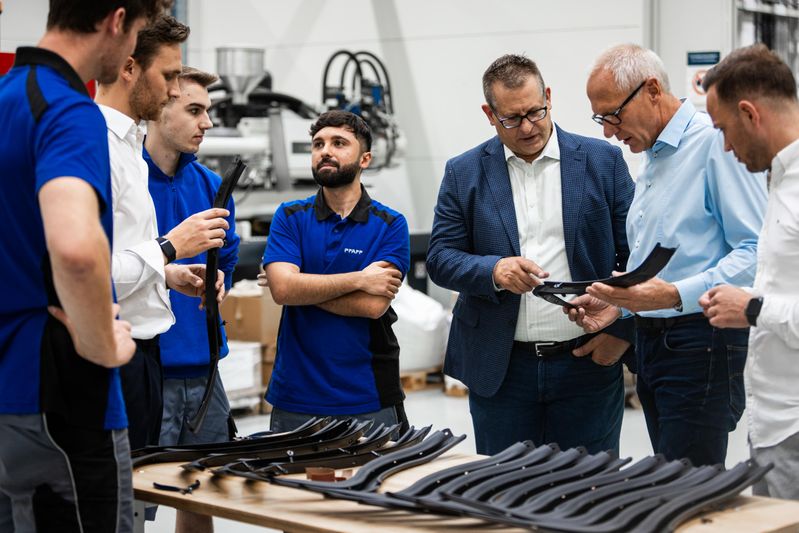
In automotive sealing systems, many processes must be perfectly coordinated. Here, an interdisciplinary team is discussing ways to optimize a component.
(Bild: Pfaff)
The manufacture of highly complex injection molds for automotive seals and glass overmolding requires seamless coordination of all process steps. Pfaff, the Allgäu-based mold maker, ensures the quality of its molds right from the start in its technical center under real production conditions. By using Engel Duo two-platen injection molding machines, the mold maker can reliably test even the most demanding multi-component applications.
“In glass overmolding, we work with numerous inserts—such as mounting pins, metal and plastic inserts for component reinforcement or thinning, as well as trim strips with a chrome or piano-black finish. These must be positioned precisely during overmolding and remain undamaged at the same time,” explains Mathias Knebel, who is responsible for sales and project management of glass overmolding and multi-component molds at Pfaff. “This process begins right at the part design stage. We invest a great deal of time in filling simulations to avoid pressure spikes and air entrapment and to prevent the inserts from shifting.”
Many of our customers use Engel machines themselves. That means we speak the same language.
Mathias Knebel, responsible for sales and project management of glass-injection and multi-component molds at Pfaff
The materials used are subject to significant fluctuations in some cases. According to Knebel, ensuring stable and reproducible production requires precise temperature control, defined injection profiles, and precise cascade control. This is precisely where Engel’s Duo machines demonstrate their strengths—through repeatability, reliability, and high precision, even with varying injection volumes. With a Duo 1000 and a Duo 700 Combi M, Pfaff has two high-performance machines at its in-house technical center, which enable precise prototyping of even the most demanding tools. “Even small volumes outside the typical operating range can be processed with a high degree of process reliability,” says Knebel.
Two machines, many options
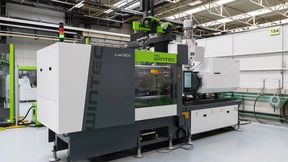
The Engel Duo 1000, with a clamping force of 10,000 kN and a rotary table, is used in particular for classic multi-component parts such as water deflectors or joint seals—an application area in which many Pfaff customers also rely on rotary table machines. An Engel Duo 700 Combi M with 7,000 kN clamping force and a reversible plate has also recently become available, which additionally enables the prototyping of reversible plate molds.
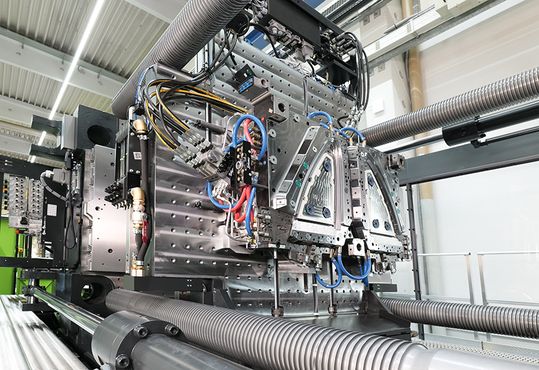
The Engel Duo 700 Combi M enables Pfaff to create sample parts using indexable insert tools.
(Bild: Angels)
Both machines are individually equipped with, among other things, pneumatic and hydraulic cascades as well as vacuum functions required for glass overmolding. The Duo is a large-format injection molding machine and, thanks to its modular design, offers a wide range of configuration options while maintaining a compact footprint. Pfaff’s customers also benefit from this, as it leaves more free space around the machines in the technical center for peripherals and handling.
The decision to acquire an additional indexable insert machine was based on strategic considerations: “We’ve been manufacturing indexable insert tools for quite some time, but until now we haven’t been able to produce samples ourselves,” reports Mathias Knebel. “Now we have the ability to test them in-house—and to use the same machine as a 1K system for glass overmolding. This significantly expands our capacity and our product portfolio.”
Technical Center on Par with Production
A key priority at Pfaff is to test tools under realistic conditions—that is, in the same way they will later be used in mass production. To achieve this, the machines must not only be powerful and flexible, but also easily accessible—an area where the Duo series truly shines. “Especially with our numerous inserts, the machines’ easy accessibility is a major advantage,” emphasizes Knebel. “We need to be able to get inside the machine without any trouble—that makes our work easier.”
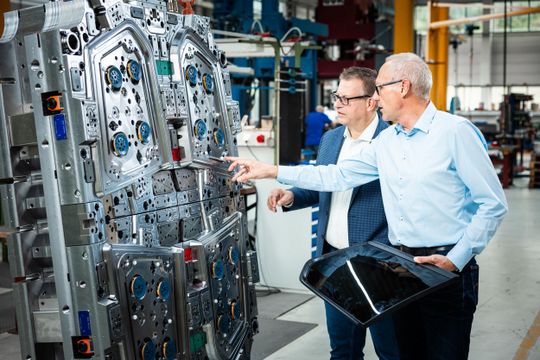
Overmolding of glass components places high demands on process control and precision, as consistently stable and reproducible quality must be ensured in mass production. Pfaff counts this demanding process among its core competencies.
(Bild: Pfaff)
At the same time, the machines offer the precision required for demanding applications. According to Knebel, the plane-parallelism of the clamping unit, the repeatability of the injection profiles, and the measurement accuracy during the running process are crucial for working with complex molds.
This also makes it easier to communicate with customers. “Many of our customers use Engel machines themselves. That means we speak the same language, exchange process parameters, and, if necessary, provide support directly on-site at the customer’s location.”
Date: 08.12.2025
Naturally, we always handle your personal data responsibly. Any personal data we receive from you is processed in accordance with applicable data protection legislation. For detailed information please see our privacy policy.
Consent to the use of data for promotional purposes
I hereby consent to Vogel Communications Group GmbH & Co. KG, Max-Planck-Str. 7-9, 97082 Würzburg including any affiliated companies according to §§ 15 et seq. AktG (hereafter: Vogel Communications Group) using my e-mail address to send editorial newsletters. A list of all affiliated companies can be found here
Newsletter content may include all products and services of any companies mentioned above, including for example specialist journals and books, events and fairs as well as event-related products and services, print and digital media offers and services such as additional (editorial) newsletters, raffles, lead campaigns, market research both online and offline, specialist webportals and e-learning offers. In case my personal telephone number has also been collected, it may be used for offers of aforementioned products, for services of the companies mentioned above, and market research purposes.
Additionally, my consent also includes the processing of my email address and telephone number for data matching for marketing purposes with select advertising partners such as LinkedIn, Google, and Meta. For this, Vogel Communications Group may transmit said data in hashed form to the advertising partners who then use said data to determine whether I am also a member of the mentioned advertising partner portals. Vogel Communications Group uses this feature for the purposes of re-targeting (up-selling, cross-selling, and customer loyalty), generating so-called look-alike audiences for acquisition of new customers, and as basis for exclusion for on-going advertising campaigns. Further information can be found in section “data matching for marketing purposes”.
In case I access protected data on Internet portals of Vogel Communications Group including any affiliated companies according to §§ 15 et seq. AktG, I need to provide further data in order to register for the access to such content. In return for this free access to editorial content, my data may be used in accordance with this consent for the purposes stated here. This does not apply to data matching for marketing purposes.
Right of revocation
I understand that I can revoke my consent at will. My revocation does not change the lawfulness of data processing that was conducted based on my consent leading up to my revocation. One option to declare my revocation is to use the contact form found at https://contact.vogel.de. In case I no longer wish to receive certain newsletters, I have subscribed to, I can also click on the unsubscribe link included at the end of a newsletter. Further information regarding my right of revocation and the implementation of it as well as the consequences of my revocation can be found in the data protection declaration, section editorial newsletter.
Simulation as a Foundation
At Pfaff, mold quality doesn’t begin with the first shot in the technical center, but rather as early as the design and quotation phase. “Both our multi-component applications and our glass overmolding processes have very specific requirements in terms of surface quality, dimensional accuracy, and maximum internal mold pressure.”
Using the Cadmold simulation software, we simulate at an early stage how these requirements can be implemented in terms of tooling and machinery.
Tool testing under realistic conditions
At Pfaff, the focus of mold testing is not primarily on optimizing energy and resource savings, but rather on what is known as a “stress test.” “We reduce the clamping force, work with high injection pressures, and specifically test the mold’s leak tightness,” explains Knebel. The goal is to ensure that the mold functions reliably even in the face of process fluctuations during subsequent series production.
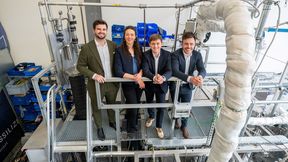
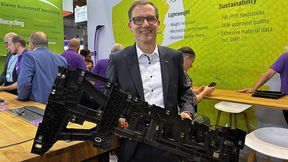
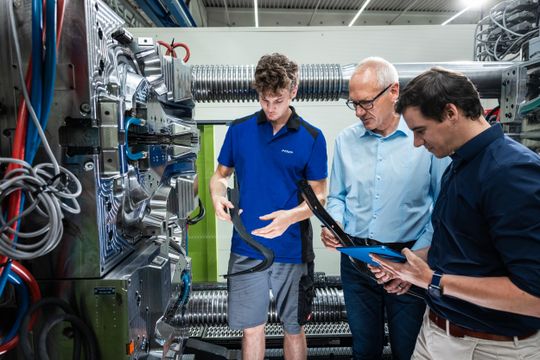
Matthias Knebel (center), sales and project manager at Pfaff, inspecting components from a new injection-molding tool.
(Bild: Pfaff)
“Of course, we keep an eye on the direction in which our customers are moving and adapt the specifications of our pilot plant machines accordingly,” says Knebel. “Our goal is to test the tools under exactly the same conditions under which they will later be used by our customers.”
When Pfaff customers use Engel injection molding machines themselves, these machines are typically equipped with digital assistance systems that automatically compensate for process fluctuations. This further helps reduce scrap and maximize machine efficiency.
Despite the focus on functional testing, energy efficiency also plays an important role at Pfaff. Both machines are equipped with Engel Ecodrive, which significantly reduces energy consumption. “Of course, we could argue that a pilot plant machine doesn’t run in three shifts and that electricity consumption is therefore of secondary importance—but that would be the wrong approach,” emphasizes Knebel. “We, too, must submit energy-saving plans. Every kilowatt we can save makes a difference.”
A partnership among equals
Engel has been a long-standing partner of Pfaff. Both companies prioritize continuity, thorough training, and a long-term perspective. This close relationship also offers clear benefits for Pfaff’s customers. Tools can be tested under real-world conditions, process parameters can be directly adopted, and sample production in the customer’s environment can be specifically supported.
“The fact that we’re very familiar with most of our customers’ Engel machines makes working together much easier,” said Knebel. “We can provide optimal support—and that’s greatly appreciated.”
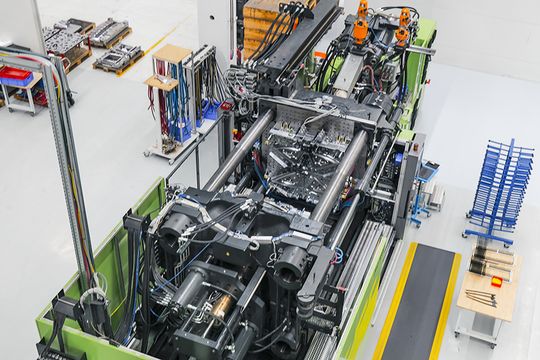
For the tooling company Pfaff, easy access to the tool room is not merely a convenience, but a key factor in productivity and quality. Especially during the prototyping, optimization, and maintenance phases, it determines time efficiency, precision, and cost-effectiveness. A view from above into the Engel Duo 1000—shown here with a complex rotary table mold—illustrates this point.
(Bild: Angels)
Conclusion
By expanding its technical center with the Duo 700 Combi M, Pfaff has strengthened its expertise in tool testing to include indexable insert technology. The toolmaker now covers the entire spectrum, from single-component (1K) applications to complex multi-component solutions. This forms the basis for stable mass-production processes and offers measurable added value for international customer projects in the automotive supply industry.