Skilled Workers from Third CountriesHow Can We Successfully Integrate Plastics Technologists from Third Countries?
A guest post by
Tim Miller
| Translated by AI
6 min Reading Time
In many injection molding and extrusion facilities, operator positions remain unfilled for months. Anyone hiring applicants from non-EU countries must clarify three things: what the person is actually capable of, how the certification process works, and how to safely train them to operate the equipment. This article shows how companies evaluate educational credentials, initiate the recognition and entry processes simultaneously, and develop a training program that leads to the ability to set up machinery independently.
Injection molding machines and extrusion lines operate in shifts, and every hour of downtime costs money. If there isn’t a skilled worker available to change the mold, start up the machine, and assess part quality, even the best equipment is of little use.
Injection molding machines and extrusion lines operate in shifts, and every hour of downtime costs money. If there isn’t a skilled worker available to change the mold, start up the machine, and assess part quality, even the best equipment is of little use. That’s why more and more companies are turning to candidates from countries outside the EU.
First, a clarification of terminology: Since the 2023 restructuring, the three-year vocational training program is known as “Plastics and Rubber Technologist.” In certificates, job postings, and day-to-day workplace settings, you will still come across the former name, “Process Mechanic for Plastics and Rubber Technology.” This refers to the same profession both before and after the restructuring.
Assign Qualifications Correctly
Foreign degrees can rarely be compared one-to-one with German vocational training. Many applicants have a high school or technical education in polymer engineering, mechanical engineering, or mechatronics, often with less on-the-job experience than the German dual training program provides. Others have no formal degree in the field but have worked on machines for years. Three questions can help with the assessment.
First: Does the experience match the field of specialization? In Germany, training is divided, among other things, into molded parts—primarily injection molding—and semi-finished products—primarily extrusion. Someone who has spent years extruding pipes cannot automatically set up an injection molding machine with a complex mold, and vice versa.
Second: What machines, materials, and tasks are involved in this job title? A resume often simply lists “Machine Operator.” Ask about clamping force and machine type, the materials processed, the shift schedule, the number of setup changes per week, and experience with measuring equipment and inspection plans.
Third: How can you assess practical skills during an interview and a work sample? Ask the applicant to describe, step by step, how to change a tool and start up the machine, and have your shift supervisor listen in. Those who are truly prepared will spontaneously mention the sequence of steps, checkpoints, and common mistakes. A video interview featuring a sketch or photo of a tool, along with a work sample after the candidate arrives, rounds out the picture. This does not replace formal certification, but it helps determine where the candidate fits into the company.
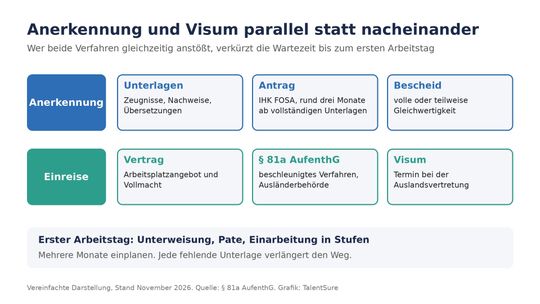
If you submit your application, power of attorney, and job offer all at once early on, you'll shorten the wait until your first day on the job.
(Bild: TalentSure)
The Path to Recognition
The IHK Fosa is the competent authority for apprenticeship programs in industry and commerce. It assesses whether a foreign qualification is equivalent to the corresponding German occupation. The application requires diplomas, proof of work experience, a resume, details of the training program, and proof of identity—usually accompanied by translations. Those living outside the EU must also demonstrate that they intend to work in Germany, for example, by providing an employment contract or job applications.
The IHK Fosa estimates that the preliminary review takes about one month and the equivalency assessment takes three months, once all documents are complete. The flat fee ranges from 100 to 600 EUR. Those who submit all documents early save the most time.
The process concludes with a determination of full equivalence, partial equivalence, or rejection. In the case of partial equivalence, the decision specifies the key differences. These can be addressed through an adaptation program, such as on-the-job training, courses, or an examination administered by the Chamber of Industry and Commerce (IHK). The plan for this is developed during a recognition consultation. The skilled worker submits a follow-up application with supporting documentation no later than five years after the initial decision. For companies, this presents an opportunity: On-the-job training on the machine can simultaneously serve as the evidence required for the follow-up application.
Entry into the country is governed by the Skilled Workers Immigration Act. Under the expedited skilled worker procedure pursuant to Section 81a of the Residence Act, the employer—with the skilled worker’s authorization—may apply to the Foreigners’ Registration Office for a consolidated procedure. A concrete job offer is required, and the fee is 411 EUR. The recognition authority is expected to make a decision within two months of receiving a complete set of documents, and the diplomatic mission is expected to offer a visa appointment within three weeks. Even so, companies should plan for several months, and any missing documents will delay the process. In the case of partial recognition, a recognition partnership under Section 16d of the Residence Act may be an option under certain conditions. The Foreigners’ Registration Office will determine what is possible on a case-by-case basis.
Date: 08.12.2025
Naturally, we always handle your personal data responsibly. Any personal data we receive from you is processed in accordance with applicable data protection legislation. For detailed information please see our privacy policy.
Consent to the use of data for promotional purposes
I hereby consent to Vogel Communications Group GmbH & Co. KG, Max-Planck-Str. 7-9, 97082 Würzburg including any affiliated companies according to §§ 15 et seq. AktG (hereafter: Vogel Communications Group) using my e-mail address to send editorial newsletters. A list of all affiliated companies can be found here
Newsletter content may include all products and services of any companies mentioned above, including for example specialist journals and books, events and fairs as well as event-related products and services, print and digital media offers and services such as additional (editorial) newsletters, raffles, lead campaigns, market research both online and offline, specialist webportals and e-learning offers. In case my personal telephone number has also been collected, it may be used for offers of aforementioned products, for services of the companies mentioned above, and market research purposes.
Additionally, my consent also includes the processing of my email address and telephone number for data matching for marketing purposes with select advertising partners such as LinkedIn, Google, and Meta. For this, Vogel Communications Group may transmit said data in hashed form to the advertising partners who then use said data to determine whether I am also a member of the mentioned advertising partner portals. Vogel Communications Group uses this feature for the purposes of re-targeting (up-selling, cross-selling, and customer loyalty), generating so-called look-alike audiences for acquisition of new customers, and as basis for exclusion for on-going advertising campaigns. Further information can be found in section “data matching for marketing purposes”.
In case I access protected data on Internet portals of Vogel Communications Group including any affiliated companies according to §§ 15 et seq. AktG, I need to provide further data in order to register for the access to such content. In return for this free access to editorial content, my data may be used in accordance with this consent for the purposes stated here. This does not apply to data matching for marketing purposes.
Right of revocation
I understand that I can revoke my consent at will. My revocation does not change the lawfulness of data processing that was conducted based on my consent leading up to my revocation. One option to declare my revocation is to use the contact form found at https://contact.vogel.de. In case I no longer wish to receive certain newsletters, I have subscribed to, I can also click on the unsubscribe link included at the end of a newsletter. Further information regarding my right of revocation and the implementation of it as well as the consequences of my revocation can be found in the data protection declaration, section editorial newsletter.
The order is important: Don't apply for recognition and a visa one after the other—instead, start both processes at the same time, and determine your job, responsibilities, and point of contact before you even submit your application.
Training until you can set up equipment on your own
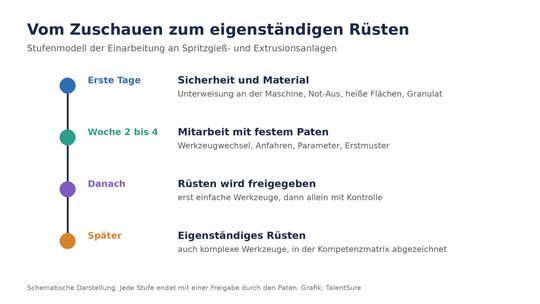
On-the-job training is effective when it is structured in stages and each stage concludes with a verifiable outcome.
The first few days are dedicated to safety. Training before starting work is mandatory and must be easy to understand—that is, in simple language, with pictures, and demonstrated on the actual equipment: safety guards and safety doors on the machine, hot surfaces on cylinders and hot runners, hydraulics, emergency stop buttons, and the proper use of tools and lifting equipment. Operating instructions with photos from your own facility are more helpful than a long text. In addition, there is materials science: identifying, drying, and sorting granules.
Each step ends with approval from the mentor and makes the progress visible to both parties.
(Bild: TalentSure)
During weeks two through four, the new colleague works under the guidance of a designated mentor. This is a specific person from the shift who is given time for this. Together, they change tools, start up machines, document parameters, and perform the initial sample inspection. It’s important that the mentor not only demonstrates but also explains why each step is performed in that particular order.
After that, tool setup is gradually authorized: first, simple tools under supervision; then, working independently with oversight from the mentor; and finally, even complex tools. A brief competency matrix, in which the mentor checks off each level, makes progress visible—both to the company and to the skilled worker. In the case of partial recognition, the same matrix can be used for the adaptation qualification plan.
Language training belongs in every level. A glossary with about a hundred technical terms and photos, labeled machines, and the rule “show me before you do it” build confidence faster than a language course alone. The course still runs in parallel, ideally at times that fit the work schedule.
As a general rule of thumb, many companies allow several months for an employee to become reliably capable of setting up equipment independently. By honestly factoring this timeframe into production planning, companies can avoid overburdening both the skilled worker and their colleagues.
Checklist for Installers
Determine your needs: What machines, field of specialization, and shift schedule?
Review documents early: diplomas, transcripts, proof of work experience, translations
Initiate the recognition and visa processes simultaneously; clarify responsibilities and authorities
Assign mentors and schedule time for orientation
Prepare training materials in easy-to-understand language; include photos in operating instructions
Create a competency matrix for step-by-step setup
Incorporating a Technical Glossary and Language Development
Coordinate the schedule with production planning
Sources IHK FOSA: Procedures, Duration, and Partial Recognition (ihk-fosa.de), Federal Institute for Vocational Education and Training: Plastics and Rubber Technologist, 2023 Revision (bibb.de), Section 81a of the Residence Act (AufenthG), Expedited Skilled Worker Procedure (gesetze-im-internet.de), Federal Employment Agency: Preliminary Approval for Foreign Employees (arbeitsagentur.de).
Tim Miller Tim Miller ist Gründer von TalentSure und Geschäftsführer der Certif-ID International GmbH.