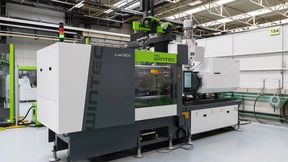
If you don’t keep up with the times, you’ll be left behind—and that goes for injection molding machines, too. This poses a problem for plastics processors. After all, even after years of use, most machines are still “reliable workhorses.” This is exactly where control system retrofits come into play.
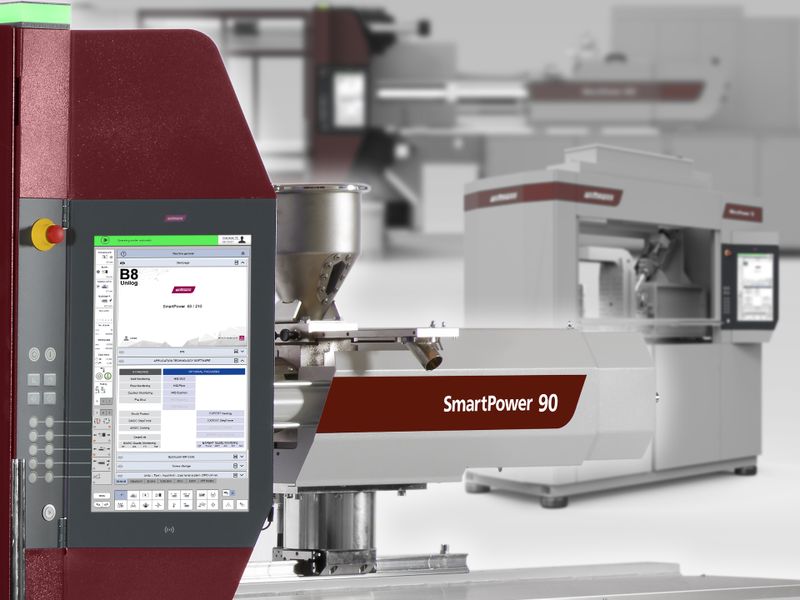
The Unilog B8 enables the machine and peripheral devices to be networked, with operation handled through a unified Windows interface.
(Bild: Wittmann)
Greater efficiency, greater process reliability, greater digitalization—constantly rising demands often pose challenges for existing machinery. This usually comes down to the control systems. After all, injection molding machines that have been producing reliably for 20, 30, or even 40 years are often still in good mechanical condition.
“Older control systems can increase the risk of downtime, drive up energy consumption, and are often unable to meet modern networking requirements,” says Jürgen Gerster, a service technician at Wittmann Battenfeld Germany. He is familiar with the issue from his day-to-day work. Together with his colleague Oliver Pabst, he has become a specialist in control system retrofits within the group. These retrofit projects take the service teams all over the world.
Cost-Effective Alternative
An example from Germany illustrates a typical retrofit project. A manufacturer of large containers operates 20 large injection molding machines with clamping forces of up to 3,000 metric tons. The machines have been in service for between 30 and 40 years. “Solid workhorses,” says Gerster. They have been regularly maintained and are in very good mechanical condition.
The challenge, however, is that replacement screens are no longer available for the old Unilog 9000 controllers. To prevent unplanned downtime, the company has tasked its service team with installing a modern Unilog B8 controller on seven machines to start.
(Source: Wittmann)
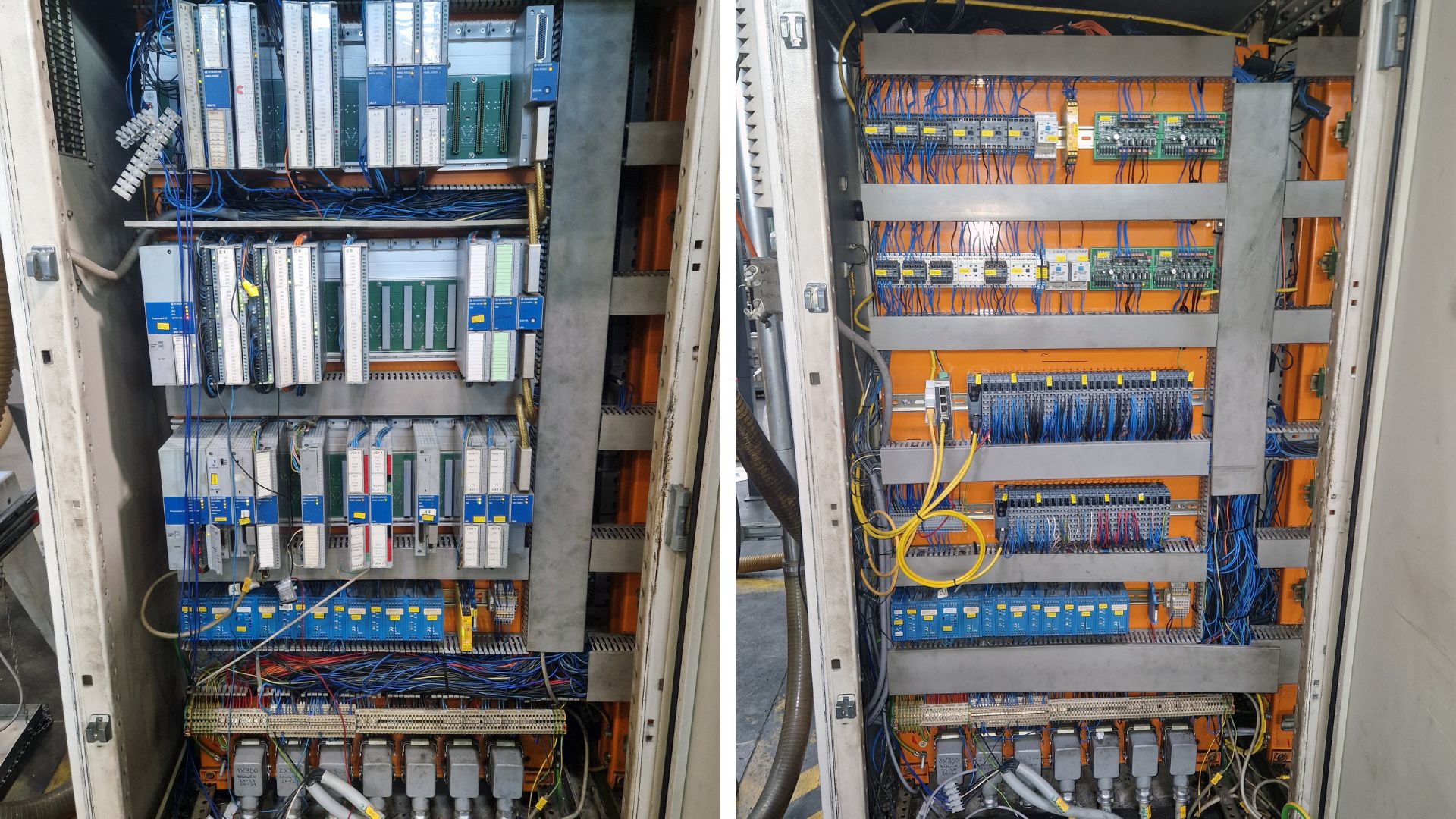
The control cabinet of a large injection molding machine built in 1989 before the retrofit (left) and after being converted to a Unilog B8 control system (right). The new control components take up significantly less space. This creates room for additional options without requiring extra floor space.
“Eighty percent of retrofit projects involve large machines,” explains Pabst. And there’s a simple reason for that: For large machines with a very high purchase price, a retrofit is significantly more cost-effective than buying a new machine.
What Needs to Be Evaluated
Buy new or retrofit—to gain clarity on this issue, a thorough evaluation is necessary. Wittmann provides consulting support in this process. Among other things, the following aspects are analyzed, for example:
Which products, materials, and tools should be used on the machine in the future?
What is the condition of the machine's mechanical components?
How carefully was the machine maintained?
What kind of automation is planned?
What is the situation regarding energy consumption, and what percentage of unit costs does it account for?
What new requirements are end customers imposing? What documentation or data, for example, is being requested?
What does the company's medium- to long-term digitalization strategy look like?
Based on the responses, the cost-effectiveness and long-term viability of a retrofit are compared to the cost of a new machine using reliable metrics. “Often, a retrofit costs only a fraction of the cost of a new investment,” says Pabst. This is a great opportunity for processors who are unable to secure approval for new investments.
What’s more, the effort involved in a retrofit is significantly less than that required for a machine replacement. “Our teams retrofit most machines on site,” explains Gerster. They schedule two weeks for this. “But we’re usually done much faster than that.” This includes recommissioning, since that’s part of the scope of services.
During this time, the control panel will be replaced and the existing control cabinet will be retrofitted. The new control system takes up less space in the control cabinet than the old one. This creates an opportunity to retrofit additional options or integrate external systems without taking up additional production space.
(Source:Wittmann/Graphic: PlastXnow)
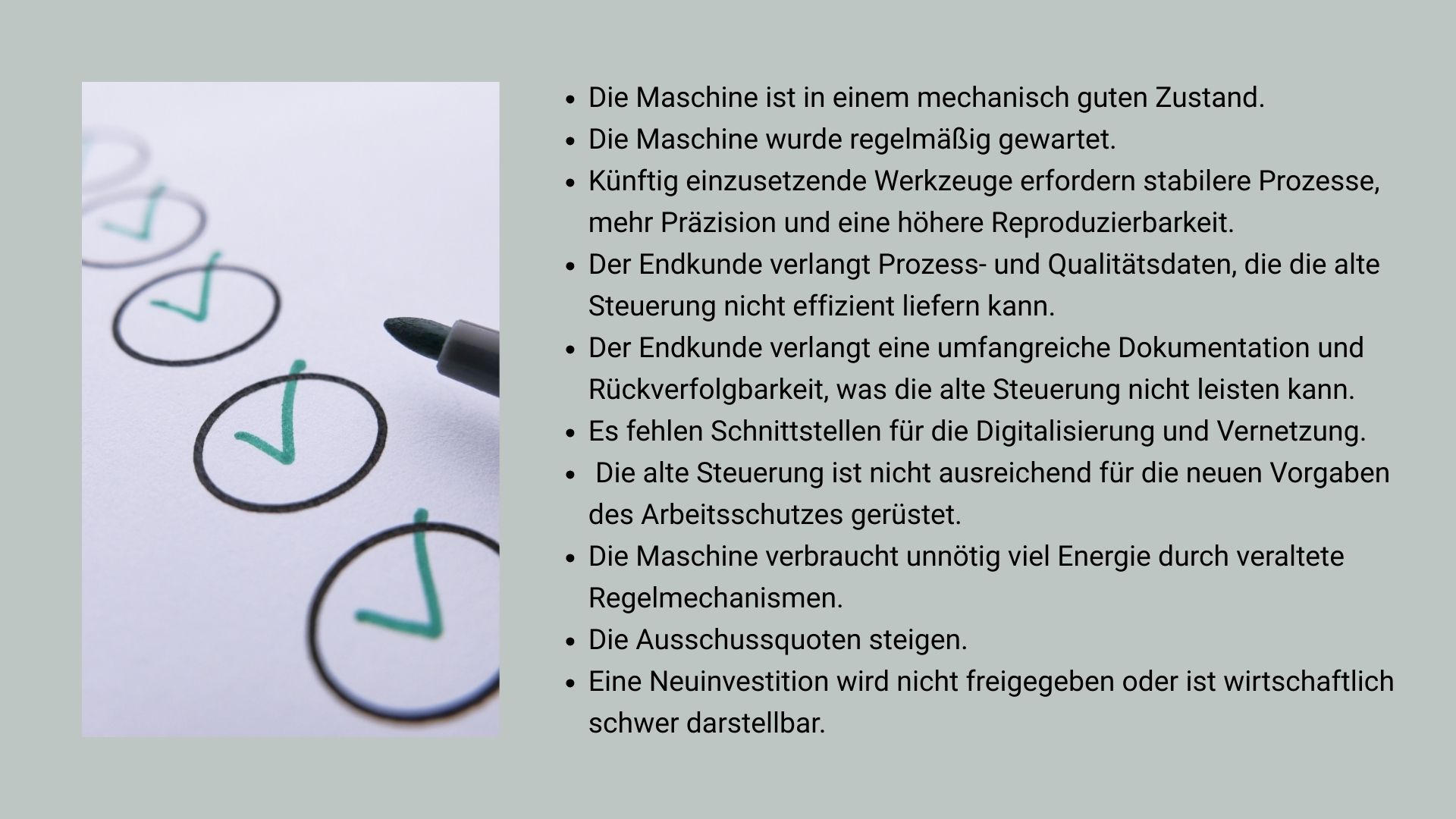
Control System Retrofit Checklist: The more "yes" answers you have, the more beneficial a retrofit of the machine control system will be.
For the German container manufacturer, the investment in the new control systems has paid off. The risk of unplanned equipment downtime has been eliminated. Another major advantage is that the processor can now take advantage of Wittmann’s online support. This will drastically reduce service costs.
Plan for Future Needs
The Unilog B8 controller features a 21.5-inch Full HD multitouch display with gesture control, thereby enhancing ease of use. At the same time, thanks to the Windows 10 IoT operating system, the operator benefits from improved performance. This is reflected, for example, in more precise control and greater reproducibility.
“It’s important in a retrofit project to always plan for the future,” Gerster emphasizes. After all, digitalization is advancing rapidly. The retrofitted machines now feature modern interfaces for connecting to various external systems—for example, for inline quality control—or for integrating the production cell into a master computer system. Even if not everything is needed right away, the machines are already equipped to meet future requirements.
Date: 08.12.2025
Naturally, we always handle your personal data responsibly. Any personal data we receive from you is processed in accordance with applicable data protection legislation. For detailed information please see our privacy policy.
Consent to the use of data for promotional purposes
I hereby consent to Vogel Communications Group GmbH & Co. KG, Max-Planck-Str. 7-9, 97082 Würzburg including any affiliated companies according to §§ 15 et seq. AktG (hereafter: Vogel Communications Group) using my e-mail address to send editorial newsletters. A list of all affiliated companies can be found here
Newsletter content may include all products and services of any companies mentioned above, including for example specialist journals and books, events and fairs as well as event-related products and services, print and digital media offers and services such as additional (editorial) newsletters, raffles, lead campaigns, market research both online and offline, specialist webportals and e-learning offers. In case my personal telephone number has also been collected, it may be used for offers of aforementioned products, for services of the companies mentioned above, and market research purposes.
Additionally, my consent also includes the processing of my email address and telephone number for data matching for marketing purposes with select advertising partners such as LinkedIn, Google, and Meta. For this, Vogel Communications Group may transmit said data in hashed form to the advertising partners who then use said data to determine whether I am also a member of the mentioned advertising partner portals. Vogel Communications Group uses this feature for the purposes of re-targeting (up-selling, cross-selling, and customer loyalty), generating so-called look-alike audiences for acquisition of new customers, and as basis for exclusion for on-going advertising campaigns. Further information can be found in section “data matching for marketing purposes”.
In case I access protected data on Internet portals of Vogel Communications Group including any affiliated companies according to §§ 15 et seq. AktG, I need to provide further data in order to register for the access to such content. In return for this free access to editorial content, my data may be used in accordance with this consent for the purposes stated here. This does not apply to data matching for marketing purposes.
Right of revocation
I understand that I can revoke my consent at will. My revocation does not change the lawfulness of data processing that was conducted based on my consent leading up to my revocation. One option to declare my revocation is to use the contact form found at https://contact.vogel.de. In case I no longer wish to receive certain newsletters, I have subscribed to, I can also click on the unsubscribe link included at the end of a newsletter. Further information regarding my right of revocation and the implementation of it as well as the consequences of my revocation can be found in the data protection declaration, section editorial newsletter.
The Unilog B8 controller also enables the integration of the entire workcell via OPC UA and creates a unified operating platform that spans the injection molding machine, peripherals, and automation. In a production cell networked via Wittmann 4.0, even an older injection molding machine can thus become a communication hub with plug-and-produce functionality.
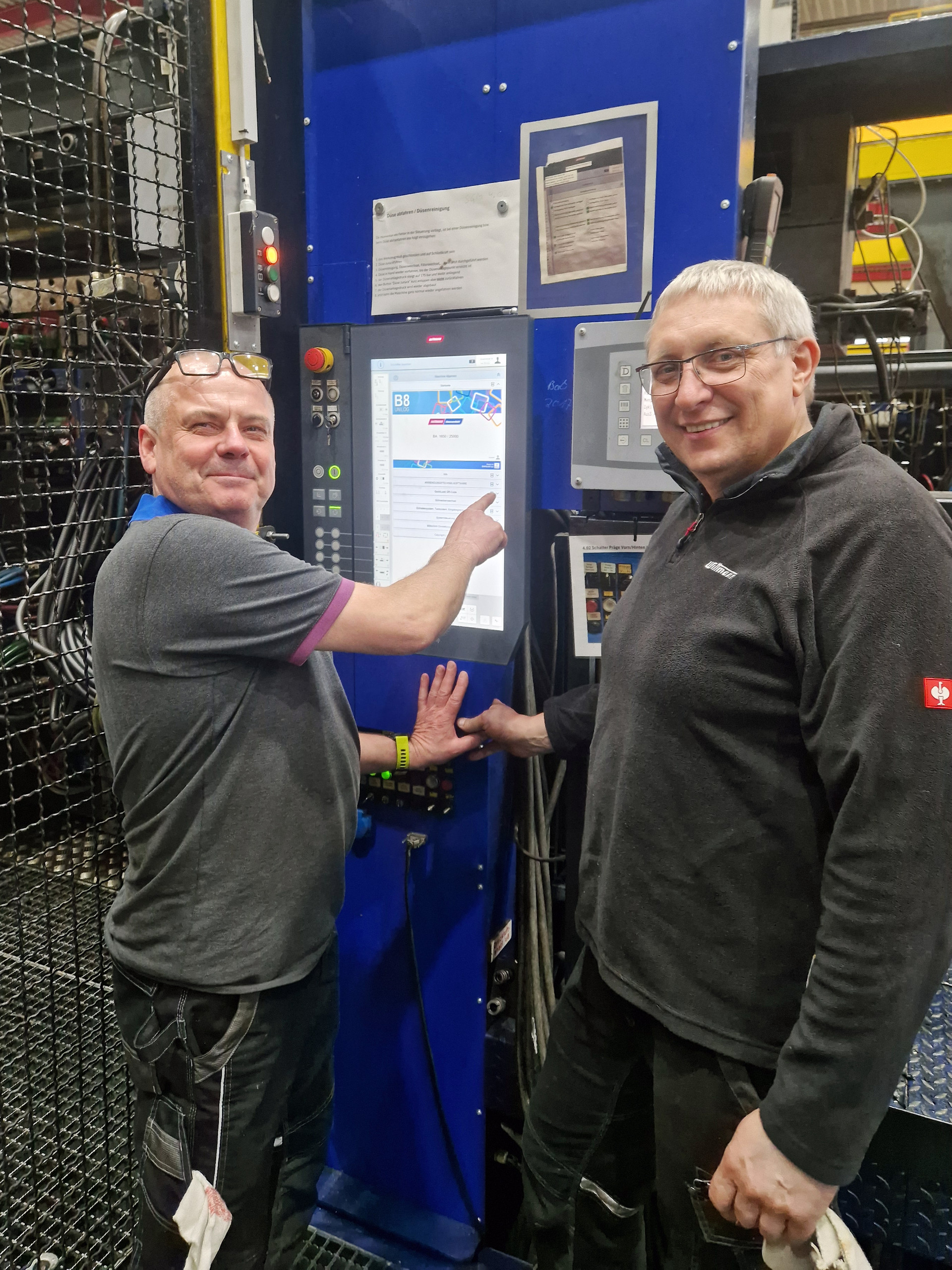
Wittmann service technicians Markus Walus (left) and Reiner Schäl (right) retrofitting a large injection molding machine. The old Unilog 9000 controller has already been replaced with a Unilog B8 controller.
(Source: Wittmann)
Ten more years
“The availability of replacement parts and the need to digitize are the most common reasons for requesting a retrofit,” Gerster reports. However, safety concerns are often a driving factor as well. For example, additional photoelectric sensors cannot be integrated into all earlier generations of control systems.
One project even involved structural considerations. “Replacing the machine would have been far too complicated because a wall would have had to be removed,” said Gerster.
A control system retrofit extends the service life of injection molding machines by at least ten years. Wittmann also guarantees the availability of replacement parts throughout this period.
Info
Author
Susanne Zinckgraf is Head of Strategic Marketing at the Wittmann Group.
Service
For more information on the Unilog B8 controller, click here.