In the Carbex project, Covestro and Fraunhofer Umsicht are extracting benzene and toluene from shredder residue from end-of-life vehicles, which until now has mostly been sent to incineration. By 2028, a pilot plant is scheduled to test the process at a rate of 10 kg/h. Initial laboratory data show why the process does not require external catalysts.
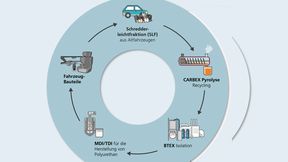
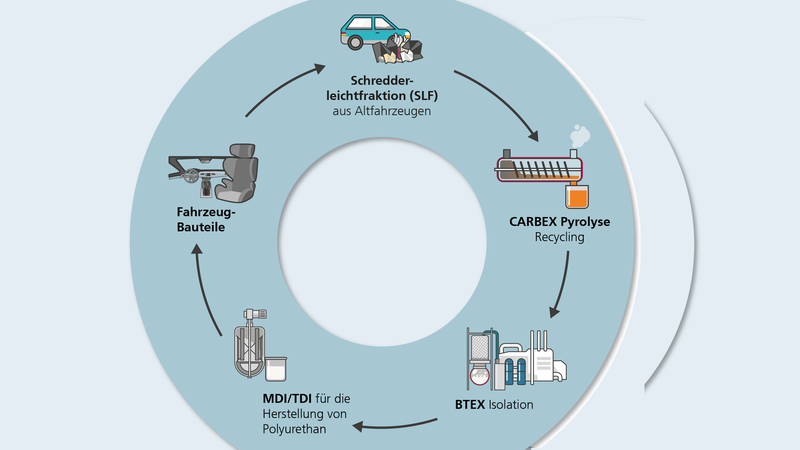
From end-of-life vehicles to aromatics and recycled polyurethane: The Carbex project recovers chemical building blocks for new plastics.
(Bild: Covestro)
Covestro and Fraunhofer Umsicht, together with Carbon Minds, have launched the Carbex research project. Under Covestro’s industrial leadership, the consortium will validate a process by August 2029 that recovers the aromatic compounds benzene, toluene, ethylbenzene, and xylenes (BTEX) from the light shredder fraction (SLF) of end-of-life vehicles.
Until now, this waste material has primarily been incinerated, even though it consists of an average of 20 percent by mass of polyurethanes. Since Covestro processes benzene into MDI and toluene into TDI, processors will in the future have access to circular raw materials for the production of polyurethane foams used in insulation, car seats, and structural and acoustic components.
Pyrolysis coke acts as a catalyst and halogen scavenger
The technological basis is the Pyromat process, which combines pyrolysis with downstream autocatalytic reforming. At around 500 °C, the pyrolysis coke produced in the process acts as both a catalyst and an adsorbent. Its components—calcium carbonate, titanium dioxide, and copper—promote the formation of aromatic compounds while simultaneously binding halogens such as chlorine and bromine, eliminating the need for expensive, sensitive external catalysts. In laboratory tests with SLF, the institute has already achieved a BTEX mass fraction of 62% in the pyrolysis oil—about 60% more than with conventional pyrolysis—and reduced the halogen content by up to 99%.
“Pyromat technology uses pyrolysis coke as both a catalyst and an adsorbent—which makes the process robust and cost-effective, especially for heavily contaminated waste streams. In this project, we are scaling up this approach from the laboratory to continuous pilot-plant operation at a rate of 10 kg/h,” explains Dr. Thomas Fehn, project manager at the Sulzbach-Rosenberg branch of Fraunhofer Umsicht.
To this end, the institute is converting an existing pyrolysis plant from a fixed-bed to a moving-bed reactor and determining stable process windows. The goal is to produce at least 50 kg of BTEX-rich pyrolysis oil with a halogen content of less than 30 mg/kg—ensuring that the oil meets the limit value for large-scale further processing. While Covestro uses a model-based approach to calculate how benzene and toluene can be separated by distillation, validates both substances in MDI and TDI production and evaluates the process from a technical and economic perspective, Carbon Minds is preparing an ISO-compliant life cycle assessment based on the cradle-to-gate approach.
As associate industry partners, Becklönne Maschinenbau is contributing its expertise in plant engineering, and Rain Carbon is contributing its experience in large-scale distillation and marketing. Upon completion of the project, the consortium plans to build a demonstration plant based on this foundation (TRL 7).
Closing Loops, Meeting Quotas
For the German chemical and plastics industry, this process offers significant market and substitution potential, as more than 2.6 million metric tons of aromatics—worth approximately 1.95 billion euros—are produced in Germany each year. To date, the process has been dominated by the steam cracking of fossil naphtha, which generates approximately 8 million metric tons of CO2 equivalents per year in process emissions in Germany, as well as an additional 11 million metric tons in upstream processes. The Pyromat process reduces process emissions to approximately 1.1 metric tons of CO2-equivalents per metric ton of BTEX—that is nearly 40% below the 1.6 to 1.8 metric tons produced by steam cracking and enables nationwide savings of up to 640 metric tons of CO2 equivalents per metric ton of BTEX—which is nearly 40% lower than the 1.6 to 1.8 metric tons from steam cracking and enables nationwide savings of up to 640,000 metric tons of CO2 equivalents per year.
“If we can recover benzene and toluene from the lightweight fraction of shredded material in a quality suitable for use in our MDI and TDI production processes, we close the loop and simultaneously replace an emission-intensive step in basic chemical production,” emphasizes Dr. Stefanie Eiden, project manager at Covestro.
Date: 08.12.2025
Naturally, we always handle your personal data responsibly. Any personal data we receive from you is processed in accordance with applicable data protection legislation. For detailed information please see our privacy policy.
Consent to the use of data for promotional purposes
I hereby consent to Vogel Communications Group GmbH & Co. KG, Max-Planck-Str. 7-9, 97082 Würzburg including any affiliated companies according to §§ 15 et seq. AktG (hereafter: Vogel Communications Group) using my e-mail address to send editorial newsletters. A list of all affiliated companies can be found here
Newsletter content may include all products and services of any companies mentioned above, including for example specialist journals and books, events and fairs as well as event-related products and services, print and digital media offers and services such as additional (editorial) newsletters, raffles, lead campaigns, market research both online and offline, specialist webportals and e-learning offers. In case my personal telephone number has also been collected, it may be used for offers of aforementioned products, for services of the companies mentioned above, and market research purposes.
Additionally, my consent also includes the processing of my email address and telephone number for data matching for marketing purposes with select advertising partners such as LinkedIn, Google, and Meta. For this, Vogel Communications Group may transmit said data in hashed form to the advertising partners who then use said data to determine whether I am also a member of the mentioned advertising partner portals. Vogel Communications Group uses this feature for the purposes of re-targeting (up-selling, cross-selling, and customer loyalty), generating so-called look-alike audiences for acquisition of new customers, and as basis for exclusion for on-going advertising campaigns. Further information can be found in section “data matching for marketing purposes”.
In case I access protected data on Internet portals of Vogel Communications Group including any affiliated companies according to §§ 15 et seq. AktG, I need to provide further data in order to register for the access to such content. In return for this free access to editorial content, my data may be used in accordance with this consent for the purposes stated here. This does not apply to data matching for marketing purposes.
Right of revocation
I understand that I can revoke my consent at will. My revocation does not change the lawfulness of data processing that was conducted based on my consent leading up to my revocation. One option to declare my revocation is to use the contact form found at https://contact.vogel.de. In case I no longer wish to receive certain newsletters, I have subscribed to, I can also click on the unsubscribe link included at the end of a newsletter. Further information regarding my right of revocation and the implementation of it as well as the consequences of my revocation can be found in the data protection declaration, section editorial newsletter.
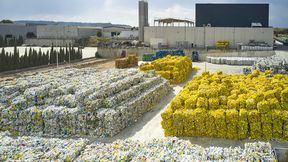
On the raw materials side, more than 466,000 metric tons of lightweight shredder residue are generated annually in Germany, of which approximately 210,000 metric tons are currently sent for energy recovery or disposal. At the same time, the planned EU End-of-Life Vehicles Regulation (ELVR) is increasing the pressure on processors and automakers to take action, as it mandates binding recycled content quotas for plastics in vehicles—a portion of which must come directly from end-of-life vehicles—starting in 2032. (mg)
Funding Notice
The Federal Ministry of Research, Technology, and Space is providing funding to Carbex as part of the initiative “Prevention of Climate-Relevant Process Emissions in Industry” (KlimPro-Industrie II)“.