The transition to a circular economy is presenting companies in the plastics and chemical industries with new requirements for skills and continuing education. The SKZ’s collaborative projects, Kare and Skills4Circle, are examining the skills employees need and developing practical learning programs. The focus is on the circular economy, regulatory requirements, the use of recycled materials, and AI-supported, adaptive learning concepts.
The transition to a circular economy is not only a technological challenge; it also requires new skills, changes in work practices, and organizational adjustments.
Finite resources, geopolitically fragile supply chains, climate change, and increasing regulatory requirements are intensifying the pressure on the plastics industry to transform. The circular economy (CE) is considered a key approach to reducing the consumption of primary raw materials, closing material loops, and increasing resource efficiency. The CE is therefore not only ecologically necessary but also represents a key factor in ensuring companies’ long-term competitiveness, market viability, and sustainability.
The Regional Center of Excellence for Labor Research (Kare) and the Skills4Circle project aim to prepare employees in the plastics and chemical industries for the CE, although there are differences in the focus and implementation of the training programs:
The Kare collaborative project, led by SKZ and consisting of 16 interdisciplinary consortium partners from the research sector, companies in the plastics industry, and the TecPart e.V. association, supports companies in the plastics industry as they transition to CE compliance. Key components of this effort include assessing training needs and developing and testing tailored continuing education programs.
The Skills4Circle collaborative project, consisting of partners from the plastics and chemical industries as well as the field of educational design, focuses on professional development and aims to prepare employees in the plastics and chemical sectors to meet the challenges of the CE. In addition to conducting its own needs assessment with the participating companies, Skills4Circle builds on these findings and examines how digital and adaptive learning concepts can support skills development in the plastics and chemical industries.
Empowering Companies to Implement the Circular Economy
As part of a comprehensive needs assessment conducted jointly by the education and research partners—which consisted of a nationwide online survey of companies (n = 82), interviews with experts and executives, workshops, and initial pilot projects at partner companies, key findings were gathered that now form the basis for the development of training programs.
The needs assessment shows that companies have recognized the strategic importance of CE. At the same time, there is a value-action gap between ambitious goals and their implementation. Training needs exist in particular when it comes to developing a shared understanding of CE, addressing regulatory issues, and tackling technical topics such as product design, the use of recycled materials, and resource efficiency. The surveys also show that CE is often reduced to recycling alone and that further knowledge regarding circular strategies and business models is needed.
The needs assessment currently being conducted as part of the Skills4Circle project is already revealing similar trends, such as needs in the areas of regulation and waste management.
Examples of training programs: Circular Economy Fundamentals Module
The foundational modules on the Circular Economy (CE), developed jointly by Kare’s education and research partners in collaboration with Skills4Circle, foster a shared understanding of the key principles, drivers, and strategies of the CE. Topics covered include the importance of CE for the plastics industry, the waste hierarchy, the 10R strategies, and fundamental approaches to circular business models. The module is specifically designed for employees who have had little prior exposure to the topic and serves as the foundation for advanced training programs.
Regulatory Framework
The training modules on CE regulations provide employees and managers with a structured overview of key national and European regulatory frameworks. The goal is to enable companies to independently assess regulatory developments and evaluate their impact on products, processes, and business models. This is achieved through various formats, such as e-learning and consulting services.
Date: 08.12.2025
Naturally, we always handle your personal data responsibly. Any personal data we receive from you is processed in accordance with applicable data protection legislation. For detailed information please see our privacy policy.
Consent to the use of data for promotional purposes
I hereby consent to Vogel Communications Group GmbH & Co. KG, Max-Planck-Str. 7-9, 97082 Würzburg including any affiliated companies according to §§ 15 et seq. AktG (hereafter: Vogel Communications Group) using my e-mail address to send editorial newsletters. A list of all affiliated companies can be found here
Newsletter content may include all products and services of any companies mentioned above, including for example specialist journals and books, events and fairs as well as event-related products and services, print and digital media offers and services such as additional (editorial) newsletters, raffles, lead campaigns, market research both online and offline, specialist webportals and e-learning offers. In case my personal telephone number has also been collected, it may be used for offers of aforementioned products, for services of the companies mentioned above, and market research purposes.
Additionally, my consent also includes the processing of my email address and telephone number for data matching for marketing purposes with select advertising partners such as LinkedIn, Google, and Meta. For this, Vogel Communications Group may transmit said data in hashed form to the advertising partners who then use said data to determine whether I am also a member of the mentioned advertising partner portals. Vogel Communications Group uses this feature for the purposes of re-targeting (up-selling, cross-selling, and customer loyalty), generating so-called look-alike audiences for acquisition of new customers, and as basis for exclusion for on-going advertising campaigns. Further information can be found in section “data matching for marketing purposes”.
In case I access protected data on Internet portals of Vogel Communications Group including any affiliated companies according to §§ 15 et seq. AktG, I need to provide further data in order to register for the access to such content. In return for this free access to editorial content, my data may be used in accordance with this consent for the purposes stated here. This does not apply to data matching for marketing purposes.
Right of revocation
I understand that I can revoke my consent at will. My revocation does not change the lawfulness of data processing that was conducted based on my consent leading up to my revocation. One option to declare my revocation is to use the contact form found at https://contact.vogel.de. In case I no longer wish to receive certain newsletters, I have subscribed to, I can also click on the unsubscribe link included at the end of a newsletter. Further information regarding my right of revocation and the implementation of it as well as the consequences of my revocation can be found in the data protection declaration, section editorial newsletter.
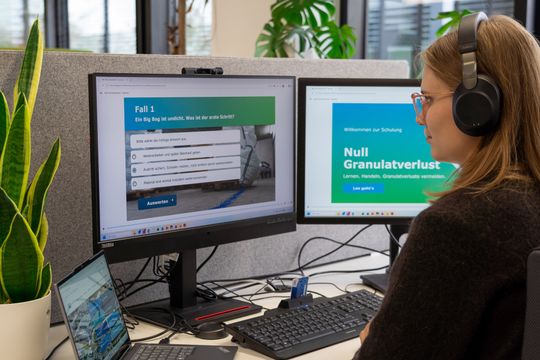
In addition, there are in-depth modules on specific legislation, such as the Zero-Pellet-Loss Regulation or the Packaging and Packaging Waste (PPWR) Regulation. The “Zero Pellet Loss” e-learning module—developed jointly by the Research Institute for Corporate Education (f-bb), TecPart – Association for Technical Plastic Products e.V., and SKZ – The Plastics Center, in cooperation with the transform.by project, a practice-oriented training program has been created to support companies in implementing European requirements for preventing plastic pellet losses. The multilingual module, available free of charge, comes in various versions tailored to specific target groups and is thus aimed at the logistics industry (truck drivers, etc.), employees in intralogistics or production, as well as shift supervisors and plant managers at plastics-processing companies. This enables these companies to fulfill the training requirement established by the Zero Pellet Loss Regulation. The “Packaging and Packaging Waste Regulation (PPWR)” course, designed by SKZ, provides practical support to plastics processors in implementing the new EU Packaging Regulation. The focus is on regulatory obligations, compliance requirements, and the correct identification of one’s own role within the supply chain, which determines the relevant legal obligations.
The Skills4Circle project is developing adaptive learning programs. Unlike traditional, linear e-learning, this concept is characterized by the fact that the learning content is automatically adapted in real time by AI-powered software to match the participants’ level of knowledge, skill level, and learning progress.
(Bild: Luca Hoffmannbeck, SKZ)
Adaptive Learning Concepts as a New Approach to Skills Development
The Skills4Circle project is developing adaptive learning programs. Unlike traditional, linear e-learning, this concept is characterized by the fact that the learning content is automatically adapted in real time—via AI-powered software—to participants’ current knowledge, skill level, and learning progress. This ensures that learners receive exactly the content relevant to building their competencies, making the learning process targeted and time-efficient.
The project examines the role that adaptive learning systems can play in building competencies. The findings will be incorporated, among other things, into a guide for developing digital and adaptive learning modules.
Conclusion
The Kare and Skills4Circle projects are creating practical training programs designed to support companies in building the skills needed for the CE. The digital and analog learning formats developed are intended to empower employees and managers to successfully navigate the challenges of this transformation. Under the leadership of the SKZ, the project partners are actively involved in the development, testing, and implementation of these programs. Companies seeking to position themselves for the future are invited to take advantage of the programs developed.
Funding Information
The “Skills4Circle – Skills for a Circular Economy” is funded as part of the “Sustainable Careers—Future-Oriented Training” program by the Federal Ministry of Education, Family Affairs, Senior Citizens, Women, and Youth and the European Union through the European Social Fund Plus (ESF Plus).
The Kare project, “Kare Center of Excellence for Labor Research: Building Competencies for the Circular Economy of Plastics,” is funded by the Federal Ministry of Research, Technology, and Space (BMFTR) as part of the program “The Future of Value Creation—Research on Production, Services, and Work” (Grant Number: 02L22C200) and is managed by the Project Management Agency Karlsruhe (PTKA).
Malena Müller Scientist „Transformation der Kunststoffindustrie“ am SKZ – Das Kunststoff-Zentrum & Projektleitung Skills4Circle
Bildquelle:
Victoria Tengelmann Scientist „Transformation der Kunststoffindustrie“ am SKZ – Das Kunststoff-Zentrum
Bildquelle:
Jonathan Lambers Gruppenleiter „Transformation der Kunststoffindustrie“ am SKZ – Das Kunststoff-Zentrum & Projektleitung Kare