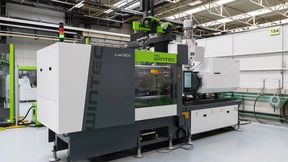
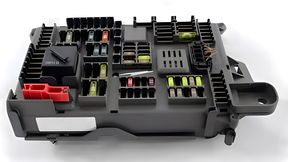
With an area of approximately 200 square meters, the production cell is one of the largest and most complex at the Swoboda site in Jihlava. Several million control cabinet housing components are produced on this line each year. What sets this line apart is its high degree of automation.
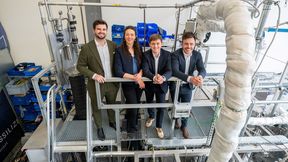
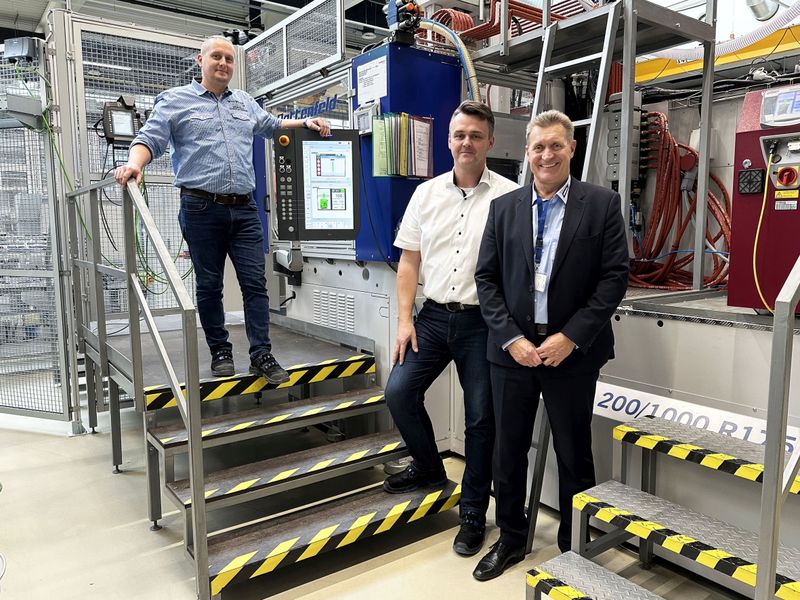
Working Together for Maximum Efficiency: Pavel Bohuněk and Marek Hejl from Swoboda CZ with Michal Slaba from Wittmann Battenfeld CZ (from left to right)
(Bild: Wittmann)
We are at Swoboda CZ in Jihlava, Czech Republic, 120 kilometers southeast of Prague. The facility, which is part of the global Swoboda Group, specializes in sophisticated metal-plastic composite assemblies, as Václav Dostal, Managing Director of Swoboda CZ s.r.o., explains to us. While control cabinet housing components are not a new product for the on-site team, the production process has undergone a complete transformation. “Cost pressure has increased dramatically,” says Dostal. “That’s why we decided to invest in a new, fully automated production cell.”
The evolution of the process can be clearly traced during a tour of the plant, as the two existing production cells are still in operation. They operate on a semi-automated basis. “With the new process, we’ve doubled our capacity,” says Dostal. Swoboda is benefiting from the global expansion of renewable energy with this product. It’s a project the team in the Czech Republic is particularly proud of. Orders like these help reduce dependence on the automotive industry.
INFO
WIN Verlag: About Us
You can read more exciting insights into renewable energy in an industrial setting on our portal www.r-energy.eu.
With the development of the new production process, automation was redesigned from the ground up. At the same time, tried-and-true elements were retained. For example, at the center of the production cell stands a large vertical injection molding machine from Wittmann with a clamping force of 270 metric tons—equipped with a two-station rotary table and temperature control units, which also come from the Austrian machine manufacturer.
“The Wittmann vertical machines offer our production staff a particularly high level of convenience,” says Production Manager Pavel Bohuněk, emphasizing that every single vertical machine in the plant comes from the Wittmann Group. Some have been performing reliably for many years.
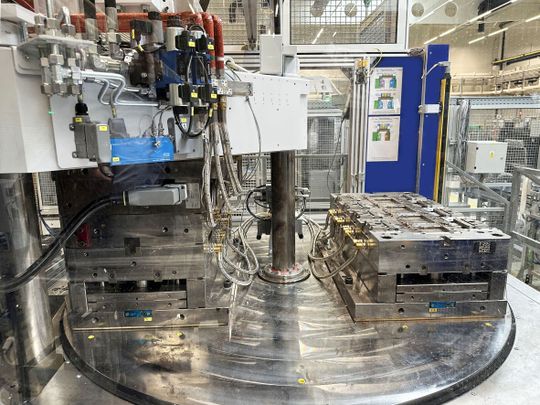
Figure 1. The temperature control fluid connections come from above, so the injection molding machine does not need a central rotary manifold. This ensures excellent accessibility to the molds.
(Bild: Wittmann)
What does “comfort” mean to Swoboda? – Two things, Bohuněk explains. First, it’s about the intuitive user interface of the machine control system, which enables even trained production staff with limited experience to maintain consistently high component quality and efficiently restart the process after an interruption. Second, the production manager highlights a design feature of the vertical machines that is offered as standard on all models equipped with a two-station rotary table.
“It’s all about the supply of the temperature-control media,” explains Michal Slaba, Managing Director of Wittmann Battenfeld CZ: The connections come from above (Figure 1), “so we can do without a central rotary manifold.” This ensures excellent accessibility to the molds, which simplifies both automation and manual work—for example, during maintenance.
The transfer system links the individual work steps
The mold bases are mounted on the rotary table used for producing the switchgear enclosure components. The large six-axis robot removes the components and simultaneously loads the cavities with the insert parts. “The challenge with this component is the large number and variety of insert parts that the automation system must handle reliably,” explains Dostal.
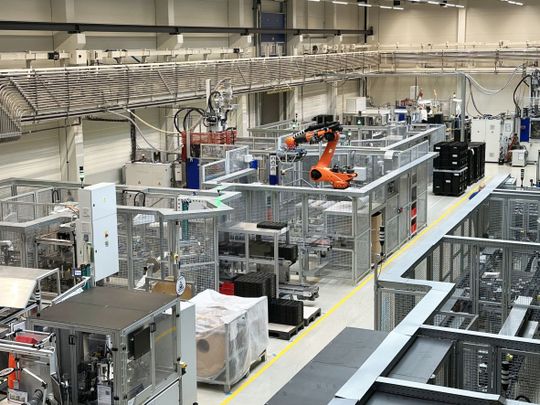
Figure 2. The automated system, featuring a sophisticated transfer system, surrounds the injection molding machine.
(Bild: Wittmann)
Another robot assists the large six-axis industrial robot. This robot is responsible for pre-positioning the inserts into the frames. Among other things, several signal pins, power pins, and sockets are overmolded. Some inserts are fed to the robot via trays. Some of the pins are punched and bent inline using reel-to-reel systems.
The transfer system within the production cell is impressive (Figure 2). The frames are transported via a rail system to the clamping unit, where the multi-axis robot picks up the complete insert sets to place the pins and sockets into the mold cavities. Overmolding is performed using a white, glass-fiber-filled thermoplastic.
The freshly molded components are transported away from the clamping unit by the transfer system, first for camera inspection and laser marking. The components are then placed into trays and leave the production cell. All empty frames and transport carriages automatically return to the starting point at the end of the cycle.
Date: 08.12.2025
Naturally, we always handle your personal data responsibly. Any personal data we receive from you is processed in accordance with applicable data protection legislation. For detailed information please see our privacy policy.
Consent to the use of data for promotional purposes
I hereby consent to Vogel Communications Group GmbH & Co. KG, Max-Planck-Str. 7-9, 97082 Würzburg including any affiliated companies according to §§ 15 et seq. AktG (hereafter: Vogel Communications Group) using my e-mail address to send editorial newsletters. A list of all affiliated companies can be found here
Newsletter content may include all products and services of any companies mentioned above, including for example specialist journals and books, events and fairs as well as event-related products and services, print and digital media offers and services such as additional (editorial) newsletters, raffles, lead campaigns, market research both online and offline, specialist webportals and e-learning offers. In case my personal telephone number has also been collected, it may be used for offers of aforementioned products, for services of the companies mentioned above, and market research purposes.
Additionally, my consent also includes the processing of my email address and telephone number for data matching for marketing purposes with select advertising partners such as LinkedIn, Google, and Meta. For this, Vogel Communications Group may transmit said data in hashed form to the advertising partners who then use said data to determine whether I am also a member of the mentioned advertising partner portals. Vogel Communications Group uses this feature for the purposes of re-targeting (up-selling, cross-selling, and customer loyalty), generating so-called look-alike audiences for acquisition of new customers, and as basis for exclusion for on-going advertising campaigns. Further information can be found in section “data matching for marketing purposes”.
In case I access protected data on Internet portals of Vogel Communications Group including any affiliated companies according to §§ 15 et seq. AktG, I need to provide further data in order to register for the access to such content. In return for this free access to editorial content, my data may be used in accordance with this consent for the purposes stated here. This does not apply to data matching for marketing purposes.
Right of revocation
I understand that I can revoke my consent at will. My revocation does not change the lawfulness of data processing that was conducted based on my consent leading up to my revocation. One option to declare my revocation is to use the contact form found at https://contact.vogel.de. In case I no longer wish to receive certain newsletters, I have subscribed to, I can also click on the unsubscribe link included at the end of a newsletter. Further information regarding my right of revocation and the implementation of it as well as the consequences of my revocation can be found in the data protection declaration, section editorial newsletter.
Setting an example for other locations worldwide
The entire automation system was developed and built on-site. Automation solutions from Jihlava are also in use at other Swoboda Group plants worldwide. The new production process for switchgear enclosure components serves as a model. The full automation of all process steps and the high repeatability of the injection molding machine successfully increase efficiency and enable lower unit costs. In addition, they ensure high process stability and consistent quality.
Wittmann and Swoboda in the Czech Republic describe their collaboration as a true partnership. This is due in part to the short distances involved and the excellent facilities at Wittmann’s Czech branch, which includes its own spare parts warehouse, training center, and application laboratory. “When it comes to optimizing processes for greater efficiency, we serve as an important sounding board for many customers,” emphasizes Michal Slaba.
INFO
Profile
The Wittmann Group is a leading global manufacturer of injection molding machines, robots, and peripheral equipment for processing a wide variety of plasticizable materials. The group is headquartered in Vienna, Austria, and consists of two main business divisions: Wittmann Battenfeld and Wittmann.
Together, the Group’s companies operate ten production facilities in seven countries. With their 35 locations, the additional sales subsidiaries are represented in all major industrial markets around the world.
The Author
Susanne Zinckgraf is Head of Strategic Marketing at Wittmann Tec Group GmbH.