Demand for micro-components made of silicone is growing. LSR processor Starlim manufactures components weighing less than 10 milligrams in quantities running into the millions. A look at the production process reveals how high-precision molds and compact machine designs ensure this demanding production process.
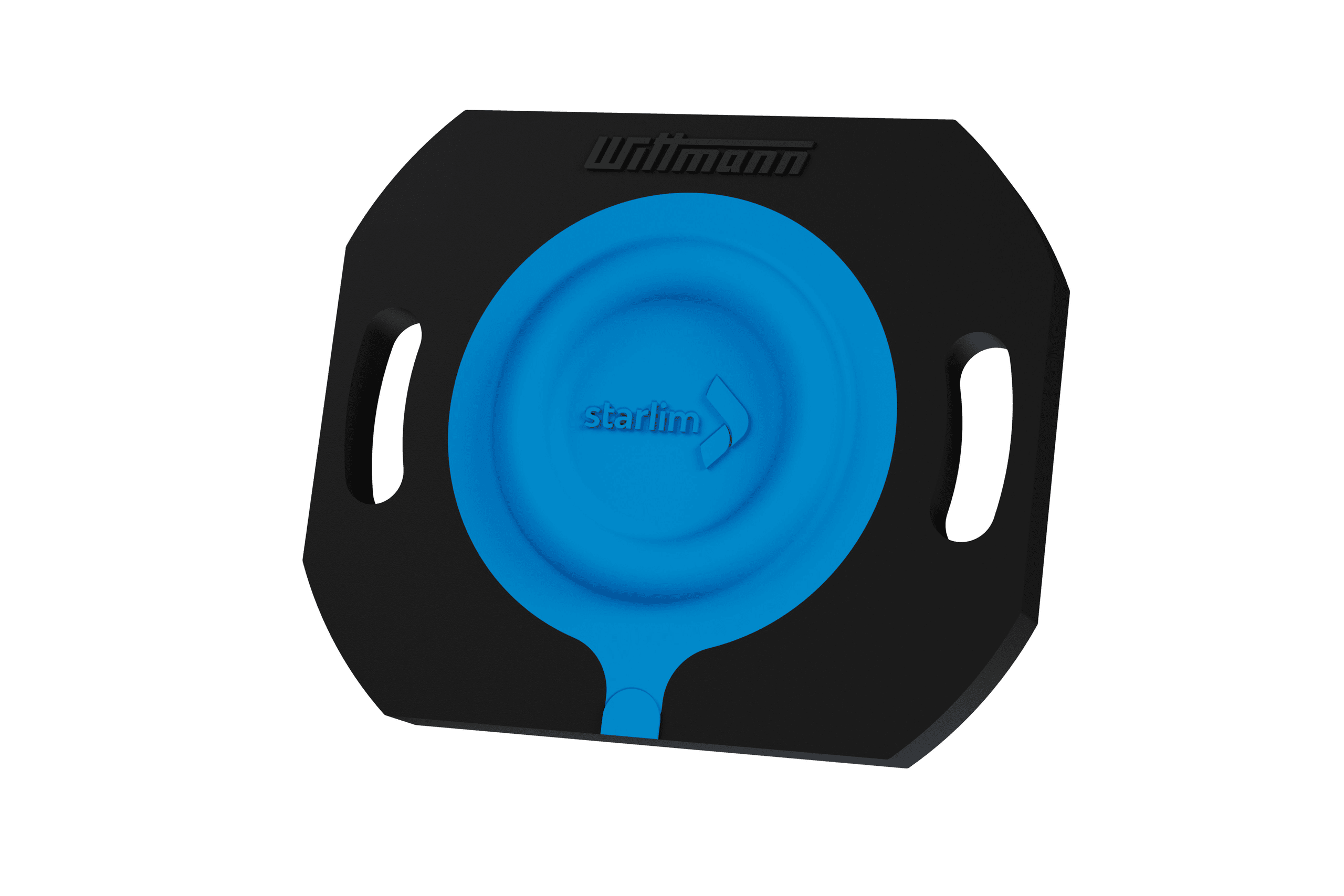
Two-component component for hearing aids: The highest level of injection molding precision is essential for accurate sound reproduction.
(Bild: Starlim)
New applications in medical technology, automotive electronics, and other industries are driving rising demand for micro-components made of silicone. Starlim, the world’s largest processor of liquid silicone rubber (LSR), is ready to meet this demand. At its headquarters in Marchtrenk, Upper Austria, a dedicated department focuses on micro molding—equipped with Micro Power injection molding machines from Wittmann and its own cleanroom.
Micro-injection molding follows its own set of rules
“Anything weighing less than ten milligrams is ‘micro’ to us,” says Dominik Kreuzmayr, pointing to an O-ring and a hearing aid component with a blue LSR diaphragm as examples. Kreuzmayr is a team leader in marketing and established the Micro Molding department internally. He knows that there is no universally accepted definition of micro injection molding. At Starlim, the classification is based on many years of experience and a deep understanding of material behavior in very fine mold structures. After all, entirely different principles apply here.
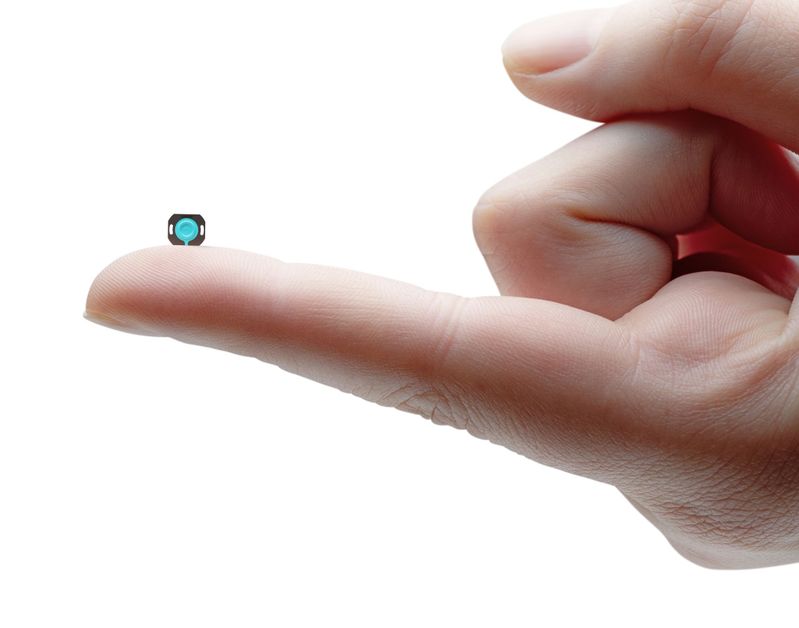
Both micro-parts are packaged in a transparent bag. Measuring 0.7 x 0.4 mm2 , the O-ring is too small to be grasped with the fingers. It is a prime example of the precision achieved in the mass production of micro-parts.
Hearing aid component as a two-part assembly: At its center is a membrane made of blue-colored liquid silicone. The tolerances are +/- 2 µm.
(Source: Starlim)
In direct comparison to the O-ring, the hearing aid component—measuring 6 x 5 x 1 mm3—seems almost large, but its design is impressive. It is a two-component part. At its center is a diaphragm made of blue-colored liquid silicone (LSR). This is encased in a sturdy, thermoplastic frame made of PBT, which simplifies installation in the hearing aid. The application determines the component size.
Highest precision in the submillimeter range
The hearing aid component was produced in a 1-cavity mold on a fully electric Micro Power injection molding machine from Wittmann. “For industrial-scale production, we’ll scale up to four cavities,” explains Kreuzmayr. Sixteen cavities would be too many, because when maximum precision in the submillimeter range is required, it is important that the cavities are very close together. The main challenges in producing hearing aid components are the tight tolerances around the flange on the diaphragm body.
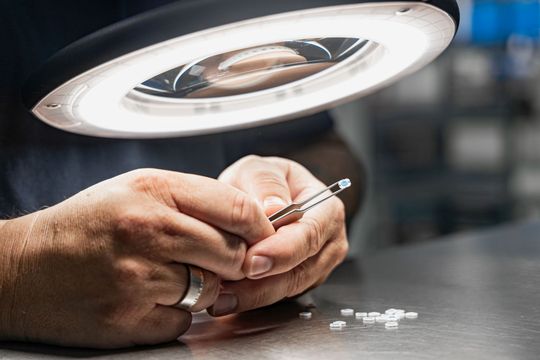
In the field of micro-molding, a magnifying glass isn't always enough to assess the quality of the components. Often, this can only be done under a microscope.
(Bild: Starlim)
“We have to be able to rely on the injection molding machine’s precision here, because—unlike when molding larger parts—the overmolded material allowance isn’t a factor,” emphasizes Günter Polt, an application engineer in the micro-injection molding division at Starlim. Polt has been working in the field of silicone injection molding for nearly 30 years. When he moved to the Micro Molding department a few years ago, it was “quite a shock,” as he reveals with a wink. “You can’t assess the quality of the parts with the naked eye. That’s often only possible under a microscope.”
“The Micro Power machines impress with their exceptional precision in implementing all adjustment parameters,” emphasizes Kreuzmayr. “This sensitive dynamics, combined with stable, accurate control, sets new standards—it really makes you rethink process reliability and reproducibility.”
When it comes to hearing aid components, high molding precision is not only crucial for an efficient assembly process. Even more important in this application is precision for accurate sound reproduction. The tolerances are +/- 2 µm, relative to the finished two-component part. This requires very precise adjustment and control of the clamping force, as well as a highly precise mold.
Innovative Tooling Technology with Integrated Quality Control
The mold comes from the company’s in-house toolmaking division, where the group’s roots lie. In 1974, Franz Sterner founded the toolmaking company Sterner Werkzeugbau. It wasn’t until ten years later that Starlim Spritzguss was established. Both business units have long since formed an inseparable whole. Today, tools are manufactured exclusively for the company’s own production. This is a major advantage for customers—they receive coordinated solutions from a single source and benefit from knowledge transfer and integrated development. It is only thanks to new laser technologies and micro-3D printing that it is now possible to build molds for such small hearing aid components with such high acoustic quality requirements.
When it comes to hearing aid components, we've truly achieved a breakthrough thanks to innovative tooling technology and highly efficient manufacturing techniques
Dominik Kreuzmayr, Marketing Team Leader at Starlim
For mass production, the plan is to test the vibration characteristics of the diaphragm inline—that is, immediately after injection molding, while it is still in the mold cavity. This is the most efficient approach because the tiny components are still in a defined position at that point and do not need to be repositioned for quality control. The tooling department has integrated a sound emitter and a laser measurement system into the robot gripper for the vibration test. “Thanks to innovative mold technology and highly efficient processing techniques, we’ve truly achieved a breakthrough with this hearing aid component,” says Kreuzmayr.
Date: 08.12.2025
Naturally, we always handle your personal data responsibly. Any personal data we receive from you is processed in accordance with applicable data protection legislation. For detailed information please see our privacy policy.
Consent to the use of data for promotional purposes
I hereby consent to Vogel Communications Group GmbH & Co. KG, Max-Planck-Str. 7-9, 97082 Würzburg including any affiliated companies according to §§ 15 et seq. AktG (hereafter: Vogel Communications Group) using my e-mail address to send editorial newsletters. A list of all affiliated companies can be found here
Newsletter content may include all products and services of any companies mentioned above, including for example specialist journals and books, events and fairs as well as event-related products and services, print and digital media offers and services such as additional (editorial) newsletters, raffles, lead campaigns, market research both online and offline, specialist webportals and e-learning offers. In case my personal telephone number has also been collected, it may be used for offers of aforementioned products, for services of the companies mentioned above, and market research purposes.
Additionally, my consent also includes the processing of my email address and telephone number for data matching for marketing purposes with select advertising partners such as LinkedIn, Google, and Meta. For this, Vogel Communications Group may transmit said data in hashed form to the advertising partners who then use said data to determine whether I am also a member of the mentioned advertising partner portals. Vogel Communications Group uses this feature for the purposes of re-targeting (up-selling, cross-selling, and customer loyalty), generating so-called look-alike audiences for acquisition of new customers, and as basis for exclusion for on-going advertising campaigns. Further information can be found in section “data matching for marketing purposes”.
In case I access protected data on Internet portals of Vogel Communications Group including any affiliated companies according to §§ 15 et seq. AktG, I need to provide further data in order to register for the access to such content. In return for this free access to editorial content, my data may be used in accordance with this consent for the purposes stated here. This does not apply to data matching for marketing purposes.
Right of revocation
I understand that I can revoke my consent at will. My revocation does not change the lawfulness of data processing that was conducted based on my consent leading up to my revocation. One option to declare my revocation is to use the contact form found at https://contact.vogel.de. In case I no longer wish to receive certain newsletters, I have subscribed to, I can also click on the unsubscribe link included at the end of a newsletter. Further information regarding my right of revocation and the implementation of it as well as the consequences of my revocation can be found in the data protection declaration, section editorial newsletter.
Compact, with a production area of two square meters
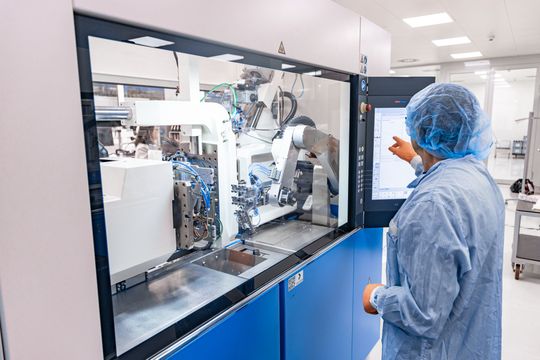
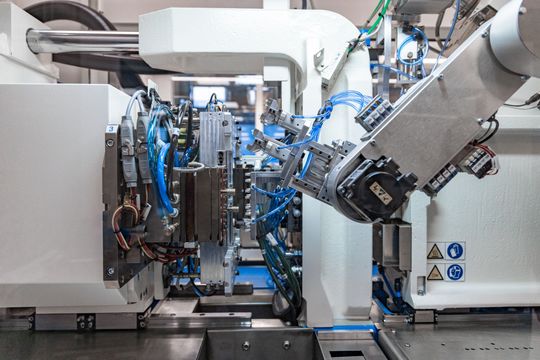
The MicroPower is not just an injection molding machine, but a complete production cell. It combines all process components in an extremely compact space.
(Bild: Starlim)
The Micro Power’s design concept is particularly well-suited to integrating additional process steps, such as quality control. With a footprint of just 2 m², the fully electric work cell combines the clamping unit equipped with a rotary table, the patented 2-stage injection system, material handling, automation, the temperature control unit, quality assurance, and other process units. At the same time, the mold mounting area—with a plate spacing of 400 mm—remains easily accessible. Linear guides ensure highly sensitive mold protection, and thanks to 5-point precision toggle levers, the clamping force is distributed very evenly across the parting line.
“The machine’s design allows the injection piston to reach all the way to the mold’s parting line,” says Jochen Sassmann, who, as regional sales manager at the Wittmann Group, works closely with the Micro Molding team at Starlim—highlighting another feature that contributes to high processing efficiency. As a result, the gate is significantly reduced in size, if not eliminated entirely. Since cured LSR cannot be recycled, silicone injection molding in particular benefits from this material-saving process.
The Micro Power offers a great deal of flexibility for automation. In addition to the vertically integrated SCARA robot, custom-developed solutions can also be integrated via interfaces.
(Bild: Starlim)
It has been 15 years since Starlim founded its Micro Molding division. Several Micro Power injection molding machines are currently in operation at Starlim in Marchtrenk, some of them in the new cleanroom, where, among other things, precision products for eye surgery are manufactured. Each machine is tailored to the requirements of specific product groups. There are fully equipped machines for single-component injection molding, two-component machines, and a combined system consisting of two individual machines linked by a robot. The combined system increases flexibility. Two-component parts can be produced very efficiently, but the two machines can also be utilized independently of one another with single-component molds.
When it comes to automation, the Micro Power concept offers a great deal of flexibility. In addition to the vertically mounted SCARA robot, which is an integral part of the production cell, various handling systems—including those developed in-house by Starlim—can be integrated via interfaces.
Multi-component machine or integrated system?
For every new project, we evaluate which production concept—a multi-component machine or a composite system—achieves greater overall efficiency. The share of two-component products currently stands at around 40 percent. The Micro Molding Team at Starlim is confident that this figure will rise. Two-component parts are already in greater demand, but they also require more development time.
Mass production—which was originally the deciding factor in the partnership with the Wittmann Group in the field of micro molding—continues to dominate day-to-day production in Marchtrenk. Batch sizes in the millions are not uncommon. “Micro Power machines operate reliably under these extreme conditions and enable us to run a secure process,” says Dominik Kreuzmayr, who also emphasizes the strong partnership with the Wittmann Group. “We communicate through short, direct channels and have so far found a solution together for every challenge. Thanks to our strong partnership, we’re able to get the most out of what the machines have to offer technologically.”
Susanne Zinckgraf Head of Strategic Marketing, Wittmann Tec Group



:quality(80)/p7i.vogel.de/wcms/78/ce/78ce24a7ba8343ef49bc3dbb49016443/pasja1000-the-bottle-5128607v1.jpeg "The new plastic tax would amount to 0.28 cents for a yogurt cup and 1.93 cents for a large PET bottle. (Bild: pasja1000)")
:quality(80)/p7i.vogel.de/wcms/cc/db/ccdb09d1d9b3fcabf147abba7fd9e3c5/pasja1000-the-bottle-5128607v1.jpeg "The new plastic tax would amount to 0.28 cents for a yogurt cup and 1.93 cents for a large PET bottle. (Bild: pasja1000)")
:quality(80)/p7i.vogel.de/wcms/be/0a/be0a2864a5f59b0c9bca685dd23bdf79/pasja1000-the-bottle-5128607v1.jpeg "The new plastic tax would amount to 0.28 cents for a yogurt cup and 1.93 cents for a large PET bottle. (Bild: pasja1000)")
:quality(80)/p7i.vogel.de/wcms/b6/fe/b6fe83997fc68192cf8cd8a89b0bab5f/pasja1000-the-bottle-5128607v1.jpeg "The new plastic tax would amount to 0.28 cents for a yogurt cup and 1.93 cents for a large PET bottle. (Bild: pasja1000)")
:quality(80)/p7i.vogel.de/wcms/ce/ee/ceeeef086bfb174ebdda31c0dfccaf9a/2-weiss-blick-in-produktion-dji-0095-kopiev1.jpeg "A look inside the injection molding shop at Weiss Kunststoffverarbeitung in Illertissen, Bavaria. (Bild: White)")
:quality(80)/p7i.vogel.de/wcms/33/08/3308710c85715e917ec1baf9767fe4a7/2026-ewikon-wago-hei-kanalv1.png "Ewikon's 48-cavity hot runner as a production mold. (Bild: Ewikon)")
:quality(80)/p7i.vogel.de/wcms/a2/a5/a2a516dc69b4c8f8ad6f475ae6746a08/sxkh-bei-hpf-gesamtwerkzeugv1.png "The HMG 70XS1510 trimming press from the Chinese manufacturer SXKH combines all the functions required by toolmakers at HPF in a very compact design. The deciding factors in the purchase were the purchase price—and confidence in the quality of established international key components. (Bild: Pergler Media)")
:quality(80)/p7i.vogel.de/wcms/19/5f/195fdb6e09629994f1d6e3cf94dac8d8/bild-1-exam510-ultem9085v1.jpeg "Granular printing (FGF) makes it cost-effective to produce large-format functional parts from high-performance polymers such as Ultem 9085. (Bild: NEW AIM3D)")
:quality(80)/p7i.vogel.de/wcms/d5/c4/d5c46d40e1ae062370d058e2c006c376/dimitrisvetsikas1969-belgium-3595351v1.jpeg "European Plastics Industry Calls for Immediate Action to Address the Industry Crisis (Bild: dimitrisvetsikas1969)")
:quality(80)/p7i.vogel.de/wcms/e6/63/e663f0e1dd8818fc501c6fb5c5d33712/19-5689-circular-economy-of-resourcesv1.jpeg "Plastic waste from the average household is very heterogeneous. Only the right mix of technologies can turn all types of plastic waste into a new source of raw materials. (Bild: BASF)")
:quality(80)/p7i.vogel.de/wcms/31/5b/315b714f653484179232fbc4d6d79543/sesotec-img-andreas-hanus-25-20-281-29v1.jpeg "Andreas Hanus, Head of AI Development at Sesotec: “AI will not replace traditional sorting technology, but will intelligently enhance it.” (Bild: Sesotec)")
:quality(80)/p7i.vogel.de/wcms/74/5f/745f512239689819275af39a82f59860/b-brenkenv1.jpeg "Dr. Benedikt Brenken, Director of R-Cycle: \"The digital product passport will fundamentally change plastic recycling.\" (Bild: R-Cycle)")
:quality(80)/p7i.vogel.de/wcms/40/6d/406d05534ab4d28194bd29699e023e67/2026-09-09-uni-kiel-aufmacherv1.jpeg "These self-polarizing polymer coatings could be used in a wide variety of electronic components in the future. (Bild: University of Kiel/C. Anders)")
:quality(80)/p7i.vogel.de/wcms/5d/46/5d46e098a7cfaebdd9643df47153c5af/aufmacherv1.png "The PPWR imposes new requirements on packaging: What impact does this have on mechanical engineering? (Bild: KI-generiert / Dall-E)")
:quality(80)/p7i.vogel.de/wcms/70/13/7013fe202fb4790708f62f69cd0c83d4/aufmacher-st-c3-a4rkeschaumfoliev1.png "Using thermoplastic starch as a base, researchers at the IKV successfully produced a flexible foam film using physical blowing agents. (Bild: IKV)")
:quality(80)/p7i.vogel.de/wcms/d1/2b/d12b536ba3b382d0d138e342ac1038e6/03--20pm-imm-mgsv1.jpeg "MGS Richfield Site (Bild: MGS)")
:quality(80)/p7i.vogel.de/wcms/90/9c/909cf6eb1b91a9a84ff535033ea9b048/honeycombv1.jpeg "The composite material made of epoxy and glass fibers not only protects against flames but is also fully recyclable. (Bild: Empa)")
:quality(80)/p7i.vogel.de/wcms/6a/d5/6ad5980b0c965409c71582fc59145e13/1920-covestro-new-covestro-headquartersv1.jpeg "Covestro's corporate headquarters in Leverkusen (Bild: Covestro)")
:quality(80)/p7i.vogel.de/wcms/db/74/db741079d26ad9e7a69278fde45e79c7/aufmacherv1.png "(Bild: KI-generiert / Dall-E)")
:quality(80)/p7i.vogel.de/wcms/b3/65/b3654df434f4d31e1fda3c79bc7bb4b0/nakura-20kunstrasenteppich-20ohne-20verf-c3-bcllungv1.jpeg "Tecnaro has developed synthetic turf fibers using a specially formulated Arboblend blend that offers high resistance to heat, UV rays, and weathering, and, because it is niobium-based, sequesters CO₂ over the long term. (Bild: Tecnaro)")
:quality(80)/p7i.vogel.de/wcms/a2/a5/a2a516dc69b4c8f8ad6f475ae6746a08/sxkh-bei-hpf-gesamtwerkzeugv1.png "The HMG 70XS1510 trimming press from the Chinese manufacturer SXKH combines all the functions required by toolmakers at HPF in a very compact design. The deciding factors in the purchase were the purchase price—and confidence in the quality of established international key components. (Bild: Pergler Media)")
:quality(80)/p7i.vogel.de/wcms/b6/fe/b6fe858573ab1dbb65b090cb05e71cf6/3c52b2f78e99f3fc47b1778433adcd43e358e020v1.jpeg "The Stargate HRS needle-less hot-runner nozzle concept uses an innovative mechanical system to open and close the nozzle. (Image:Oerlikon HRSflow)")