Injection MoldingResearch for Practical Application
From
Prof. Dr.-Ing. Christian Hopmann, Director of the IKV and Chair of Plastics Processing; Moritz Mascher, M.Sc., Thermoset Injection Molding + Cross-Phase Process Control; Matthias Schöll, M.Sc., Cascade Injection Molding
| Translated by AI
4 min Reading Time
Researchers at the Institute for Plastics Processing (IKV) in Industry and Trade at RWTH Aachen University provide exclusive coverage of current topics for PLASTVERARBEITER.
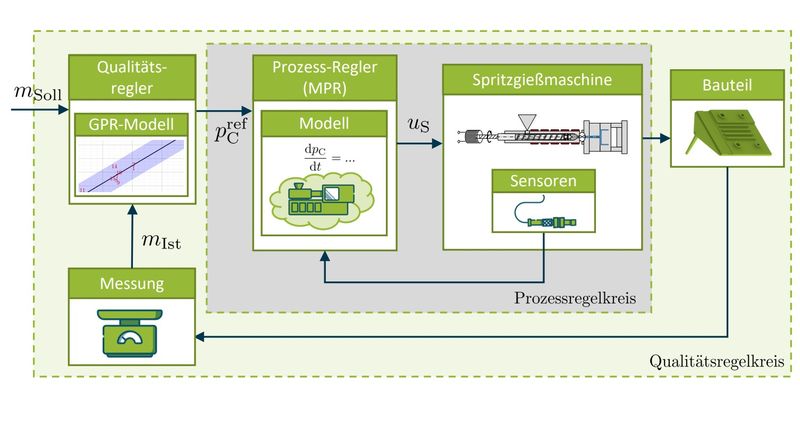
The control concept for thermoplastic injection molding is based on a learning, model-predictive control system
(Bild: IKV)
Process Variable Control Concept for Thermoset Injection Molding
In injection molding, a process-variable-based control system—rather than a machine-based one—can increase both productivity and molded part quality. In the IGF project “Thermoset Control,” the IKV, in collaboration with the Institute for Control Engineering (IRT) at RWTH Aachen University, adapted this type of process-variable-based control—which had previously existed only for thermoplastics—for thermoset processing as well. Based on injection molding tests, the project identified the internal mold pressure profile as a suitable control variable for real-time process control. To this end, part quality was evaluated based on weight, mechanical properties, and surface quality and correlated with the process variables.
Model predictive control (MPC; Figure 1) of the mold cavity pressure along a specified reference pressure curve was achieved by adjusting the screw speed via an external analog voltage signal applied to the injection molding machine’s servo drive. The reference pressure specified by the operator could be precisely regulated without overshoot by controlling the screw speed via the control voltage. The injection molding process was described using a physical model that accounted for the specific material properties of thermosets, as well as volumetric flow rates and reaction kinetics, in order to incorporate process knowledge into the control system.
By determining the part mass at three different pressure levels, a Gaussian process regression (GPR) model was trained without any prior knowledge of the process. The Gaussian process regression model identified a correlation between the mold cavity pressure reference and the measured part mass. Various phenolic and epoxy resins were investigated as materials. Process variations in the injection molding process were simulated by varying the machine parameters.
The process model was continuously improved through machine learning during production. The MPC achieved good results in the tests and outperformed a simple proportional-integral-derivative (PID) controller. As measured by the cross-cycle consistency of the mold internal pressure integral and the part mass, greater process stability was achieved by controlling the mold internal pressure.
The IGF project 22193 N was funded by the Federal Ministry for Economic Affairs and Energy (BMWE) as part of the Joint Industrial Research and Development (IGF) program.
Cross-Phase Process Control in the Injection Molding of Recycled Materials
When processing post-consumer recycled materials (PCR) , there are significant differences in the properties of the material batches. To ensure consistently high component quality in injection molding despite batch-to-batch variations, the phase-matching process control concept for recycled plastic pellets—developed at the IKV as part of a DFG project—has been expanded.
The underlying phase-integrating process control strategy—which employs continuous mold pressure control during the injection and holding phases—solves, for the first time, the switching problem associated with conventional process control in injection molding. Using model predictive control (MPR), a high degree of reproducibility in both the process and part quality was demonstrated.
To expand this process control concept for the processing of recycled materials, batch-to-batch variations were first recorded in the testing laboratory and during injection molding trials, and the relationships between the material, process parameter trends, and part quality were mapped. No clear correlation could be established either between the material properties of the recycled materials and part quality or between the process parameters for recycled material processing and part quality, as there are interactions with the material composition. However, the parameters for screw pressure and mold cavity pressure profiles can be monitored to detect changes in the injection molding process and thus account for batch-to-batch variations in the process control strategy.
Date: 08.12.2025
Naturally, we always handle your personal data responsibly. Any personal data we receive from you is processed in accordance with applicable data protection legislation. For detailed information please see our privacy policy.
Consent to the use of data for promotional purposes
I hereby consent to Vogel Communications Group GmbH & Co. KG, Max-Planck-Str. 7-9, 97082 Würzburg including any affiliated companies according to §§ 15 et seq. AktG (hereafter: Vogel Communications Group) using my e-mail address to send editorial newsletters. A list of all affiliated companies can be found here
Newsletter content may include all products and services of any companies mentioned above, including for example specialist journals and books, events and fairs as well as event-related products and services, print and digital media offers and services such as additional (editorial) newsletters, raffles, lead campaigns, market research both online and offline, specialist webportals and e-learning offers. In case my personal telephone number has also been collected, it may be used for offers of aforementioned products, for services of the companies mentioned above, and market research purposes.
Additionally, my consent also includes the processing of my email address and telephone number for data matching for marketing purposes with select advertising partners such as LinkedIn, Google, and Meta. For this, Vogel Communications Group may transmit said data in hashed form to the advertising partners who then use said data to determine whether I am also a member of the mentioned advertising partner portals. Vogel Communications Group uses this feature for the purposes of re-targeting (up-selling, cross-selling, and customer loyalty), generating so-called look-alike audiences for acquisition of new customers, and as basis for exclusion for on-going advertising campaigns. Further information can be found in section “data matching for marketing purposes”.
In case I access protected data on Internet portals of Vogel Communications Group including any affiliated companies according to §§ 15 et seq. AktG, I need to provide further data in order to register for the access to such content. In return for this free access to editorial content, my data may be used in accordance with this consent for the purposes stated here. This does not apply to data matching for marketing purposes.
Right of revocation
I understand that I can revoke my consent at will. My revocation does not change the lawfulness of data processing that was conducted based on my consent leading up to my revocation. One option to declare my revocation is to use the contact form found at https://contact.vogel.de. In case I no longer wish to receive certain newsletters, I have subscribed to, I can also click on the unsubscribe link included at the end of a newsletter. Further information regarding my right of revocation and the implementation of it as well as the consequences of my revocation can be found in the data protection declaration, section editorial newsletter.
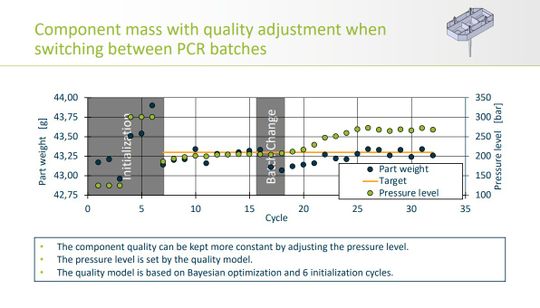
Adjusting the internal tool pressure level based on the BO can compensate for material variations.
(Bild: IKV)
As part of the project, the alternative approach of direct quality tracking was therefore pursued. Bayesian optimization (BO) was used for this purpose, which does not require explicit modeling of the correlations between the tool internal pressure reference and component quality. Instead, the causal relationships are modeled indirectly via a data-driven surrogate model. Based on an extended model-predictive mold pressure control system and a superimposed reference optimization, Bayesian optimization was used to successfully demonstrate the tracking of part quality across different PCR batches and parts (Figure 2). The achieved reproducibility of process and part quality surpasses that of conventional process control methods in plastic injection molding. Project HO 4776/44-2 was funded by the German Research Foundation (DFG).
Control Strategy for Cascade Injection Molding
Cascade injection molding is the preferred process for manufacturing components with long flow paths without visible weld lines. To compensate for process fluctuations, such as those caused by processing different material batches, the IKV has developed an internal mold pressure control system for cascade injection molding as part of an IGF project. In this system, pressure transfer into the cavity at each gate is regulated by adjusting the pressure transfer via variable opening strokes of the hot runner shut-off needles.
To improve control quality, the geometries of the needle guide and the shut-off needle were numerically optimized in a first step, thereby linearizing the relationship between the opening stroke and the flow resistance. The optimization was based on a physical process model describing the system’s behavior. The improved control quality—resulting from the uniform influence of the needle movements on the control quality—allows for further improvement in process consistency.
To develop the mold pressure control system for cascade injection molding, the process control strategy was first designed. Because filling occurs through multiple gates, the pressure transfer into the cavity can be individually controlled at each gate. Injection molding simulations were used to analyze the influence of individual needle movements on the pressure and temperature distribution within the cavity. Since the needle movements affect process conditions only in areas close to the nozzles due to material cooling during sequential filling, all needles are moved equally for the control system. Applying this control system improves process consistency in cascade injection molding. IGF Project 22805 N was funded by the Federal Ministry for Economic Affairs and Energy (BMWE) as part of the Joint Industrial Research and Development (IGF) program.