Sustainable Packaging SolutionsBio-Netz Combines Compostability and High Performance
A guest post by
Dr. Rudi Eswein, Director of Sustainability, Plastrans Technologies GmbH
| Translated by AI
4 min Reading Time
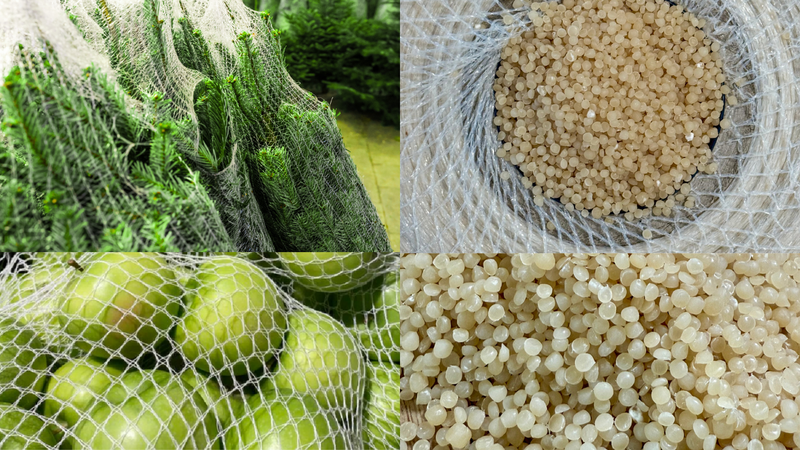
A newly developed bio-based net combines, for the first time, the mechanical performance of conventional plastic nets with certified compostability. This material innovation, based on thermoplastic starch, can be processed on existing production lines and opens up new possibilities for sustainable packaging and agricultural applications.
The Bio-Net thus combines key characteristics of conventional plastic nets—particularly mechanical performance and efficient use of materials—with the advantages of biodegradability and compostability.
(Bild: Plastrans)
Knitted plastic nets have become indispensable in packaging and agricultural applications. Whether in the retail sector for fruits and vegetables or in agriculture for transport and covering solutions, they stand out for their low material usage combined with high functionality. At the same time, conventional nets are increasingly becoming the focus of sustainability discussions. A newly developed bio-net now combines high mechanical performance with biodegradability for the first time, thereby opening up new possibilities for this established product group.
Established materials with known limitations
Today, modern knitted nets are primarily made of polyethylene (HDPE) or polypropylene (PP), and in some cases also from recycled HDPE. These materials offer high strength, are cost-effective, and can be reliably processed on established production lines. Consequently, they are widely used in applications such as food packaging, transport nets, and covering systems.
At the same time, however, significant challenges arise at the end of the life cycle. In practice, the nets are often used for only a short time and are subsequently incinerated or landfilled. Although mechanical recycling is possible in principle, it often fails due to the typical geometry of the nets, contamination—such as from organic residues in the food industry—and process-related risks in sorting facilities, where nets can become entangled in moving components.
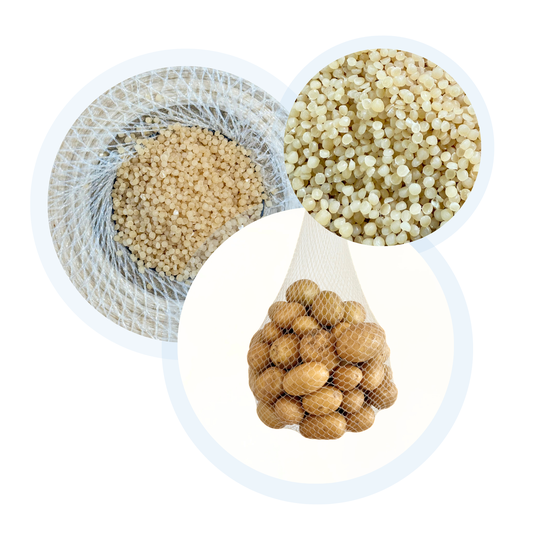
The newly developed organic net specifically addresses many challenges. It combines mechanical performance comparable to that of conventional plastic nets with the use of fully certified compostable raw materials.
(Bild: Plastrans)
Bio-based alternatives – technically limited
Cellulose nets are a well-known bio-based alternative. They are made from cellulose fibers—some of which come from wood waste—and are generally biodegradable. At the same time, they typically do not match the mechanical properties of conventional plastic nets. This significantly limits their use, particularly in more demanding applications.
Regardless of the material used, knitted nets also have a distinctive structural feature: when cut, the stitches open up, creating small fragments. While this is not a concern with cellulose, nets made of polyolefins can contribute to the release of persistent microplastic particles.
Organic Networks as a New Approach
The newly developed bio-net specifically addresses these challenges. It combines mechanical performance comparable to that of conventional plastic nets with the use of fully certified compostable raw materials.
This made it possible to produce filaments with a diameter of just 4 µm that can withstand loads of up to 70 kg. At the same time, the pricing structure is comparable to that of established alternative solutions, making the technology economically viable.
Cooperation Along the Value Chain
Bio-Netz is the result of an international collaboration: Meshpack GmbH (Germany) contributes its expertise in mesh production, while BiologiQ Inc. (U.S.) provides the material technology. Plastrans GmbH (Austria) is specifically responsible for coordinating and establishing the value chain. At the heart of the system is a compound based on thermoplastic starch (TPS), marketed under the name NuPlastiQ.
Thermoplastic starch as a functional matrix component
Thermoplastic starch is not a traditional thermoplastic, but rather plastified starch in which the originally crystalline structures have been converted into an amorphous state. This makes the material processable in principle, but it does not meet the requirements of many technical applications in its pure form.
Given this, TPS is typically used in combination with a carrier polymer in which the starch is present as a dispersed phase. The quality of the dispersion is critical to the material's performance.
Key: Ultra-fine dispersion for ultra-thin structures
Particle size plays a key role, especially in applications involving extremely thin filaments—such as in this case, where diameters are in the micrometer range. If the TPS particles are not significantly smaller than the filament dimensions, inhomogeneities arise that can lead to mechanical weaknesses.
BiologiQ's material technology enables a sufficiently fine and stable dispersion, which is essential for successful processing and the required mechanical performance.
Date: 08.12.2025
Naturally, we always handle your personal data responsibly. Any personal data we receive from you is processed in accordance with applicable data protection legislation. For detailed information please see our privacy policy.
Consent to the use of data for promotional purposes
I hereby consent to Vogel Communications Group GmbH & Co. KG, Max-Planck-Str. 7-9, 97082 Würzburg including any affiliated companies according to §§ 15 et seq. AktG (hereafter: Vogel Communications Group) using my e-mail address to send editorial newsletters. A list of all affiliated companies can be found here
Newsletter content may include all products and services of any companies mentioned above, including for example specialist journals and books, events and fairs as well as event-related products and services, print and digital media offers and services such as additional (editorial) newsletters, raffles, lead campaigns, market research both online and offline, specialist webportals and e-learning offers. In case my personal telephone number has also been collected, it may be used for offers of aforementioned products, for services of the companies mentioned above, and market research purposes.
Additionally, my consent also includes the processing of my email address and telephone number for data matching for marketing purposes with select advertising partners such as LinkedIn, Google, and Meta. For this, Vogel Communications Group may transmit said data in hashed form to the advertising partners who then use said data to determine whether I am also a member of the mentioned advertising partner portals. Vogel Communications Group uses this feature for the purposes of re-targeting (up-selling, cross-selling, and customer loyalty), generating so-called look-alike audiences for acquisition of new customers, and as basis for exclusion for on-going advertising campaigns. Further information can be found in section “data matching for marketing purposes”.
In case I access protected data on Internet portals of Vogel Communications Group including any affiliated companies according to §§ 15 et seq. AktG, I need to provide further data in order to register for the access to such content. In return for this free access to editorial content, my data may be used in accordance with this consent for the purposes stated here. This does not apply to data matching for marketing purposes.
Right of revocation
I understand that I can revoke my consent at will. My revocation does not change the lawfulness of data processing that was conducted based on my consent leading up to my revocation. One option to declare my revocation is to use the contact form found at https://contact.vogel.de. In case I no longer wish to receive certain newsletters, I have subscribed to, I can also click on the unsubscribe link included at the end of a newsletter. Further information regarding my right of revocation and the implementation of it as well as the consequences of my revocation can be found in the data protection declaration, section editorial newsletter.
Processing on Existing Equipment
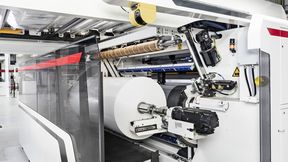
At Meshpack, the compound is first processed into films, which are then cut into thousands of individual filaments and stretched in the next step. By carefully adjusting process parameters—particularly with regard to pre-tensioning and temperature control—the material was successfully processed on existing equipment originally designed for polyolefins.
Process stability poses a particular challenge here: If a single filament breaks, the entire process must be stopped and the filament rethreaded by hand. Consequently, the requirements for material consistency and processing quality are very high.
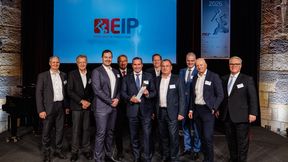
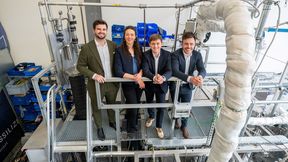
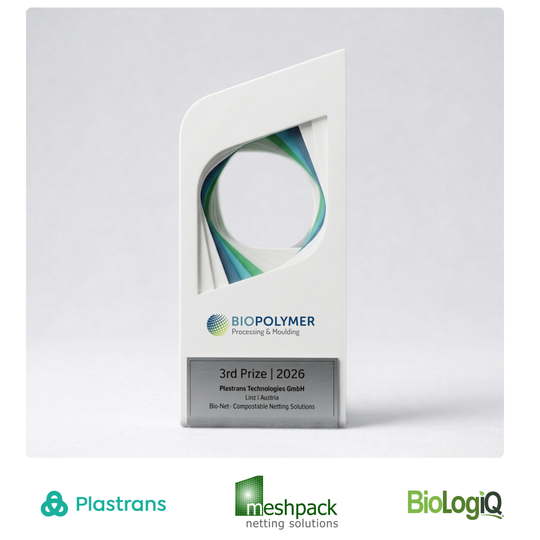
Bio-Netz was awarded third place in the Biopolymer Innovation Awards during the International Biopolymer Congress.
(Bild: Plastrans)
Potential for More Sustainable Network Applications
The Bio-Net thus combines key characteristics of conventional plastic nets—particularly mechanical performance and efficient use of materials—with the advantages of biodegradability and compostability.
This opens up new possibilities for applications in which fossil-based materials have traditionally dominated and offers a practical option for reconciling sustainability requirements with technical and economic demands.
The Bio-Netz was awarded third place in the Biopolymer Innovation Awards during the International Biopolymer Congress.