What role does AI play in sorting technology today—and what are its limitations? Andreas Hanus, Head of AI Development at Sesotec, explains why powerful AI encompasses far more than just object recognition and what matters most in its practical application.
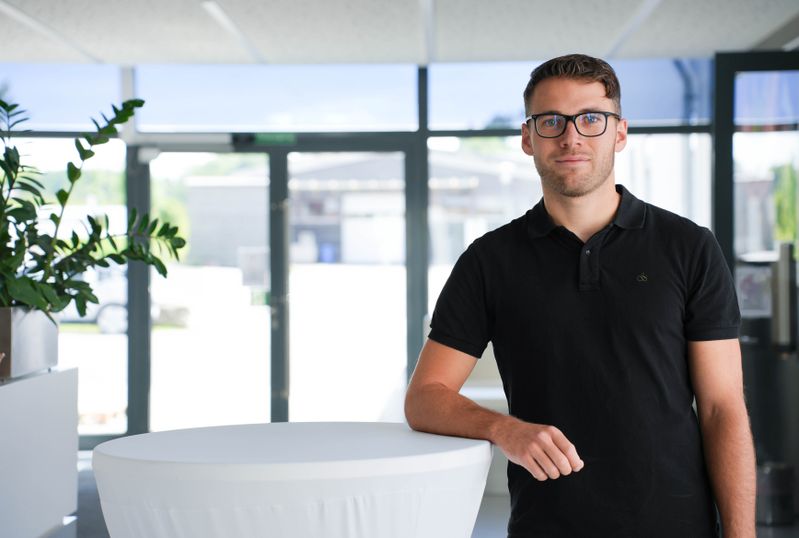
Andreas Hanus, Head of AI Development at Sesotec: “AI will not replace traditional sorting technology, but will intelligently enhance it.”
(Bild: Sesotec)
In sorting technology, artificial intelligence (AI) represents the logical next step in the evolution of established methods—such as near-infrared spectroscopy, where AI makes material identification significantly more precise. Particularly with multilayer packaging in the PET sector, where different plastic layers have traditionally been difficult to distinguish, AI detects subtle differences much more reliably.
What are the benefits of this? When does AI reach its limits? And how will this change the circular economy for plastics in the long term? We spoke with Andreas Hanus, Head of Development AI at Sesotec, about these topics.
PlastXnow: What specific advantages does AI offer over traditional sorting methods?
Andreas Hanus: The real technological breakthrough, however, lies in AI-powered object recognition. It evaluates—much like a human—color, shape, texture, imprints, and other characteristics simultaneously. While traditional, rule-based systems are usually limited to individual measurable criteria, AI can combine this information to make a significantly more informed decision.
The key advantage is that well-trained AI sorting systems today make decisions that were previously often only possible through manual re-sorting—but with the speed, consistency, and reproducibility of a machine. Simply put: The system gains a measure of human judgment without inheriting its limitations in terms of speed and endurance.
Where are the current limitations of plastic waste sorting technology—and how can AI help overcome them?
A recent example is the European Packaging Regulation (PPWR). In the future, it will require mandatory minimum recycled content percentages for numerous plastic packaging—including food packaging that comes into direct contact with food. This requires particularly clean and carefully sorted material streams.
Traditional sorting technology reaches its limits here, because even when the polymer type and color are similar, it often cannot determine whether an item originally came from the food or non-food sector. A cleaning solution bottle and a food package made from the same PET can be nearly identical in appearance and material—the crucial information about the original use cannot be reliably determined based on material or color alone.
How can AI help overcome these obstacles?
AI-based object recognition opens up new possibilities. It takes into account additional characteristics such as shape, printed markings, or typical design elements and can use this information to infer the original application. In Sesotec’s PAC2PAC project, we were able to demonstrate that reliable food/non-food sorting is technically feasible—an important step toward meeting the requirements of the PPWR and enabling high-quality packaging-to-packaging recycling.
But we must also be honest: AI object recognition has its limits. Where even humans can no longer distinguish differences based on visible or sensor-detectable features—such as in the case of heavily soiled, faded, or damaged packaging without recognizable markings—AI also struggles. Object recognition is ultimately limited to the information available from cameras and sensors. This limitation does not automatically shift simply because a system is called “AI.”
The quality of recycled materials determines their subsequent use. How do AI-powered sorting systems help generate higher-quality material streams?
In addition to tapping into new material streams, AI object recognition also improves the quality of existing recycled plastics. It specifically removes contaminants such as silicone cartridges, pump bottles, or oil canisters, which—despite being the correct polymer type—can compromise the quality of the recycled material due to residual contents, additives, or their original use.
At the same time, items that are particularly valuable or suitable for specific recycling loops can be selectively separated. This ability to recognize individual object types rather than merely material classes gives AI a decisive advantage over conventional sorting methods. As a result, heterogeneous input materials are transformed into higher-quality and more marketable recycled materials that are also suitable for more demanding applications and support the transition from downcycling to true circular economies.
Looking ahead to the coming years: What developments do you expect to see in AI-powered sorting?
It will be crucial to continuously expand the data set and adapt the models on an ongoing basis to changing material flows. Seasonal, regional, and quality-related fluctuations necessitate regular monitoring and targeted retraining. Issues such as data quality, model versioning, and controlled releases are therefore becoming significantly more important.
Equally important will be the continuous evaluation of quality metrics such as purity, yield, and food-grade content. In the future, sorting and analysis systems will need to work more closely together so that insights from the final result can be directly incorporated into the optimization of the sorting strategy. The operators’ process knowledge remains crucial in this regard and can be specifically integrated into the AI.
Another key component is the integration with other sensor technologies, such as NIR or metal sensors. Viewing AI object recognition in isolation is insufficient—it only truly demonstrates its strength when used in conjunction with other methods that capture different aspects of a material.
How will this change the circular economy for plastics in the long term?
However, a powerful algorithm alone is not enough. What matters most is how robust and reliable AI applications are under real-world operating conditions—even when material qualities and environmental conditions vary.
For the circular economy, this means that material streams that were previously difficult to harness can now be better utilized, existing material streams can be cleaned more effectively, and facilities can be adapted more flexibly to new packaging concepts and regulatory requirements. AI will not replace traditional sorting technology, but will intelligently enhance it—making sorting facilities more efficient, flexible, and sustainable.
Info
Profile
Sesotec’s customers in the food, plastics, and recycling industries face the challenge of balancing sustainability with profitability. With intelligent technologies and services for foreign object detection, material sorting, and analysis, the company helps ensure resource-efficient and highly efficient production. Since 1976, Sesotec has been developing and manufacturing high-tech systems for a wide range of requirements in close cooperation with customers around the world. In addition to its headquarters in Germany, the sorting specialist is represented in 17 other countries and through more than 60 partners in all major markets worldwide.
Service
For more information on the use of AI in Sesotec products, click here.
Date: 08.12.2025
Naturally, we always handle your personal data responsibly. Any personal data we receive from you is processed in accordance with applicable data protection legislation. For detailed information please see our privacy policy.
Consent to the use of data for promotional purposes
I hereby consent to Vogel Communications Group GmbH & Co. KG, Max-Planck-Str. 7-9, 97082 Würzburg including any affiliated companies according to §§ 15 et seq. AktG (hereafter: Vogel Communications Group) using my e-mail address to send editorial newsletters. A list of all affiliated companies can be found here
Newsletter content may include all products and services of any companies mentioned above, including for example specialist journals and books, events and fairs as well as event-related products and services, print and digital media offers and services such as additional (editorial) newsletters, raffles, lead campaigns, market research both online and offline, specialist webportals and e-learning offers. In case my personal telephone number has also been collected, it may be used for offers of aforementioned products, for services of the companies mentioned above, and market research purposes.
Additionally, my consent also includes the processing of my email address and telephone number for data matching for marketing purposes with select advertising partners such as LinkedIn, Google, and Meta. For this, Vogel Communications Group may transmit said data in hashed form to the advertising partners who then use said data to determine whether I am also a member of the mentioned advertising partner portals. Vogel Communications Group uses this feature for the purposes of re-targeting (up-selling, cross-selling, and customer loyalty), generating so-called look-alike audiences for acquisition of new customers, and as basis for exclusion for on-going advertising campaigns. Further information can be found in section “data matching for marketing purposes”.
In case I access protected data on Internet portals of Vogel Communications Group including any affiliated companies according to §§ 15 et seq. AktG, I need to provide further data in order to register for the access to such content. In return for this free access to editorial content, my data may be used in accordance with this consent for the purposes stated here. This does not apply to data matching for marketing purposes.
Right of revocation
I understand that I can revoke my consent at will. My revocation does not change the lawfulness of data processing that was conducted based on my consent leading up to my revocation. One option to declare my revocation is to use the contact form found at https://contact.vogel.de. In case I no longer wish to receive certain newsletters, I have subscribed to, I can also click on the unsubscribe link included at the end of a newsletter. Further information regarding my right of revocation and the implementation of it as well as the consequences of my revocation can be found in the data protection declaration, section editorial newsletter.