Trends in the Circular Economy"The digital product passport provides the missing piece of the puzzle"
The interview was conducted by
Melanie Ehrhardt
| Translated by AI
5 min Reading Time
How does plastic packaging become a high-quality secondary raw material? A key prerequisite for this is reliable information about material composition, additives, and processing steps. The digital product passport is therefore considered a key technology for the circular economy.
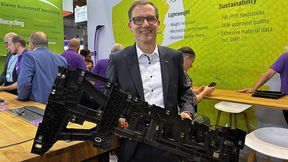
Dr. Benedikt Brenken, Director of R-Cycle: "The digital product passport will fundamentally change plastic recycling."
(Bild: R-Cycle)
The Digital Product Passport (DDP) is considered a key technology for the European circular economy. In plastics recycling in particular, the availability of reliable data is increasingly determining whether materials can be recycled into high-quality products.
What information is actually needed along the value chain, what specific added value do digital product passports provide for recyclers and packaging manufacturers—and where do the biggest hurdles to implementation lie? Dr. Benedikt Brenken, Director of R-Cycle, discusses these topics in an interview with PlastXnow.
PlastXnow: The digital product passport is considered a key component of the European circular economy. Why is it so important, particularly for plastics recycling?
Dr. Benedikt Brenken: Plastic is unmatched in terms of performance and versatility, and it has become an indispensable part of modern life—for example, as safe packaging for food or medical devices. The problem, however, lies in precise recycling. Today’s household waste is a highly complex waste stream. Without precise information about the exact type of plastic, its components, or its previous use, the waste cannot be sorted by type. The result is a low-quality mixture that cannot be recycled optimally and, in the worst case, must be thermally recycled—that is, burned without being put to use.
To what extent does the digital DDP change that?
The digital product passport provides the missing piece of the puzzle: information. By automatically recording recycling-relevant properties—such as material composition and additives used during manufacturing—and including them on the packaging, modern sorting facilities can analyze this information. Only this data-driven sorting makes it possible to create single-material fractions and thus produce high-quality recyclates for a truly closed-loop material cycle.
In your opinion, what information should a digital product passport contain, at a minimum, so that recyclers and processors can derive real value from it?
To create genuine added value along the entire value chain, a DPP must address two dimensions:
For recycling: At a minimum, precise details are required regarding the types of plastic used, the additives and dyes contained, as well as information about previous use—for example, food-grade status for food packaging. Important—the focus is on the ingredients, not on the exact formulations, which constitute proprietary know-how that packaging manufacturers must protect. This is the only way to ensure that waste is sorted accurately into the correct categories.
For regulatory requirements (such as the PPWR): This is precisely where the real benefit lies: The structured data collected for recycling purposes can also be used to meet legal documentation requirements. Starting August 12, 2026, this data will serve as the basis for the PPWR declaration of conformity regarding substances in packaging and, in the future, also for verifying the recycled content and recyclability. In the future, an increasing amount of information will need to be reported accordingly.
What challenges do you see in the implementation of the digital product passport—particularly with regard to data quality, standardization, and collaboration along the value chain?
The biggest challenge lies in the lack of an interoperable infrastructure for standardized data exchange across organizational boundaries. Since the production of plastic packaging typically involves many different stakeholders, manual data collection results in an enormous amount of work.
How can this be changed?
Our response to this is based on two pillars:
Global Standards: Data quality and interoperability can only be achieved through open, established standards. That is why R-Cycle is consistently based on the global GS1 standards.
The Community Approach: A system like this cannot be developed in isolation. R-Cycle is an initiative “by the industry, for the industry.” More than 50 leading global industrial companies and organizations across the entire value chain now support our network. Only through this collaborative approach can we create practical solutions that integrate seamlessly into existing processes and ERP systems.
How will the digital product passport specifically change plastics recycling and the use of recycled materials in the coming years?
Fundamentally—though not overnight. It will gradually evolve from an innovative, pioneering technology into an industry standard and lay the foundation for data-driven circular economy processes.
A key driver in this regard is European regulation. The digital product passport enables companies to consolidate requirements from various regulatory frameworks—such as the PPWR, the ESPR, or the EmpCo Directive—into a single centralized system. At the same time, it unlocks potential that goes beyond mere compliance, such as transparent customer communication or new marketing and service offerings.
What is the greatest benefit here?
For the plastic recycling, the greatest added value lies in the availability of standardized, reliable product and material data. Improved sorting processes enhance the quality of recycled materials and create the necessary transparency to provide traceable proof of the use of recycled materials throughout the entire value chain. In combination with GS1 standards, this proof can be exchanged efficiently and securely among all stakeholders.
At the same time, companies do not have to wait for the widespread adoption of the digital product passport. The immediate benefits of high-quality packaging data are already evident today—especially when implementing the PPWR.
INFO
The clock is ticking: Key requirements of the PPWR will take effect on August 12, 2026. R-Cycle’s new PPWR Compliance Compass is designed to help packaging manufacturers tackle this monumental task.
At the heart of the solution is a specially developed AI that automatically extracts and consolidates relevant packaging data from unstructured sources such as PDFs, Excel files, or supplier documents. An integrated traffic-light system immediately highlights missing information, while a specialized PPWR AI chatbot answers regulatory questions directly within the application. Once all required data is available, the legally required PPWR declaration of conformity can be generated with the click of a button.
In this way, companies are already creating the database they can use in the future for the Digital Product Passport. For more information, click here.
Date: 08.12.2025
Naturally, we always handle your personal data responsibly. Any personal data we receive from you is processed in accordance with applicable data protection legislation. For detailed information please see our privacy policy.
Consent to the use of data for promotional purposes
I hereby consent to Vogel Communications Group GmbH & Co. KG, Max-Planck-Str. 7-9, 97082 Würzburg including any affiliated companies according to §§ 15 et seq. AktG (hereafter: Vogel Communications Group) using my e-mail address to send editorial newsletters. A list of all affiliated companies can be found here
Newsletter content may include all products and services of any companies mentioned above, including for example specialist journals and books, events and fairs as well as event-related products and services, print and digital media offers and services such as additional (editorial) newsletters, raffles, lead campaigns, market research both online and offline, specialist webportals and e-learning offers. In case my personal telephone number has also been collected, it may be used for offers of aforementioned products, for services of the companies mentioned above, and market research purposes.
Additionally, my consent also includes the processing of my email address and telephone number for data matching for marketing purposes with select advertising partners such as LinkedIn, Google, and Meta. For this, Vogel Communications Group may transmit said data in hashed form to the advertising partners who then use said data to determine whether I am also a member of the mentioned advertising partner portals. Vogel Communications Group uses this feature for the purposes of re-targeting (up-selling, cross-selling, and customer loyalty), generating so-called look-alike audiences for acquisition of new customers, and as basis for exclusion for on-going advertising campaigns. Further information can be found in section “data matching for marketing purposes”.
In case I access protected data on Internet portals of Vogel Communications Group including any affiliated companies according to §§ 15 et seq. AktG, I need to provide further data in order to register for the access to such content. In return for this free access to editorial content, my data may be used in accordance with this consent for the purposes stated here. This does not apply to data matching for marketing purposes.
Right of revocation
I understand that I can revoke my consent at will. My revocation does not change the lawfulness of data processing that was conducted based on my consent leading up to my revocation. One option to declare my revocation is to use the contact form found at https://contact.vogel.de. In case I no longer wish to receive certain newsletters, I have subscribed to, I can also click on the unsubscribe link included at the end of a newsletter. Further information regarding my right of revocation and the implementation of it as well as the consequences of my revocation can be found in the data protection declaration, section editorial newsletter.