Plastics processors are increasingly being called upon to increase the proportion of recycled material they use. In doing so, they often find themselves caught between the conflicting priorities of sustainability and cost-effectiveness. Why are recycled materials often more expensive than virgin materials, why is it still worth using them, and what impact do regulations have? Here’s an overview.
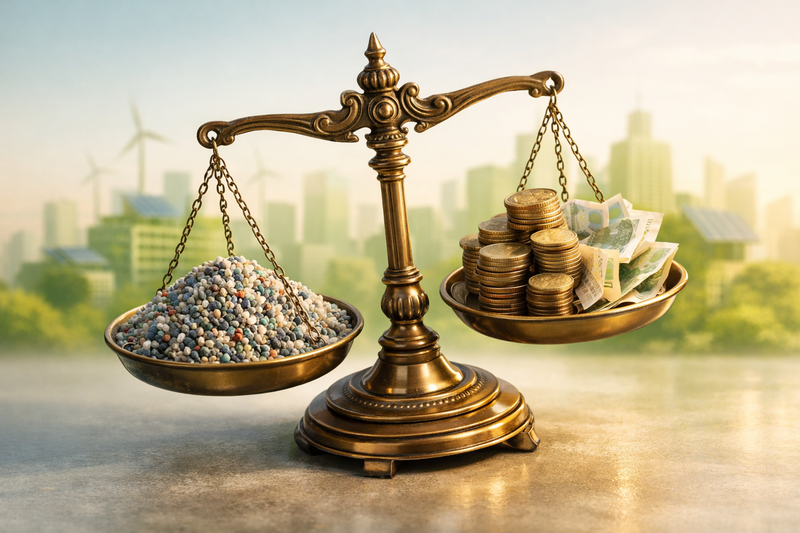
(Bild: KI-generiert / Dall-E)
Many plastics processors are currently keeping a close eye on the Strait of Hormuz. This waterway not only connects the Persian Gulf in the west with the Gulf of Oman in the east; it also plays a crucial role in global energy and petrochemical supply chains. One-fifth of the world’s oil and liquefied natural gas supplies flow through the strait.
If operations come to a standstill here—as is currently the case due to the war in Iran—it leads to shortages and uncertainty in the market. Consumers feel this most acutely at the gas pump at first. But it’s not just gas prices that are rising right now; but also the prices of plastics. This is because plastics are partly made from petroleum and natural gas.
War with Iran Sparks a Boom in Recycled Materials
These include, among others, polyethylene (PE) and polypropylene (PP), two of the most widely used plastics in the world. According to “The Plastic Exchanges,” a platform that tracks transaction data for the plastics market, prices for plastic pellets have already risen by double-digit percentages in most manufacturing sectors in recent weeks.
Manufacturers of plastic products are therefore looking for alternatives. As a result, demand for recycled materials is skyrocketing. “A boom with a bad aftertaste,” as the Swabians would say. After all, in normal times, the situation is usually different—here, sustainability and economic efficiency are at odds with each other in an unhealthy way. In other words, virgin material is so cheap that using recycled materials simply isn’t cost-effective.
In a Nutshell
Recycled material is reprocessed plastic that is not produced from raw materials but comes from products that have already been used. A distinction is made between recycled materials from industrial waste (post-industrial recycled materials, or PIR for short) and those from end-consumer waste (post-consumer recycled materials, or PCR for short).
What factors influence the price of recycled materials?
Essentially, the market for recycled materials works just like any other raw materials market. Prices are determined primarily by supply and demand.
When demand for recycled materials—such as metals, plastics, or paper—is high, prices typically rise. This is often the case when manufacturers are actively seeking cost-effective or sustainable alternatives to virgin materials. If, on the other hand, supply exceeds demand, prices can fall rapidly.
This balance can shift quickly, especially in global markets, where even minor disruptions can have far-reaching consequences—including for supply chains and pricing structures. This is because currency fluctuations, trade policies, and geopolitical factors also play a role.
Where do the additional costs arise in the recycling process?
“Energy prices generally have a significant impact, since the recycling process is energy-intensive,” explains Interzero’s press office. Regranulation, in particular, is energy-intensive. Rising electricity and gas prices therefore also drive up the cost of recycled materials.
Quality is also a key economic factor. A high level of contamination leads to additional cleaning costs and/or poorer material properties. “These, in turn, limit the potential applications of the recycled materials,” according to Interzero. Clean material streams are therefore the key to economic viability.
It should not only be clean, but also as free of other materials as possible. Unfortunately, the reality is quite different. Recyclers must extract the purest possible fractions of PET (polyethylene terephthalate), PP, or PE from a mixture of various plastics, the respective proportions of which are unknown. This also means: “The poorer the input, the greater the sorting effort and the associated costs,” as Interzero puts it.
However, it is not always possible to avoid using different materials. Sausage or cheese packaging, for example, requires an oxygen barrier and a water barrier to prevent the food from spoiling. Films made from two different plastics are required for both functions.
Date: 08.12.2025
Naturally, we always handle your personal data responsibly. Any personal data we receive from you is processed in accordance with applicable data protection legislation. For detailed information please see our privacy policy.
Consent to the use of data for promotional purposes
I hereby consent to Vogel Communications Group GmbH & Co. KG, Max-Planck-Str. 7-9, 97082 Würzburg including any affiliated companies according to §§ 15 et seq. AktG (hereafter: Vogel Communications Group) using my e-mail address to send editorial newsletters. A list of all affiliated companies can be found here
Newsletter content may include all products and services of any companies mentioned above, including for example specialist journals and books, events and fairs as well as event-related products and services, print and digital media offers and services such as additional (editorial) newsletters, raffles, lead campaigns, market research both online and offline, specialist webportals and e-learning offers. In case my personal telephone number has also been collected, it may be used for offers of aforementioned products, for services of the companies mentioned above, and market research purposes.
Additionally, my consent also includes the processing of my email address and telephone number for data matching for marketing purposes with select advertising partners such as LinkedIn, Google, and Meta. For this, Vogel Communications Group may transmit said data in hashed form to the advertising partners who then use said data to determine whether I am also a member of the mentioned advertising partner portals. Vogel Communications Group uses this feature for the purposes of re-targeting (up-selling, cross-selling, and customer loyalty), generating so-called look-alike audiences for acquisition of new customers, and as basis for exclusion for on-going advertising campaigns. Further information can be found in section “data matching for marketing purposes”.
In case I access protected data on Internet portals of Vogel Communications Group including any affiliated companies according to §§ 15 et seq. AktG, I need to provide further data in order to register for the access to such content. In return for this free access to editorial content, my data may be used in accordance with this consent for the purposes stated here. This does not apply to data matching for marketing purposes.
Right of revocation
I understand that I can revoke my consent at will. My revocation does not change the lawfulness of data processing that was conducted based on my consent leading up to my revocation. One option to declare my revocation is to use the contact form found at https://contact.vogel.de. In case I no longer wish to receive certain newsletters, I have subscribed to, I can also click on the unsubscribe link included at the end of a newsletter. Further information regarding my right of revocation and the implementation of it as well as the consequences of my revocation can be found in the data protection declaration, section editorial newsletter.
The problem: The two materials are incompatible, so an additional adhesive layer made of a third plastic is required. If additional functions are desired, for a plastic packaging, up to eleven different types of polymers are required.
Cost Check
Where along the process chain do the highest costs occur?
Infrastructure: Collection & Logistics
Sorting in High-Tech Facilities
Regranulation (energy-intensive)
The costs of technology, energy, and labor generally make recycled plastics 20 to 30 percent more expensive than virgin plastics.
What would need to happen for recycled materials to become price-competitive? For the recycler Interzero, it starts with the design phase, “to reduce the effort involved in the recycling process.” In addition, better waste separation increases the supply. The company sees further opportunities in minimum quotas and long-term purchase agreements for recycled materials, as well as subsidies for recycling technologies.
Why is recycling still worth it?
Despite all the challenges, recycled materials combine environmental benefits with economic efficiency. Every kilogram of secondary raw material replaces primary material and saves energy during extraction, transportation, and processing. This reduces the carbon footprint along the entire value chain. In addition, it reduces the environmental impact of plastic waste.
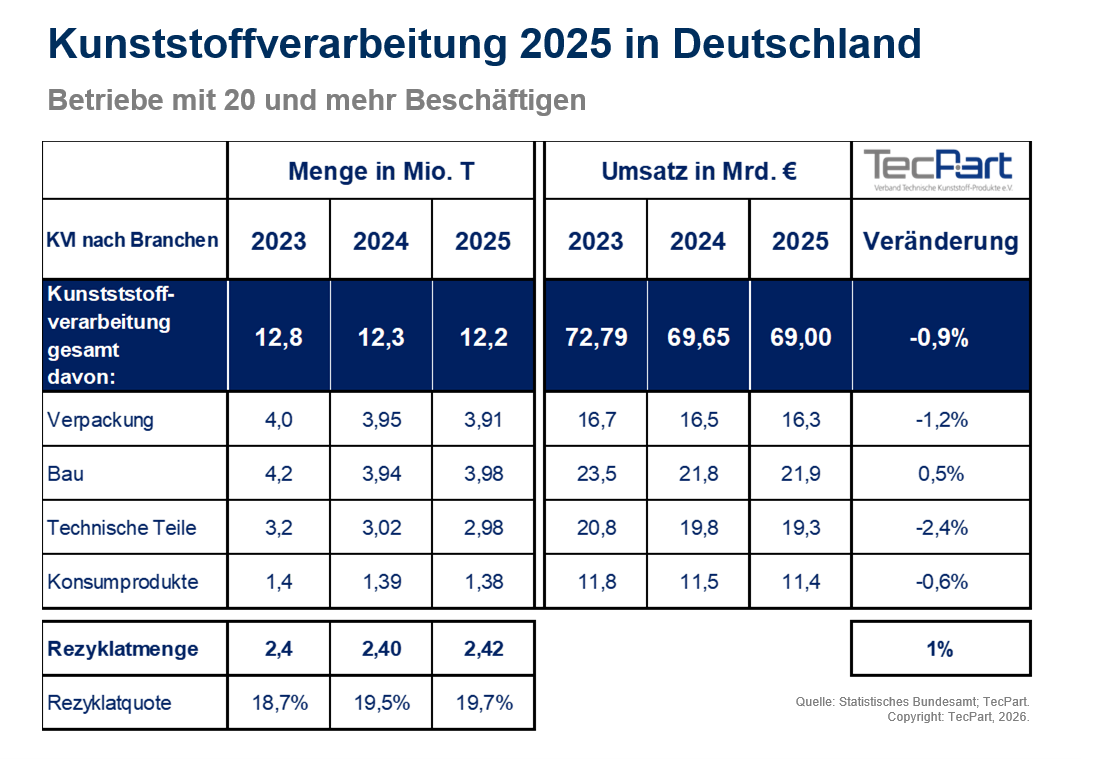
(Source: Tecpart)
The plastics processing industry in Germany saw another slight decline in 2025. Sales of engineering plastics products fell by approximately 500 million euros. At the same time, the use of recycled materials has stagnated at just under 20 percent, while the conflict in the Middle East is driving up the cost of virgin plastics and could lead to recycled materials gaining in importance.
These benefits are also a key factor for many of Pöppelmann’s customers. Since 2018, the plastics processor has been pursuing the goal of keeping plastics in the circular economy through its company-wide “Pöppelmann blue” initiative. “In this way, we’re helping our customers meet their goals. Currently, every other kilogram of plastic we use is made from recycled material,” explains Lukas Scheeben, Purchasing Team Leader.
How does Pöppelmann handle price fluctuations? “To provide financial planning certainty for the value chain all the way to the final product, we index our material prices,” says Scheeben.
When are recycled materials economically competitive?
However, it’s not just the cost of materials that plays a role. There are also investments that must be made in order to use recycled materials on a large scale. These include, for example, the necessary filtration technology for the machines or ventilation systems for production employees. “We accept the additional costs and thereby create added value for our customers—it pays off in the end.”
However, widespread adoption also requires consistent, stable quality—and that over a long period of time. According to Scheer, for automotive applications, this means at least 7 to 10 years. “Ensuring this in a constantly changing procurement market is a challenge that we, together with our suppliers, are overcoming for our customers.”
And where voluntary efforts end, the legislator takes over. This is particularly true in the packaging sector (PPWR) and in the automotive sector (EU End-of-Life Vehicles Regulation), stricter recycling quotas will apply in the future. According to Scheer, this will make the use of recycled materials in an increasing number of customer projects shift from an option to a prerequisite for order approval.
What role does regulation play in price trends?
Speaking of PPWR: The new EU Packaging Regulation entered into force on February 11, 2025, although most of its provisions will not become mandatory until after a transition period, starting August 12, 2026. The goal is to significantly reduce packaging consumption in the EU, improve recyclability, and strengthen the circular economy. In addition, mandatory requirements for recycled content, reusability, compostability, and packaging labeling are being introduced.
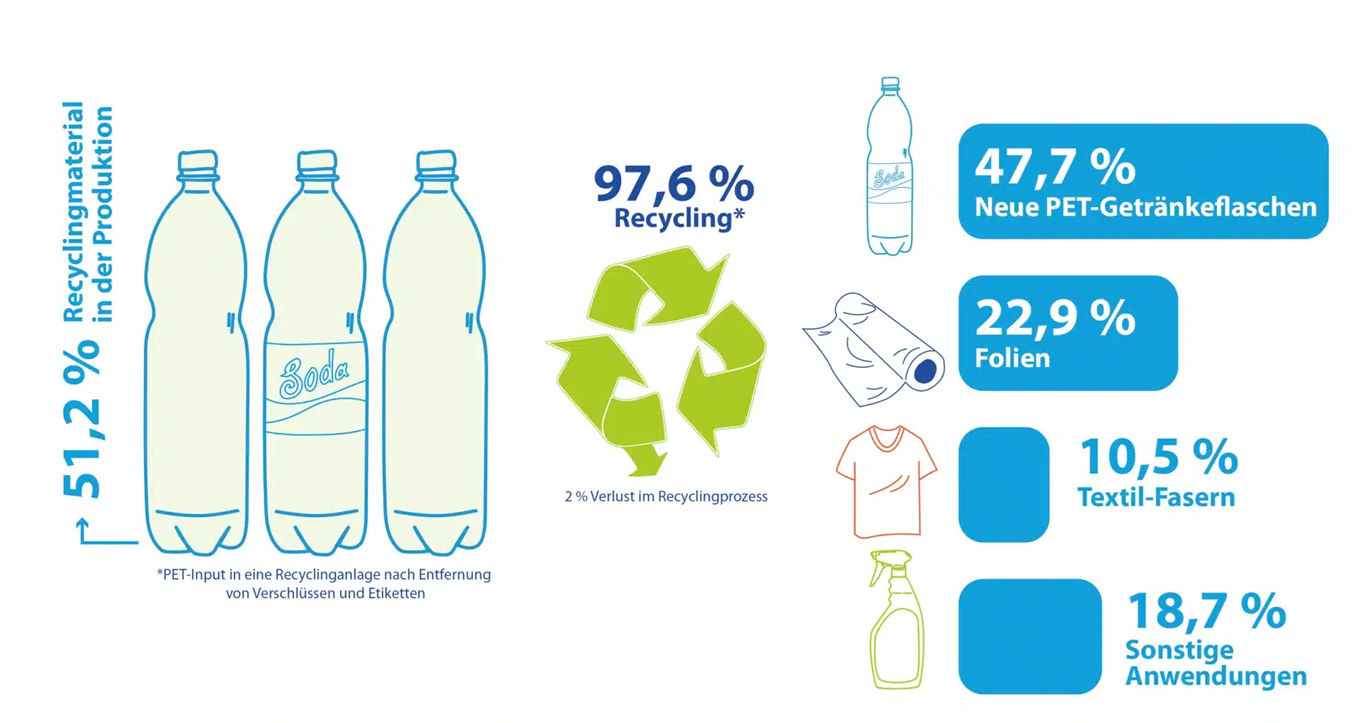
(Source: GVM 2020 | IK Industry Association for Plastic Packaging)
PET Beverage Bottles: High Recycling Rate and Increasing Use of Recycled Material (2019 Figures)
Will this also affect price trends? When asked, the Federal Association for Secondary Raw Materials and Waste Management (bvse) sees no indications of this. “However, the entry into force of the PPWR is likely to increase the willingness to use recycled materials, so that supply and demand will continue to converge and adequate pricing will be possible,” says Anna Roeb, bvse specialist for plastics recycling, tires and rubber, and hazardous waste.
What measures could make recycled materials competitive?
Regulations such as the PPWR alone will not make recycled materials more competitive. According to Roeb, public procurement should also serve as a lead market in this regard. Furthermore, the cost differences resulting from CO₂ pricing on virgin materials and from preferential treatment for plastic recyclers should be offset—through investments or the access to the industrial electricity rate.
In addition, the association recommends strict controls on imports, “since in some cases recycled materials enter the market that do not meet European food safety requirements.” Furthermore, design for recycling also plays an important role for the bvse. After all, only items that are recyclable can be processed into recycled materials and reused.
How will the market develop?
The development of the recycled materials market will continue to be heavily driven by politics in the future. Oil prices are volatile and have a direct impact on plastics recyclers. This increases pressure and competition. “We hope that the PPWR will lead to significantly higher demand for recycled materials due to the required usage quotas. Recycled materials must become a strategic raw material,” said Roeb.
Unfortunately, however, brand owners and distributors are still slow to respond at this time. This applies to both investments and technological advances. For example, there is currently no EFSA (European Food Safety Authority)-approved process that permits the use of PP and HDPE recyclates in food applications. However, this will be important for the usage rates of PPWR.
And yet: Without political intervention, the market usually does not function adequately. Recycled materials will continue to compete with virgin materials in the future, even though they are based on entirely different raw materials. Regulation alone may not be enough. “We need efficient markets that establish standards, enable competition, and also send price signals. In principle, then, we need more market mechanisms, but within a clear political framework,” Roeb concludes.
INfo
Sources
https://www.n-tv.de/wirtschaft/Iran-Krieg-laesst-auch-Plastikpreise-explodieren-id30531648.html (as of May 4, 2026)
https://sustainablebusinessmagazine.net/recycling/what-affects-the-price-of-recyclable-materials-in-todays-market/#:~:text=Processing%20costs%20and%20logistics,cost%20of%20handling%20materials%20increases. (As of May 4, 2026)
https://www.br.de/nachrichten/wissen/steuer-statt-recycling-quote-das-dilemma-mit-dem-plastikmuell,UE3aihX (as of May 4, 2026)
Research
We also asked Veolia for a statement on the matter. The company was unable—or unwilling—to comment. The reason given was that it had completely withdrawn from the production of recycled materials in Germany at the end of last year. “This decision was also made in light of the persistently difficult market conditions.”



:quality(80)/p7i.vogel.de/wcms/78/ce/78ce24a7ba8343ef49bc3dbb49016443/pasja1000-the-bottle-5128607v1.jpeg "The new plastic tax would amount to 0.28 cents for a yogurt cup and 1.93 cents for a large PET bottle. (Bild: pasja1000)")
:quality(80)/p7i.vogel.de/wcms/cc/db/ccdb09d1d9b3fcabf147abba7fd9e3c5/pasja1000-the-bottle-5128607v1.jpeg "The new plastic tax would amount to 0.28 cents for a yogurt cup and 1.93 cents for a large PET bottle. (Bild: pasja1000)")
:quality(80)/p7i.vogel.de/wcms/be/0a/be0a2864a5f59b0c9bca685dd23bdf79/pasja1000-the-bottle-5128607v1.jpeg "The new plastic tax would amount to 0.28 cents for a yogurt cup and 1.93 cents for a large PET bottle. (Bild: pasja1000)")
:quality(80)/p7i.vogel.de/wcms/b6/fe/b6fe83997fc68192cf8cd8a89b0bab5f/pasja1000-the-bottle-5128607v1.jpeg "The new plastic tax would amount to 0.28 cents for a yogurt cup and 1.93 cents for a large PET bottle. (Bild: pasja1000)")
:quality(80)/p7i.vogel.de/wcms/ce/ee/ceeeef086bfb174ebdda31c0dfccaf9a/2-weiss-blick-in-produktion-dji-0095-kopiev1.jpeg "A look inside the injection molding shop at Weiss Kunststoffverarbeitung in Illertissen, Bavaria. (Bild: White)")
:quality(80)/p7i.vogel.de/wcms/33/08/3308710c85715e917ec1baf9767fe4a7/2026-ewikon-wago-hei-kanalv1.png "Ewikon's 48-cavity hot runner as a production mold. (Bild: Ewikon)")
:quality(80)/p7i.vogel.de/wcms/a2/a5/a2a516dc69b4c8f8ad6f475ae6746a08/sxkh-bei-hpf-gesamtwerkzeugv1.png "The HMG 70XS1510 trimming press from the Chinese manufacturer SXKH combines all the functions required by toolmakers at HPF in a very compact design. The deciding factors in the purchase were the purchase price—and confidence in the quality of established international key components. (Bild: Pergler Media)")
:quality(80)/p7i.vogel.de/wcms/19/5f/195fdb6e09629994f1d6e3cf94dac8d8/bild-1-exam510-ultem9085v1.jpeg "Granular printing (FGF) makes it cost-effective to produce large-format functional parts from high-performance polymers such as Ultem 9085. (Bild: NEW AIM3D)")
:quality(80)/p7i.vogel.de/wcms/d5/c4/d5c46d40e1ae062370d058e2c006c376/dimitrisvetsikas1969-belgium-3595351v1.jpeg "European Plastics Industry Calls for Immediate Action to Address the Industry Crisis (Bild: dimitrisvetsikas1969)")
:quality(80)/p7i.vogel.de/wcms/e6/63/e663f0e1dd8818fc501c6fb5c5d33712/19-5689-circular-economy-of-resourcesv1.jpeg "Plastic waste from the average household is very heterogeneous. Only the right mix of technologies can turn all types of plastic waste into a new source of raw materials. (Bild: BASF)")
:quality(80)/p7i.vogel.de/wcms/31/5b/315b714f653484179232fbc4d6d79543/sesotec-img-andreas-hanus-25-20-281-29v1.jpeg "Andreas Hanus, Head of AI Development at Sesotec: “AI will not replace traditional sorting technology, but will intelligently enhance it.” (Bild: Sesotec)")
:quality(80)/p7i.vogel.de/wcms/74/5f/745f512239689819275af39a82f59860/b-brenkenv1.jpeg "Dr. Benedikt Brenken, Director of R-Cycle: \"The digital product passport will fundamentally change plastic recycling.\" (Bild: R-Cycle)")
:quality(80)/p7i.vogel.de/wcms/40/6d/406d05534ab4d28194bd29699e023e67/2026-09-09-uni-kiel-aufmacherv1.jpeg "These self-polarizing polymer coatings could be used in a wide variety of electronic components in the future. (Bild: University of Kiel/C. Anders)")
:quality(80)/p7i.vogel.de/wcms/5d/46/5d46e098a7cfaebdd9643df47153c5af/aufmacherv1.png "The PPWR imposes new requirements on packaging: What impact does this have on mechanical engineering? (Bild: KI-generiert / Dall-E)")
:quality(80)/p7i.vogel.de/wcms/70/13/7013fe202fb4790708f62f69cd0c83d4/aufmacher-st-c3-a4rkeschaumfoliev1.png "Using thermoplastic starch as a base, researchers at the IKV successfully produced a flexible foam film using physical blowing agents. (Bild: IKV)")
:quality(80)/p7i.vogel.de/wcms/d1/2b/d12b536ba3b382d0d138e342ac1038e6/03--20pm-imm-mgsv1.jpeg "MGS Richfield Site (Bild: MGS)")
:quality(80)/p7i.vogel.de/wcms/90/9c/909cf6eb1b91a9a84ff535033ea9b048/honeycombv1.jpeg "The composite material made of epoxy and glass fibers not only protects against flames but is also fully recyclable. (Bild: Empa)")
:quality(80)/p7i.vogel.de/wcms/6a/d5/6ad5980b0c965409c71582fc59145e13/1920-covestro-new-covestro-headquartersv1.jpeg "Covestro's corporate headquarters in Leverkusen (Bild: Covestro)")
:quality(80)/p7i.vogel.de/wcms/db/74/db741079d26ad9e7a69278fde45e79c7/aufmacherv1.png "(Bild: KI-generiert / Dall-E)")
:quality(80)/p7i.vogel.de/wcms/b3/65/b3654df434f4d31e1fda3c79bc7bb4b0/nakura-20kunstrasenteppich-20ohne-20verf-c3-bcllungv1.jpeg "Tecnaro has developed synthetic turf fibers using a specially formulated Arboblend blend that offers high resistance to heat, UV rays, and weathering, and, because it is niobium-based, sequesters CO₂ over the long term. (Bild: Tecnaro)")
:quality(80)/p7i.vogel.de/wcms/bc/2d/bc2d0b0eea87c0b2526ba0da6755c40a/plastxnow5v1.png "The participants in the PPWR roundtable and PlastXNow editor Melanie Ehrhardt. (Bild: Jacob Lohring; PED)")
:quality(80)/p7i.vogel.de/wcms/d5/c4/d5c46d40e1ae062370d058e2c006c376/dimitrisvetsikas1969-belgium-3595351v1.jpeg "European Plastics Industry Calls for Immediate Action to Address the Industry Crisis (Bild: dimitrisvetsikas1969)")