WINe O'Clock VideocastOver a Glass of Wine with Ingemar Bühler
From
Melanie Ehrhardt
6 min Reading Time
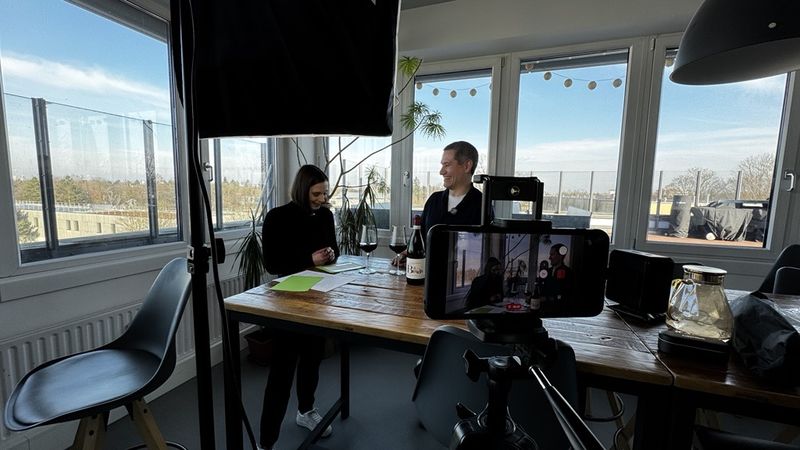
PlastXnow is hosting the second episode of the videocast “WINe O’Clock – The Business After Hour.” Over a glass of full-bodied red wine, Ingemar Bühler and Melanie Ehrhardt discuss the national circular economy as well as the current state of the chemical industry in Germany and Europe.
Melanie Ehrhardt (left) and Ingemar Bühler (right) during the recording of “WINe O’Clock”: A Circular Economy Straight from the Drawing Board?
(Bild: PlastXNow/sl)
Piedmont is located in northwestern Italy, nestled among the majestic foothills of the Alps. Famous for its unique grape varieties, the region is a paradise, especially for wine lovers.
“I really like wines from Piedmont and Piedmont itself,” says Ingemar Bühler, Head of Government Affairs at Olin. For our “WINe O’Clock” recording, he brings a bottle of Merlot—“an unassuming, mellow red wine, a single-varietal Barbera with great depth.”
But Bühler isn’t just bringing a good bottle of wine—he’s also bringing some fascinating insights from the political scene in Berlin, which he’d like to share with me today. Our topic is the National Circular Economy Strategy (NKWS for short) and the question: Can such a complex framework really be analyzed simply using a catalog of measures on the drawing board?
About the Person
Ingemar Bühler has been Head of Government Affairs at Olin since March 2025. The U.S.-based company manufactures composite materials based on epoxy resins. These are used in the wind energy, e-mobility, and construction sectors, among others.
In his role as Head of Government Affairs, Bühler serves as a liaison between the business community and the political sphere. Before joining Olin, he served, among other roles, as Managing Director of Plastics Europe Germany and held various leadership positions at Bayer.
Note: Ingemar Bühler and PlastXnow editor Melanie Ehrhardt have known each other for several years and are now on a first-name basis. We took this into account in both the video and the written interview.
PlastXnow: Federal Environment Minister Carsten Schneider says, “The circular economy is not just about environmental and resource policy; it is also about regional development, innovation, and industrial policy.” The topic of the circular economy seems to have made its way into the political arena. Is this commitment perhaps coming too late?
Ingemar Bühler: The holistic approach is the right one and it’s important. But yes, it’s coming quite late. In this case, however, better late than never. Germany must make progress in reducing its dependence on raw materials as well as in its approach to recycling, and it must leverage its innovation potential. Unfortunately, many of the inventions from our country are commercialized elsewhere. This is an ongoing problem that plagues the German economy.
Another point Schneider raises is the pressure on supply chains. He says it has rarely been as intense as it is these days. Can you confirm this based on your own experience? And to what extent can the circular economy help counteract this?
Our value chains are under massive threat due to the creation of excess capacity, particularly in China. China and several other Asian countries are sitting on large quantities of chemicals produced through the mining of rare earths. These chemicals are being dumped onto the European market with massive subsidies, first driving down prices, then disrupting trade flows, and ultimately destroying entire production capacities. This is a serious problem.
Which areas are particularly affected by this?
I see this particularly in sectors such as the energy and defense industries, where the EU must act independently. The circular economy cannot solve this problem on its own, but it is an important building block for achieving a degree of resource independence. This is because we reprocess raw materials here and because technologies such as CCU, biomass, and even modern fracking methods are enabling us to become producers of raw materials.
But that also requires the right conditions at the local level. In the plastics recycling sector in particular, we’re seeing plants close or entire companies file for bankruptcy. That doesn’t quite add up in my mind. Are policymakers overlooking the foundation—that is, the recyclers—in their deliberations?
The plant closures currently underway are primarily due to extremely high energy prices, the burden of bureaucracy, and a lack of demand. We need to finally be honest with ourselves. In other parts of the world, such as the U.S., energy costs only a fraction of the price, yet it isn’t dirtier—it’s at least just as clean, if not cleaner.
When it comes to the circular economy, there is also the fact that market incentives for more sustainable products are simply not working at the moment. No supplier is currently receiving a sustainability premium from its customers. The effort involved in circular products and recycling is not being rewarded at all at this time.
Europe—and Germany, too—tends to favor regulation. Schneider says, “Regulation provides guidance and planning certainty.” Especially when it comes to recycled plastics, very few companies would agree with that right now. Or what do you think?
Regulation requires striking the right balance. It must provide security and predictability while at the same time enabling innovation and competition. That’s a fine line to walk. At present, I would agree that hardly any of the recyclers are able to run a profitable business.
There are a few exceptions, though. What do they do differently?
The two or three companies that are succeeding in this area are counting on the regulatory status quo to protect their individual business models. The only direction EU regulation has provided over the past ten years is that companies are increasingly turning away from Europe. This is dramatic. In the case of the circular economy, there is the added factor that market-based instruments are either not yet in place or are currently ineffective.
The National Circulation Strategy includes several measures that we cannot possibly cover in their entirety here. But let’s focus on one point: digitalization. How can it help us achieve these ambitious goals?
Digitalization is a crucial factor. It can help us better understand the complexity of waste streams and organize them more effectively. It can help establish digital trading platforms for trading recycled materials and providing documentation. At the same time, research can succeed in reducing material diversity, simplifying product design while maintaining high performance, and enabling transparency regarding content, life cycle, disposition, and recycling technologies.
In closing: The environment minister himself says that these projects require staying power. You know the plastics industry well; you know how it works and how it’s faring. Does it have that staying power?
I really hope that happens for the industry. But I’m watching this trend with concern. Many companies, especially small and medium-sized businesses, have long since run out of steam. Those jobs, those facilities, and those ideas won’t be coming back. At the same time, there are companies that are finally seeing a significant increase in orders again and are starting 2026 with confidence.
Thank you very much for the conversation and the wine!
Info
(Source: PlastXnow/me)
The Wine That Followed
The B di Braida glows in the glass with a medium ruby red hue. The fruity notes of juicy, ripe plum reveal themselves subtly on the nose, which is more dominated by dark chocolate, cocoa, and walnut shell. On the palate, the wine gains body and reveals umami tones—earthy, iodine-like notes that envelop the dark fruit. Refreshing acidity gives the B di Braida vibrancy and an elegant finish.
The videocast “WINe O’Clock – The Business After Hour” is a joint production by the media brands of WIN Verlag. You can find all episodes on YouTube.
Date: 08.12.2025
Naturally, we always handle your personal data responsibly. Any personal data we receive from you is processed in accordance with applicable data protection legislation. For detailed information please see our privacy policy.
Consent to the use of data for promotional purposes
I hereby consent to Vogel Communications Group GmbH & Co. KG, Max-Planck-Str. 7-9, 97082 Würzburg including any affiliated companies according to §§ 15 et seq. AktG (hereafter: Vogel Communications Group) using my e-mail address to send editorial newsletters. A list of all affiliated companies can be found here
Newsletter content may include all products and services of any companies mentioned above, including for example specialist journals and books, events and fairs as well as event-related products and services, print and digital media offers and services such as additional (editorial) newsletters, raffles, lead campaigns, market research both online and offline, specialist webportals and e-learning offers. In case my personal telephone number has also been collected, it may be used for offers of aforementioned products, for services of the companies mentioned above, and market research purposes.
Additionally, my consent also includes the processing of my email address and telephone number for data matching for marketing purposes with select advertising partners such as LinkedIn, Google, and Meta. For this, Vogel Communications Group may transmit said data in hashed form to the advertising partners who then use said data to determine whether I am also a member of the mentioned advertising partner portals. Vogel Communications Group uses this feature for the purposes of re-targeting (up-selling, cross-selling, and customer loyalty), generating so-called look-alike audiences for acquisition of new customers, and as basis for exclusion for on-going advertising campaigns. Further information can be found in section “data matching for marketing purposes”.
In case I access protected data on Internet portals of Vogel Communications Group including any affiliated companies according to §§ 15 et seq. AktG, I need to provide further data in order to register for the access to such content. In return for this free access to editorial content, my data may be used in accordance with this consent for the purposes stated here. This does not apply to data matching for marketing purposes.
Right of revocation
I understand that I can revoke my consent at will. My revocation does not change the lawfulness of data processing that was conducted based on my consent leading up to my revocation. One option to declare my revocation is to use the contact form found at https://contact.vogel.de. In case I no longer wish to receive certain newsletters, I have subscribed to, I can also click on the unsubscribe link included at the end of a newsletter. Further information regarding my right of revocation and the implementation of it as well as the consequences of my revocation can be found in the data protection declaration, section editorial newsletter.



:quality(80)/p7i.vogel.de/wcms/97/0c/970c52fd142e10a3c4566168037ca637/materialloesungen-pressefoto-1890x1329v1.jpeg "rPET pellets: At Fraunhofer IAP, terephthalic acid is recovered from PET to produce new polymers for bottles, fibers, and films. The yellowish to grayish hues are due to the recycled raw material. Through the targeted addition of additives, the color can be adjusted to produce even colorless material. (Bild: Fraunhofer IAP / Romina Schönefeld)")
:quality(80)/p7i.vogel.de/wcms/b7/76/b776134c0507ea4671f44226bcfc4d23/materialloesungen-pressefoto-1890x1329v1.jpeg "rPET pellets: At Fraunhofer IAP, terephthalic acid is recovered from PET to produce new polymers for bottles, fibers, and films. The yellowish to grayish hues are due to the recycled raw material. Through the targeted addition of additives, the color can be adjusted to produce even colorless material. (Bild: Fraunhofer IAP / Romina Schönefeld)")
:quality(80)/p7i.vogel.de/wcms/ed/13/ed1372deb944662e350a3a7cb7722941/materialloesungen-pressefoto-1890x1329v1.jpeg "rPET pellets: At Fraunhofer IAP, terephthalic acid is recovered from PET to produce new polymers for bottles, fibers, and films. The yellowish to grayish hues are due to the recycled raw material. Through the targeted addition of additives, the color can be adjusted to produce even colorless material. (Bild: Fraunhofer IAP / Romina Schönefeld)")
:quality(80)/p7i.vogel.de/wcms/59/04/590479528acbd2eff1f451c79dd298b5/materialloesungen-pressefoto-1890x1329v1.jpeg "rPET pellets: At Fraunhofer IAP, terephthalic acid is recovered from PET to produce new polymers for bottles, fibers, and films. The yellowish to grayish hues are due to the recycled raw material. Through the targeted addition of additives, the color can be adjusted to produce even colorless material. (Bild: Fraunhofer IAP / Romina Schönefeld)")
:quality(80)/p7i.vogel.de/wcms/ce/ee/ceeeef086bfb174ebdda31c0dfccaf9a/2-weiss-blick-in-produktion-dji-0095-kopiev1.jpeg "A look inside the injection molding shop at Weiss Kunststoffverarbeitung in Illertissen, Bavaria. (Bild: White)")
:quality(80)/p7i.vogel.de/wcms/33/08/3308710c85715e917ec1baf9767fe4a7/2026-ewikon-wago-hei-kanalv1.png "Ewikon's 48-cavity hot runner as a production mold. (Bild: Ewikon)")
:quality(80)/p7i.vogel.de/wcms/a2/a5/a2a516dc69b4c8f8ad6f475ae6746a08/sxkh-bei-hpf-gesamtwerkzeugv1.png "The HMG 70XS1510 trimming press from the Chinese manufacturer SXKH combines all the functions required by toolmakers at HPF in a very compact design. The deciding factors in the purchase were the purchase price—and confidence in the quality of established international key components. (Bild: Pergler Media)")
:quality(80)/p7i.vogel.de/wcms/19/5f/195fdb6e09629994f1d6e3cf94dac8d8/bild-1-exam510-ultem9085v1.jpeg "Granular printing (FGF) makes it cost-effective to produce large-format functional parts from high-performance polymers such as Ultem 9085. (Bild: NEW AIM3D)")
:quality(80)/p7i.vogel.de/wcms/d5/c4/d5c46d40e1ae062370d058e2c006c376/dimitrisvetsikas1969-belgium-3595351v1.jpeg "European Plastics Industry Calls for Immediate Action to Address the Industry Crisis (Bild: dimitrisvetsikas1969)")
:quality(80)/p7i.vogel.de/wcms/e6/63/e663f0e1dd8818fc501c6fb5c5d33712/19-5689-circular-economy-of-resourcesv1.jpeg "Plastic waste from the average household is very heterogeneous. Only the right mix of technologies can turn all types of plastic waste into a new source of raw materials. (Bild: BASF)")
:quality(80)/p7i.vogel.de/wcms/31/5b/315b714f653484179232fbc4d6d79543/sesotec-img-andreas-hanus-25-20-281-29v1.jpeg "Andreas Hanus, Head of AI Development at Sesotec: “AI will not replace traditional sorting technology, but will intelligently enhance it.” (Bild: Sesotec)")
:quality(80)/p7i.vogel.de/wcms/74/5f/745f512239689819275af39a82f59860/b-brenkenv1.jpeg "Dr. Benedikt Brenken, Director of R-Cycle: \"The digital product passport will fundamentally change plastic recycling.\" (Bild: R-Cycle)")
:quality(80)/p7i.vogel.de/wcms/40/6d/406d05534ab4d28194bd29699e023e67/2026-09-09-uni-kiel-aufmacherv1.jpeg "These self-polarizing polymer coatings could be used in a wide variety of electronic components in the future. (Bild: University of Kiel/C. Anders)")
:quality(80)/p7i.vogel.de/wcms/5d/46/5d46e098a7cfaebdd9643df47153c5af/aufmacherv1.png "The PPWR imposes new requirements on packaging: What impact does this have on mechanical engineering? (Bild: KI-generiert / Dall-E)")
:quality(80)/p7i.vogel.de/wcms/70/13/7013fe202fb4790708f62f69cd0c83d4/aufmacher-st-c3-a4rkeschaumfoliev1.png "Using thermoplastic starch as a base, researchers at the IKV successfully produced a flexible foam film using physical blowing agents. (Bild: IKV)")
:quality(80)/p7i.vogel.de/wcms/d1/2b/d12b536ba3b382d0d138e342ac1038e6/03--20pm-imm-mgsv1.jpeg "MGS Richfield Site (Bild: MGS)")
:quality(80)/p7i.vogel.de/wcms/90/9c/909cf6eb1b91a9a84ff535033ea9b048/honeycombv1.jpeg "The composite material made of epoxy and glass fibers not only protects against flames but is also fully recyclable. (Bild: Empa)")
:quality(80)/p7i.vogel.de/wcms/6a/d5/6ad5980b0c965409c71582fc59145e13/1920-covestro-new-covestro-headquartersv1.jpeg "Covestro's corporate headquarters in Leverkusen (Bild: Covestro)")
:quality(80)/p7i.vogel.de/wcms/db/74/db741079d26ad9e7a69278fde45e79c7/aufmacherv1.png "(Bild: KI-generiert / Dall-E)")
:quality(80)/p7i.vogel.de/wcms/b3/65/b3654df434f4d31e1fda3c79bc7bb4b0/nakura-20kunstrasenteppich-20ohne-20verf-c3-bcllungv1.jpeg "Tecnaro has developed synthetic turf fibers using a specially formulated Arboblend blend that offers high resistance to heat, UV rays, and weathering, and, because it is niobium-based, sequesters CO₂ over the long term. (Bild: Tecnaro)")

:quality(80)/p7i.vogel.de/wcms/f3/8f/f38fdc5715fdeaa02640c4e093c5be91/aufmacherv1.png "Dr. Aliaksandra Shuliakevich, Head of Climate Action and Circular Economy at Plastics Europe Germany (PED) (Bild: PED)")
:quality(80)/p7i.vogel.de/wcms/5e/e3/5ee3e75c4b9f5f27409b33df04fafa3d/cre-ai-tor-adobestock-960097557v1.jpeg "August 12, 2026, marks a fundamental turning point for the entire German plastics and packaging industry. With the official entry into force of the European Packaging Regulation (PPWR) and the accompanying national Packaging Act Implementation Act (VerpackDG), the legal framework for distributors has changed overnight. (Bild: © Cre-AI-Tor – stock.adobe.com)")