IKV: Research for Practical ApplicationPUR, Blown Film, Coextrusion: Three IKV Approaches for Practical Application
A guest post by
Prof. Dr.-Ing. Christian Hopmann (Director of the IKV and Chair of Plastics Processing), Eduard Kremer (PUR Mass Production), Henrik Junge (Blown Film Extrusion), Henrik Hüpper, and Stefanie Pott (Coextrusion of Recycled Materials)
| Translated by AI
6 min Reading Time
Whether it’s release-agent-free PUR demolding, fluctuating recycled material quality in film extrusion, or boundary layer instabilities in coextrusion: plastics processing faces complex process challenges. Researchers at IKV Aachen are identifying concrete solutions using new measurement cells, scale-up models, and mold simulations.
Researchers at the Institute for Plastics Processing (IKV) in Industry and Crafts at RWTH Aachen University provide exclusive coverage of current topics for PlastXnow.
Measuring cell for release agent-free PUR mass production
Simplifying the manufacturing process can improve the cost-effectiveness of plastic-based lightweight components and help reduce CO2 emissions in industries such as automotive, transportation, aviation, shipping, and footwear. One approach is to replace conventional release agents with permanent mold coatings in PUR series production. While conventional release agents enable reliable demolding, they can cause residues on components as well as mold buildup on mold surfaces. This compromises component quality and requires regular cleaning that is costly, time-consuming, energy-intensive, and resource-intensive. Permanent, plasma-polymer mold coatings therefore offer a promising alternative. However, their use represents a sensitive intervention in the production chain, as demolding behavior depends on material chemistry, reaction kinetics, and process conditions. Until now, there has been no practical and reproducible method for evaluating the compatibility of a PUR material system with such a release layer in advance.
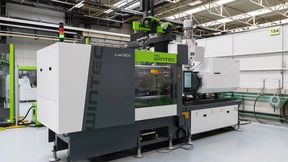
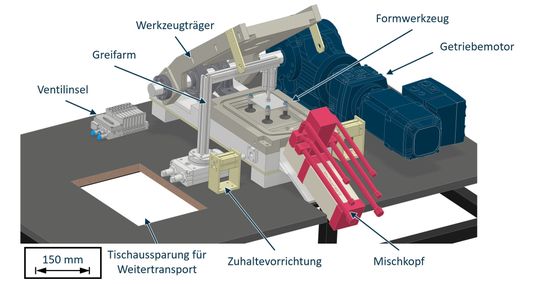
Against this backdrop, the IKV developed a measurement cell as part of a BMWE project that enables the automated analysis of release agent-free PUR processing in the PUR-RIM process under conditions close to those of mass production (Figure 1). The measurement cell was systematically developed, manufactured, and commissioned based on existing mold technologies and industrial process requirements. Key mold and process-related aspects were taken into account during the design, including gate design, sealing, venting, and temperature control. The measurement cell is connected to an industrial dosing system, and part removal is automated via a gripper system. The mold’s modular design allows for the replacement of inserts, enabling the investigation of different part geometries as well as part thicknesses ranging from 2 to 50 mm. Both compact and foamed PUR systems can be processed.
Figure 1: Overview of an automated measurement cell for investigating the demolding behavior of PUR.
(Bild: IKV)
For process and component evaluation, the measurement cell is equipped with a comprehensive array of sensors and data acquisition systems. During the chemical reaction, data on pressure, force, temperature, and dielectric properties are recorded. This allows the curing behavior of the material systems to be correlated with their demolding behavior. The analytical focus is on the automated measurement of adhesive force during defined demolding movements. All mold-forming and media-contacting areas of the measurement cell have been designed so that they can be coated with a plasma-polymer release layer.
The measurement cell developed enables systematic demolding tests to be conducted under conditions that closely resemble actual production processes. This makes it possible to specifically evaluate and compare material systems, mold coatings, and process parameters. The data obtained provides an important foundation for validating permanent mold coatings for industrial PUR series production processes. In the long term, this approach opens up the possibility of replacing conventional release agents in suitable applications. This allows environmental benefits—resulting from reduced resource consumption and emissions—to be combined with economic advantages.
The work was funded by the BMWK as part of Project 03LB3126A under the Technology Transfer Program for Lightweight Construction (TTP LB).
Blow Molding: Efficient Process Point Identification Through Scaling
The inconsistent material quality of post-consumer recycled (PCR) materials poses significant challenges for film manufacturers. To ensure quality and process stability, extensive, costly, and material-intensive test series on large-scale production lines are necessary. It would therefore be advantageous to be able to use a smaller laboratory-scale system instead of a production line to identify stable process points for the manufacture of film products with defined properties. As part of an IGF project, the IKV has been developing a scale-up protocol since November 2025 for the efficient identification of process points for processing PCR in blown film extrusion.
Since the complex thermodynamic and fluid dynamics processes behave differently on a laboratory or pilot plant scale than on a production scale, these differences are first recorded in the form of machine and plant parameters as well as film properties. To simulate the processing of PCR, model recyclates are produced whose composition corresponds to that of typical modern film packaging. A defined state of degradation can be achieved through repeated compounding. Shear and extensional viscosities are determined to evaluate material degradation.
Date: 08.12.2025
Naturally, we always handle your personal data responsibly. Any personal data we receive from you is processed in accordance with applicable data protection legislation. For detailed information please see our privacy policy.
Consent to the use of data for promotional purposes
I hereby consent to Vogel Communications Group GmbH & Co. KG, Max-Planck-Str. 7-9, 97082 Würzburg including any affiliated companies according to §§ 15 et seq. AktG (hereafter: Vogel Communications Group) using my e-mail address to send editorial newsletters. A list of all affiliated companies can be found here
Newsletter content may include all products and services of any companies mentioned above, including for example specialist journals and books, events and fairs as well as event-related products and services, print and digital media offers and services such as additional (editorial) newsletters, raffles, lead campaigns, market research both online and offline, specialist webportals and e-learning offers. In case my personal telephone number has also been collected, it may be used for offers of aforementioned products, for services of the companies mentioned above, and market research purposes.
Additionally, my consent also includes the processing of my email address and telephone number for data matching for marketing purposes with select advertising partners such as LinkedIn, Google, and Meta. For this, Vogel Communications Group may transmit said data in hashed form to the advertising partners who then use said data to determine whether I am also a member of the mentioned advertising partner portals. Vogel Communications Group uses this feature for the purposes of re-targeting (up-selling, cross-selling, and customer loyalty), generating so-called look-alike audiences for acquisition of new customers, and as basis for exclusion for on-going advertising campaigns. Further information can be found in section “data matching for marketing purposes”.
In case I access protected data on Internet portals of Vogel Communications Group including any affiliated companies according to §§ 15 et seq. AktG, I need to provide further data in order to register for the access to such content. In return for this free access to editorial content, my data may be used in accordance with this consent for the purposes stated here. This does not apply to data matching for marketing purposes.
Right of revocation
I understand that I can revoke my consent at will. My revocation does not change the lawfulness of data processing that was conducted based on my consent leading up to my revocation. One option to declare my revocation is to use the contact form found at https://contact.vogel.de. In case I no longer wish to receive certain newsletters, I have subscribed to, I can also click on the unsubscribe link included at the end of a newsletter. Further information regarding my right of revocation and the implementation of it as well as the consequences of my revocation can be found in the data protection declaration, section editorial newsletter.
Tests are being conducted on three different-sized production lines with varying mass flow rates. First, at an IKV partner company, two defined film products are produced from model recycled material on an industrial line (500 kg/h). Machine parameters, such as the extruder screw speed, are recorded, as are resulting process parameters such as the frost line height. Dimensionless indices based on similarity theory are derived from the collected data. On the one hand, established indices for blown film extrusion and extruder design are examined. On the other hand, new, material-specific indices are defined. In parallel with the initial modeling, a mini-blow-molding line (4 kg/h) is designed, engineered, and manufactured to determine the effects of individual process variables using a statistical experimental design. The die geometry is designed using a combination of analytical calculations and simulation-based analysis.
Based on the first two sets of experiments, a selection of key parameters can be made and the scale-up model can be developed. Finally, the model is validated on IKV’s own pilot-scale blown film line (50 kg/h). To characterize the mechanical properties of the produced films, the results of tensile, puncture, and shrinkage tests are implemented as target variables in the model.
The work is supported by the Federal Ministry for Economic Affairs and Energy (BMWE) as part of IGF Project 24300 N.
Automated Die Optimization for the Coextrusion of Recycled Materials
In contact-sensitive applications such as food packaging, coextrusion allows for the use of a recycled core, while the outer layers made of virgin material provide the necessary barrier and surface properties. However, flow instabilities often occur at the interface during coextrusion, leading to optical and mechanical defects. In a DFG project, the IKV is therefore investigating an automated optimization of coextrusion dies to prevent such instabilities.
A stable thickness ratio among the individual layers is critical for product quality. However, in the convergence zone of the feedblock, strong stretching flows or differences in viscosity can lead to so-called wave instabilities, which cause scrap and limit process capability. To improve flow stability, a comprehensive simulation environment is being developed in OpenFOAM. To this end, the viscoelastic properties of virgin material and recycled compounds are experimentally determined and modeled using the Phan-Thien-Tanner material model. The simulations use a volume-of-fluid approach to accurately capture the layer boundary within the mold.
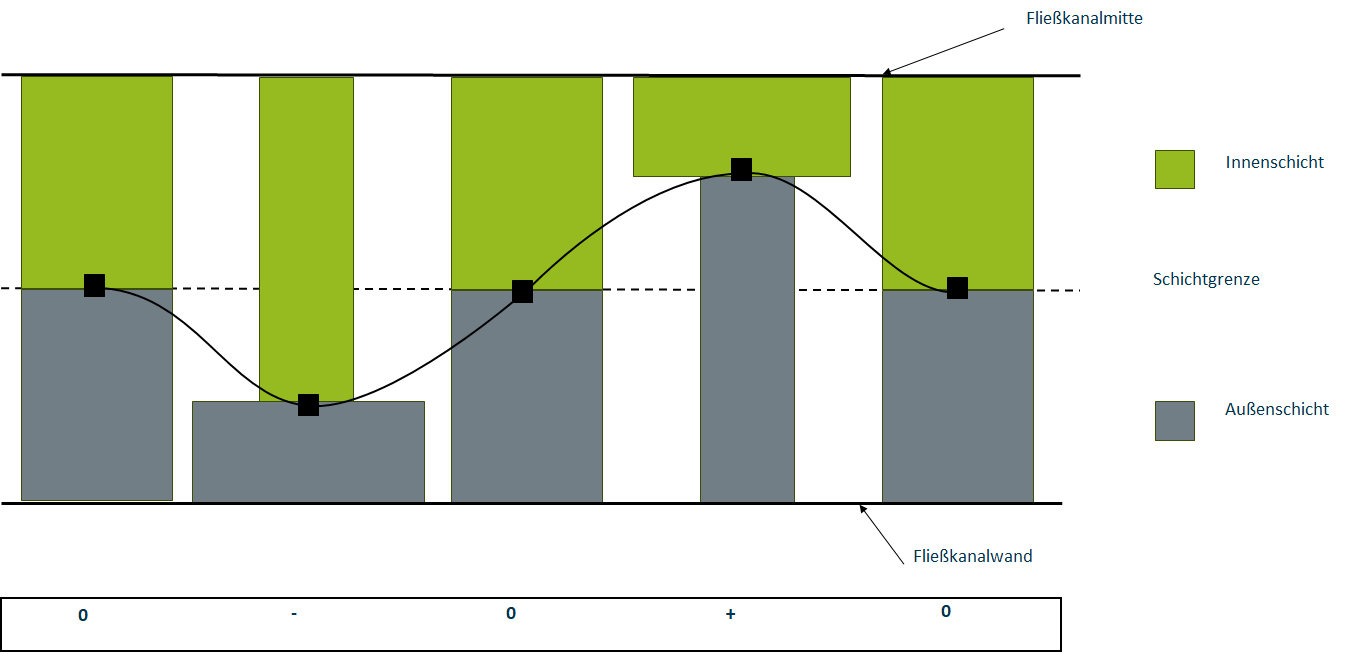
Figure 2: Schematic representation of the normal stress difference in the extruded layers.
(Source: IKV)
The central methodological approach is an adjoint optimization method that specifically adjusts the previously defined geometric degrees of freedom of the feedblock. The Total Normal Stress Difference (TNSD) criterion serves as the evaluation metric; it identifies critical normal stress differences and thus provides insight into the development of boundary layer instabilities (Figure 2). The simulation then allows for specific conclusions to be drawn regarding how the die geometry should be modified to reduce instabilities. Furthermore, various material pairings are systematically investigated. This results in a dataset that demonstrates how properties such as strain viscosity or relaxation times affect process stability. Finally, selected operating points are validated in practical experiments to ensure the transferability of the simulation to industrial practice. The project thus contributes to the cost-effective and high-quality use of recycled materials in high-quality plastic products. Mold optimization and rapid, data-driven process adjustments help reduce scrap and sustainably increase resource efficiency in the field of packaging-related coextrusion.
This work was supported by the German Research Foundation (DFG) as part of project HO 4776/98-1.
Prof. Dr.-Ing. Christian Hopmann IKV-Institutsleitung und Lehrstuhl für Kunststoffverarbeitung
Bildquelle:
Eduard Kremer, M.Sc. PUR-Serienfertigung
Bildquelle:
Henrik Junge, M.Sc. Blasfolienextrusion
Bildquelle:
Henrik Hüpper, M.Sc. und Stefanie Pott, M.Sc. Coextrusion von Rezyklaten