Additive manufacturing has made the leap from a prototyping tool to a strategic manufacturing technology. Whether it’s on-demand replacement parts, small-batch production, or mission-critical components in continuous use—one factor above all else determines the success or failure of industrial-scale production: the right material. An overview of the most important material trends in polymer-based 3D printing: from high-performance polymers such as PEEK to fiber-reinforced compounds and granule printing (FGF).
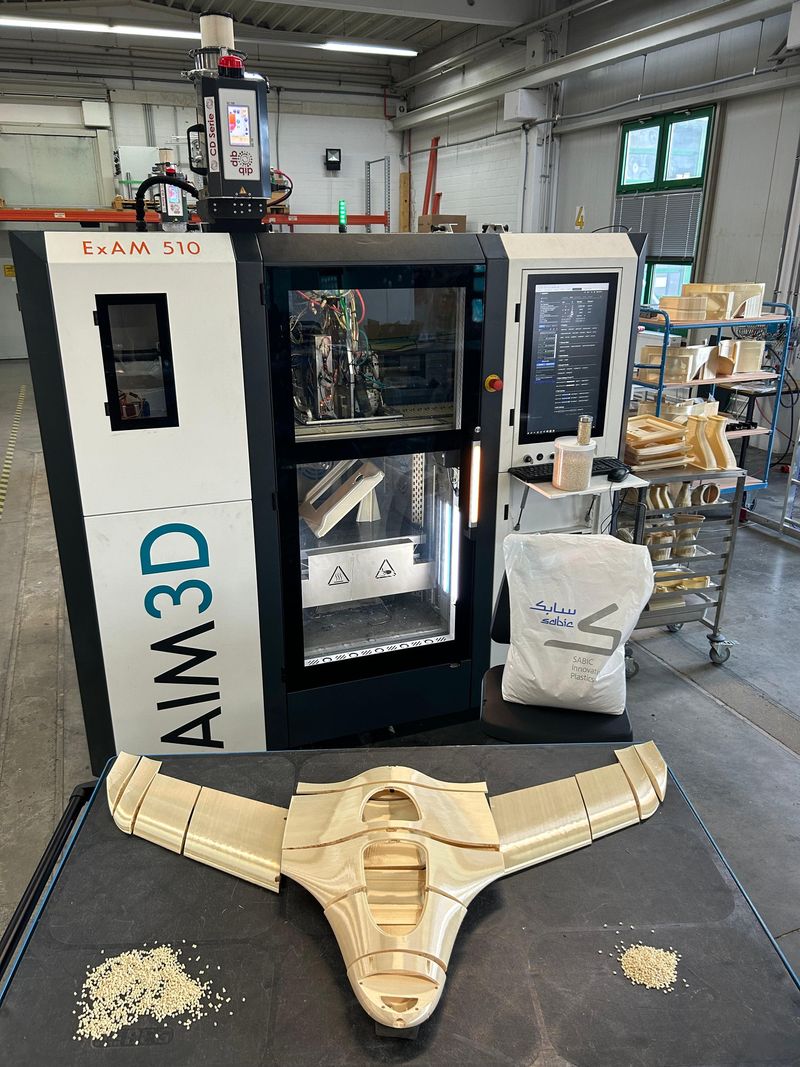
Granular printing (FGF) makes it cost-effective to produce large-format functional parts from high-performance polymers such as Ultem 9085.
(Bild: NEW AIM3D)
For a long time, 3D printing of plastics was considered the domain of prototyping. Those days are over: In mechanical engineering, electrical engineering, medical technology, and chemical engineering, additively manufactured polymer components are now used as ready-to-install functional parts—as replacement parts for discontinued components, as production equipment, or as series-produced parts in small batch sizes.
This fundamentally shifts the requirements. Whereas appearance and feel were sufficient for prototypes, industrial applications require continuous operating temperature, chemical resistance, dimensional stability, creep behavior, and reproducible mechanical properties. The choice of material thus becomes the central issue in any additive manufacturing strategy and determines whether 3D printing can be meaningfully integrated into supply chain and maintenance processes.
Trend 1: High-Performance Polymers Are Becoming Suitable for Industrial Use
The most noticeable trend in recent years: High-performance plastics, which were once reserved for the injection molding and machining industries, can now be reliably 3D printed. Leading the way is PEEK (polyetheretherketone), which has a continuous operating temperature of around 250 °C, excellent chemical resistance, and a mechanical property profile that allows it to replace metals in many applications—all at a fraction of the weight.
In addition, other members of the PAEK family are gaining ground: PEKK, with its slower crystallization rate, which makes the printing process more robust, and LM-PAEK, which was developed specifically for additive manufacturing. For applications with fire safety requirements—such as in rail technology or aviation—ULTEM 9085 (PEI) has become the standard. And PPS, often in the form of glass-fiber-reinforced PPS-GF20 or -GF40, offers an attractive balance of chemical resistance, temperature resistance, and material costs—especially for components in the process industry.
In practice, this means that the question is no longer whether a technical component can be manufactured using additive manufacturing, but rather which material meets the requirements in the most cost-effective way.
A Cost-Effective Alternative for High-Performance Polymers: PPS-GF for continuous use at temperatures up to 200 °C.
(Source: Malping)
Trend 2: Fiber-reinforced compounds bridge the stiffness gap
The second major trend is carbon- and glass-fiber-reinforced materials. Plastics such as PA12-CF15, PC-CF, or PEEK with 20% glass fiber or 30% carbon fiber content achieve stiffness levels that significantly exceed those of unreinforced polymers, thereby opening up applications such as fixtures, grippers, mounts, and structurally loaded replacement parts.
The downside: Fiber-reinforced compounds are highly abrasive and place high demands on processing technology—from wear-resistant nozzles to temperature management within the build chamber. Anyone who wants to process fiber-reinforced high-performance polymers reliably needs equipment and process expertise that go far beyond what a standard 3D printer offers. This is exactly where, in practice, the wheat is separated from the chaff: material data sheets describe the potential, but only a well-controlled process can turn that potential into reproducible part quality.
Trend 3: Granular Folding (FGF) Makes Large Components Cost-Effective
Perhaps the most exciting leap forward is currently taking place in granulate printing, known internationally as FGF (Fused Granulate Fabrication). Instead of filament, the printer uses standard plastic granules, such as those used in injection molding—with significant implications for cost-effectiveness: While PEEK filament costs between 500 and 700 euros per kilogram, depending on the type, the corresponding granules cost around 80 to 120 euros.
As a rule of thumb based on practical experience, granulate printing becomes more cost-effective than filament printing for parts with a volume of 300 cubic centimeters or more. This opens the door for FGF to produce large-volume functional parts made of high-performance plastics—a class of parts that, until now, had been machined, injection-molded, or simply not produced in plastic due to cost considerations. In combination with CNC post-processing, this results in components with additive base geometry that closely matches the final contours and machined functional surfaces with tight tolerances—in other words, the best of both manufacturing worlds.
Date: 08.12.2025
Naturally, we always handle your personal data responsibly. Any personal data we receive from you is processed in accordance with applicable data protection legislation. For detailed information please see our privacy policy.
Consent to the use of data for promotional purposes
I hereby consent to Vogel Communications Group GmbH & Co. KG, Max-Planck-Str. 7-9, 97082 Würzburg including any affiliated companies according to §§ 15 et seq. AktG (hereafter: Vogel Communications Group) using my e-mail address to send editorial newsletters. A list of all affiliated companies can be found here
Newsletter content may include all products and services of any companies mentioned above, including for example specialist journals and books, events and fairs as well as event-related products and services, print and digital media offers and services such as additional (editorial) newsletters, raffles, lead campaigns, market research both online and offline, specialist webportals and e-learning offers. In case my personal telephone number has also been collected, it may be used for offers of aforementioned products, for services of the companies mentioned above, and market research purposes.
Additionally, my consent also includes the processing of my email address and telephone number for data matching for marketing purposes with select advertising partners such as LinkedIn, Google, and Meta. For this, Vogel Communications Group may transmit said data in hashed form to the advertising partners who then use said data to determine whether I am also a member of the mentioned advertising partner portals. Vogel Communications Group uses this feature for the purposes of re-targeting (up-selling, cross-selling, and customer loyalty), generating so-called look-alike audiences for acquisition of new customers, and as basis for exclusion for on-going advertising campaigns. Further information can be found in section “data matching for marketing purposes”.
In case I access protected data on Internet portals of Vogel Communications Group including any affiliated companies according to §§ 15 et seq. AktG, I need to provide further data in order to register for the access to such content. In return for this free access to editorial content, my data may be used in accordance with this consent for the purposes stated here. This does not apply to data matching for marketing purposes.
Right of revocation
I understand that I can revoke my consent at will. My revocation does not change the lawfulness of data processing that was conducted based on my consent leading up to my revocation. One option to declare my revocation is to use the contact form found at https://contact.vogel.de. In case I no longer wish to receive certain newsletters, I have subscribed to, I can also click on the unsubscribe link included at the end of a newsletter. Further information regarding my right of revocation and the implementation of it as well as the consequences of my revocation can be found in the data protection declaration, section editorial newsletter.
Material Strategy in Spare Parts Management: Digital Storage Instead of Physical Storage
These material trends have their full strategic impact in spare parts management. The concept of the digital spare parts warehouse—that is, maintaining component data instead of physical inventory and printing spare parts on demand—stands or falls on the question of materials: Is the original material printable? If not, which additive material is functionally equivalent?
In practice, a requirements-driven approach has proven effective: First, determine which property actually limits the component—temperature, contact with media, mechanical load, or geometry. Only then is the material selected. A discontinued injection-molded part made of PA6-GF30 does not necessarily have to be reproduced in PA; depending on the load case, even a simple PLA or a carbon-fiber-reinforced polymer may be the more robust and long-term viable solution. This material substitution is the key to solving obsolescence problems, reducing inventory costs, and drastically shortening maintenance downtime. The time required for new procurement drops from several weeks to just a few days with on-demand printing.
A typical application example is housing components for high-voltage connectors: Here, stringent requirements for electrical insulation (dielectric strength and creepage current resistance) are combined with mechanical wear caused by repeated mating cycles. High-performance polymers such as PEEK combine both properties: high dielectric strength coupled with excellent abrasion and wear resistance. When manufactured using additive manufacturing, such a replacement part can be produced in just a few days from the digital data set—in a batch size of 1 and without tooling costs, and, upon request, including design adjustments such as optimized locking geometries or wall thicknesses revised for manufacturing efficiency.
AdditivX | September 22, 2026
Additive Manufacturing as a Tool for Supply Chain, Production, and Service
(Source: Vogel Communications Group / WIN Publishing)
The conference aims to demonstrate how 3D printing with plastics and metals can be used as a strategic tool for spare parts—regardless of the industry. The focus will be on materials, processes, cost-effectiveness, and integration into existing production and maintenance structures, including those from other areas of additive manufacturing.
Outlook: Materials, Processes, and Post-Processing Are Converging
The trend is clearly heading in one direction: additive manufacturing with high-performance plastics is evolving from a specialized process into an integral part of industrial manufacturing and service strategies. The range of materials is expanding, granulate printing is lowering the cost barrier for large components, and combining it with CNC machining solves the tolerance issue. Anyone developing a spare parts or small-batch production strategy today should address the material question at the very beginning, not at the end.
The presentation “High-Performance Materials in Plastic 3D Printing — From Prototype to Strategic Spare Parts Solution,” to be presented at the AdditivX conference on September 22, 2026, in Würzburg, featuring application examples from mechanical engineering, electrical engineering, and process engineering.
Info Box: Three Questions from Real-World Practice
Which material is suitable for 3D-printed replacement parts exposed to high temperatures and chemicals? For continuous operating temperatures up to about 250 °C and aggressive media, PEEK is the first choice; PPS-GF20 is the cost-effective alternative for more moderate requirements, while ULTEM 9085 is the standard for fire safety requirements.
At what point does granulate printing (FGF) become more cost-effective than filament printing (FFF)? As a rule of thumb, for part volumes of about 300 cm³ or more. The price difference between granules (approx. 80–120 €/kg for PEEK) and filament (500–700 €/kg) makes large parts produced using the FGF process significantly more cost-effective.
Can 3D-printed plastic components meet tight tolerances? Yes, through combined process chains: Additive manufacturing produces the basic geometry close to the final contour, while CNC machining brings functional surfaces, fits, and holes within tolerance.
Dr.-Ing. Bastian Gaedike Dr.-Ing. Bastian Gaedike ist Gründer und Geschäftsführer der Malping GmbH in Neuhausen auf den Fildern bei Stuttgart. Das Unternehmen ist auf die additive Fertigung von Hochleistungskunststoffen wie PEEK, PEKK und faserverstärkten Compounds spezialisiert und kombiniert Filamentdruck (FFF), Granulatdruck (FGF) und CNC-Nachbearbeitung zu durchgängigen Prozessketten für Industrie-Ersatzteile und Kleinserien.



:quality(80)/p7i.vogel.de/wcms/78/ce/78ce24a7ba8343ef49bc3dbb49016443/pasja1000-the-bottle-5128607v1.jpeg "The new plastic tax would amount to 0.28 cents for a yogurt cup and 1.93 cents for a large PET bottle. (Bild: pasja1000)")
:quality(80)/p7i.vogel.de/wcms/cc/db/ccdb09d1d9b3fcabf147abba7fd9e3c5/pasja1000-the-bottle-5128607v1.jpeg "The new plastic tax would amount to 0.28 cents for a yogurt cup and 1.93 cents for a large PET bottle. (Bild: pasja1000)")
:quality(80)/p7i.vogel.de/wcms/be/0a/be0a2864a5f59b0c9bca685dd23bdf79/pasja1000-the-bottle-5128607v1.jpeg "The new plastic tax would amount to 0.28 cents for a yogurt cup and 1.93 cents for a large PET bottle. (Bild: pasja1000)")
:quality(80)/p7i.vogel.de/wcms/b6/fe/b6fe83997fc68192cf8cd8a89b0bab5f/pasja1000-the-bottle-5128607v1.jpeg "The new plastic tax would amount to 0.28 cents for a yogurt cup and 1.93 cents for a large PET bottle. (Bild: pasja1000)")
:quality(80)/p7i.vogel.de/wcms/ce/ee/ceeeef086bfb174ebdda31c0dfccaf9a/2-weiss-blick-in-produktion-dji-0095-kopiev1.jpeg "A look inside the injection molding shop at Weiss Kunststoffverarbeitung in Illertissen, Bavaria. (Bild: White)")
:quality(80)/p7i.vogel.de/wcms/33/08/3308710c85715e917ec1baf9767fe4a7/2026-ewikon-wago-hei-kanalv1.png "Ewikon's 48-cavity hot runner as a production mold. (Bild: Ewikon)")
:quality(80)/p7i.vogel.de/wcms/a2/a5/a2a516dc69b4c8f8ad6f475ae6746a08/sxkh-bei-hpf-gesamtwerkzeugv1.png "The HMG 70XS1510 trimming press from the Chinese manufacturer SXKH combines all the functions required by toolmakers at HPF in a very compact design. The deciding factors in the purchase were the purchase price—and confidence in the quality of established international key components. (Bild: Pergler Media)")
:quality(80)/p7i.vogel.de/wcms/19/5f/195fdb6e09629994f1d6e3cf94dac8d8/bild-1-exam510-ultem9085v1.jpeg "Granular printing (FGF) makes it cost-effective to produce large-format functional parts from high-performance polymers such as Ultem 9085. (Bild: NEW AIM3D)")
:quality(80)/p7i.vogel.de/wcms/d5/c4/d5c46d40e1ae062370d058e2c006c376/dimitrisvetsikas1969-belgium-3595351v1.jpeg "European Plastics Industry Calls for Immediate Action to Address the Industry Crisis (Bild: dimitrisvetsikas1969)")
:quality(80)/p7i.vogel.de/wcms/e6/63/e663f0e1dd8818fc501c6fb5c5d33712/19-5689-circular-economy-of-resourcesv1.jpeg "Plastic waste from the average household is very heterogeneous. Only the right mix of technologies can turn all types of plastic waste into a new source of raw materials. (Bild: BASF)")
:quality(80)/p7i.vogel.de/wcms/31/5b/315b714f653484179232fbc4d6d79543/sesotec-img-andreas-hanus-25-20-281-29v1.jpeg "Andreas Hanus, Head of AI Development at Sesotec: “AI will not replace traditional sorting technology, but will intelligently enhance it.” (Bild: Sesotec)")
:quality(80)/p7i.vogel.de/wcms/74/5f/745f512239689819275af39a82f59860/b-brenkenv1.jpeg "Dr. Benedikt Brenken, Director of R-Cycle: \"The digital product passport will fundamentally change plastic recycling.\" (Bild: R-Cycle)")
:quality(80)/p7i.vogel.de/wcms/40/6d/406d05534ab4d28194bd29699e023e67/2026-09-09-uni-kiel-aufmacherv1.jpeg "These self-polarizing polymer coatings could be used in a wide variety of electronic components in the future. (Bild: University of Kiel/C. Anders)")
:quality(80)/p7i.vogel.de/wcms/5d/46/5d46e098a7cfaebdd9643df47153c5af/aufmacherv1.png "The PPWR imposes new requirements on packaging: What impact does this have on mechanical engineering? (Bild: KI-generiert / Dall-E)")
:quality(80)/p7i.vogel.de/wcms/70/13/7013fe202fb4790708f62f69cd0c83d4/aufmacher-st-c3-a4rkeschaumfoliev1.png "Using thermoplastic starch as a base, researchers at the IKV successfully produced a flexible foam film using physical blowing agents. (Bild: IKV)")
:quality(80)/p7i.vogel.de/wcms/d1/2b/d12b536ba3b382d0d138e342ac1038e6/03--20pm-imm-mgsv1.jpeg "MGS Richfield Site (Bild: MGS)")
:quality(80)/p7i.vogel.de/wcms/90/9c/909cf6eb1b91a9a84ff535033ea9b048/honeycombv1.jpeg "The composite material made of epoxy and glass fibers not only protects against flames but is also fully recyclable. (Bild: Empa)")
:quality(80)/p7i.vogel.de/wcms/6a/d5/6ad5980b0c965409c71582fc59145e13/1920-covestro-new-covestro-headquartersv1.jpeg "Covestro's corporate headquarters in Leverkusen (Bild: Covestro)")
:quality(80)/p7i.vogel.de/wcms/db/74/db741079d26ad9e7a69278fde45e79c7/aufmacherv1.png "(Bild: KI-generiert / Dall-E)")
:quality(80)/p7i.vogel.de/wcms/b3/65/b3654df434f4d31e1fda3c79bc7bb4b0/nakura-20kunstrasenteppich-20ohne-20verf-c3-bcllungv1.jpeg "Tecnaro has developed synthetic turf fibers using a specially formulated Arboblend blend that offers high resistance to heat, UV rays, and weathering, and, because it is niobium-based, sequesters CO₂ over the long term. (Bild: Tecnaro)")

:quality(80)/p7i.vogel.de/wcms/6e/28/6e285318b6c8cdbd41490469eb3ddd2d/bild--image-1v1.jpeg "Akro-Plastic will be exhibiting at Fakuma 2026 at the Feddersen Group's joint booth. (Bild: K.D. Feddersen)")
:quality(80)/p7i.vogel.de/wcms/a2/a5/a2a516dc69b4c8f8ad6f475ae6746a08/sxkh-bei-hpf-gesamtwerkzeugv1.png "The HMG 70XS1510 trimming press from the Chinese manufacturer SXKH combines all the functions required by toolmakers at HPF in a very compact design. The deciding factors in the purchase were the purchase price—and confidence in the quality of established international key components. (Bild: Pergler Media)")