Startup Palprint Custom-Fitted Packaging via 3D Printing
Source: Press release
Melanie Ehrhardt
| Translated by AI
3 min Reading Time
Single-use packaging remains a common feature of industrial logistics, particularly in the machinery and plant engineering sectors. Palprint aims to change that. Instead of producing packaging in standard sizes, the startup uses 3D printing to create packaging tailored specifically to individual components.
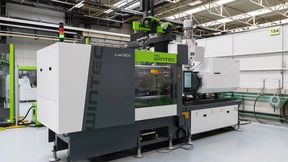
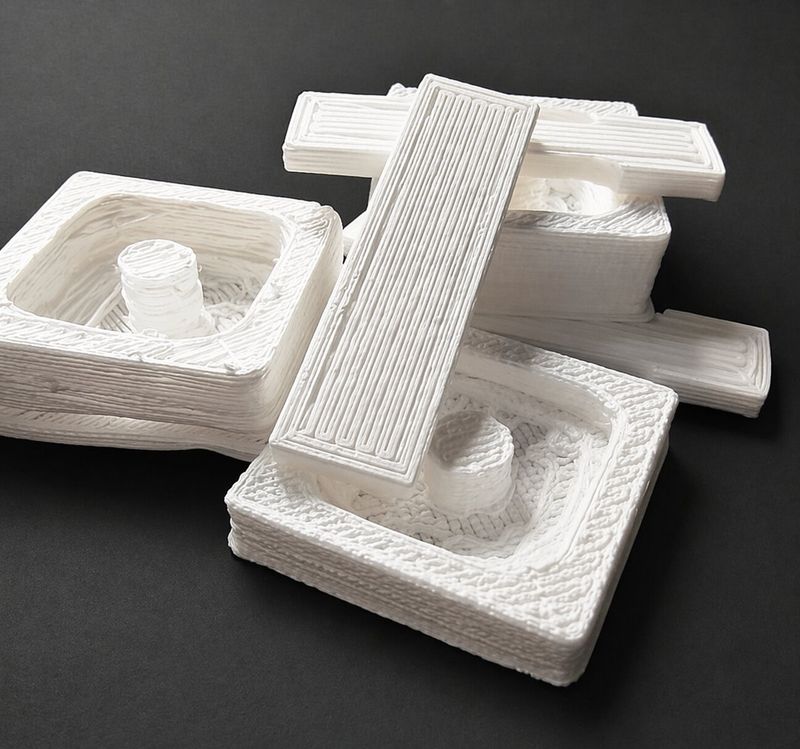
In collaboration with two Fraunhofer Institutes, the startup Palprint is developing a method for 3D printing based on PET foam.
(Bild: Palprint)
Oversized single-use packaging remains the norm in industrial logistics. The Paderborn-based startup Palprint wants to change this and is developing a system for a sustainable packaging cycle—with custom-fit plastic packaging produced via 3D printing from recycled PET. After use, they are almost entirely reused as raw material for new packaging.
The German Federal Environmental Foundation (DBU) is providing the start-up with 125,000 euros in funding. For many industries in Germany, efficient logistics are the “driving force behind successful business operations. The transport, handling, and storage of goods also offer many opportunities for greater sustainability—as well as options for economic optimization,” says DBU Secretary General Alexander Bonde.
Toward Greater Sustainability in Logistics
Palprint is a spin-off from Garage33, the University of Paderborn's startup center. The young company is currently focusing its efforts on mechanical and plant engineering to enable this industry in particular to manufacture custom packaging using 3D printing.
“We manufacture packaging in-house that is precisely tailored to each component,” explain the two founders, Paul Lindner and Andreas Ribul-Olzer. The material is recycled polyethylene terephthalate (rPET). This plastic is also used in many single-use and reusable bottles.
(Source: Palprint)
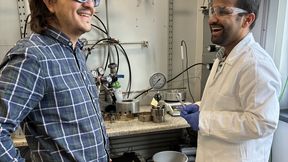
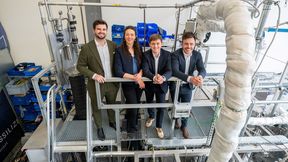
Palprint co-founders Paul Lindner (left) and Andreas Ribul-Olzer conceived their company at Garage33—a center for young entrepreneurs at the University of Paderborn.
The goal is to address the following challenge: “Companies often order large quantities of standardized packaging that isn’t designed for the specific components used in mechanical engineering and is oversized,” explain the Palprint founders. “This packaging requires costly storage and ends up in the trash after a single use.” Using its 3D method, the startup aims to significantly reduce this type of waste.
Palprint provides software and hardware as a complete system
In addition to manufacturing custom-fit packaging on a contract basis, Palprint primarily offers a system solution: Depending on customer needs, the startup supplies 3D printers from partner companies—complete with proprietary software and a supply of materials—and makes them available as a complete system. “With the help of such systems, a company can use 3D data to automatically generate packaging for the machine or replacement part to be packaged and print it on-site to fit perfectly,” explains Ribul-Olzer. The goal is to make operation as simple as possible.
Palprint is also collaborating with the Fraunhofer Institute for Manufacturing Engineering and Automation (IPA) and the Fraunhofer Institute for Chemical Technology (ICT) on a variant of 3D printing using PET foam. “Many people think of 3D printing as a slow process. But our foam expands to the desired size up to 75 percent faster and weighs up to 90 percent less,” Ribul-Olzer continued.
This allows the company to quickly produce even large volumes of packaging with a polystyrene-like feel. “The material remains recycled PET. The foam can be remelted and used for new packaging,” explains the Palprint co-founder.
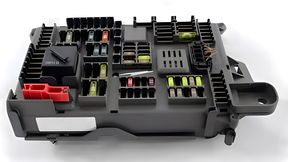
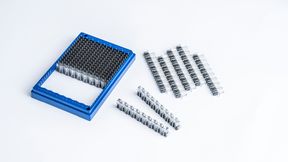
(Source: Palprint)
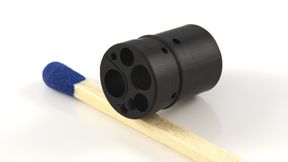
Just as shown here (photo) for transmission parts, the packaging produced by the 3D printer is precisely tailored to the contents—and is made from 100 percent recycled PET.
Keeping Raw Materials in the Cycle
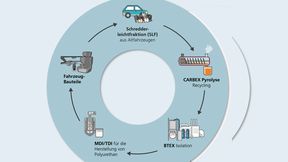
Palprint also aims to establish a recycling loop: “Once a certain amount of used packaging has accumulated in our system, we work with selected partner companies to collect the waste, recycle it, and reuse it as a new raw material,” explains Lindner. According to the co-founder, the startup’s packaging is made from nearly 100 percent recycled PET.
“This greatly simplifies recycling, since no materials need to be separated.” In this way, important raw materials would be kept in the cycle over the long term, and plastic waste would be minimized. Transportation and storage costs are also significantly reduced: “The only thing left is recycled plastics need to be delivered. These can be transported and stored in a space-saving manner,” says Lindner.
Reusable packaging and an accompanying deposit system are also planned. Lindner continued: “All of these approaches promote active environmental protection through a circular economy, material conservation, and waste reduction—at the same time, the system is intended to be more financially beneficial for companies than purchasing and storing ever-new single-use packaging.”
Date: 08.12.2025
Naturally, we always handle your personal data responsibly. Any personal data we receive from you is processed in accordance with applicable data protection legislation. For detailed information please see our privacy policy.
Consent to the use of data for promotional purposes
I hereby consent to Vogel Communications Group GmbH & Co. KG, Max-Planck-Str. 7-9, 97082 Würzburg including any affiliated companies according to §§ 15 et seq. AktG (hereafter: Vogel Communications Group) using my e-mail address to send editorial newsletters. A list of all affiliated companies can be found here
Newsletter content may include all products and services of any companies mentioned above, including for example specialist journals and books, events and fairs as well as event-related products and services, print and digital media offers and services such as additional (editorial) newsletters, raffles, lead campaigns, market research both online and offline, specialist webportals and e-learning offers. In case my personal telephone number has also been collected, it may be used for offers of aforementioned products, for services of the companies mentioned above, and market research purposes.
Additionally, my consent also includes the processing of my email address and telephone number for data matching for marketing purposes with select advertising partners such as LinkedIn, Google, and Meta. For this, Vogel Communications Group may transmit said data in hashed form to the advertising partners who then use said data to determine whether I am also a member of the mentioned advertising partner portals. Vogel Communications Group uses this feature for the purposes of re-targeting (up-selling, cross-selling, and customer loyalty), generating so-called look-alike audiences for acquisition of new customers, and as basis for exclusion for on-going advertising campaigns. Further information can be found in section “data matching for marketing purposes”.
In case I access protected data on Internet portals of Vogel Communications Group including any affiliated companies according to §§ 15 et seq. AktG, I need to provide further data in order to register for the access to such content. In return for this free access to editorial content, my data may be used in accordance with this consent for the purposes stated here. This does not apply to data matching for marketing purposes.
Right of revocation
I understand that I can revoke my consent at will. My revocation does not change the lawfulness of data processing that was conducted based on my consent leading up to my revocation. One option to declare my revocation is to use the contact form found at https://contact.vogel.de. In case I no longer wish to receive certain newsletters, I have subscribed to, I can also click on the unsubscribe link included at the end of a newsletter. Further information regarding my right of revocation and the implementation of it as well as the consequences of my revocation can be found in the data protection declaration, section editorial newsletter.
INFO
Through its Green Startup grant program, the DBU supports entrepreneurs who develop solutions for the environment, ecology, and sustainability in innovative and economically viable ways.