An Alternative to the Volatile Petrochemical IndustryBioplastics Are Moving Beyond Their Niche
From
Matthias Gutbrod
| Translated by AI
7 min Reading Time
Driven by technological breakthroughs and oil price shocks, biopolymers are emerging from their niche market. Processors see bio-based materials as a strategic tool for reducing their dependence on volatile fossil fuel sources. Regulatory measures could also provide a boost to the biopolymer market in the future.
Bioplastics are no longer just an environmental fad, but an economic factor.
(Bild: stock.adobe.com - thingamajiggs)
The global bioplastics market will reach a structural turning point in 2026. While the petrochemical industry struggles with increasing regulatory restrictions and volatile oil prices, the bioplastics sector is establishing itself as a cornerstone of industrial transformation. Estimates put the market volume for 2025 at $18.4 billion. Forecasts point to massive expansion that could reach over $93 billion by 2036, corresponding to an average annual growth rate of 15.9%.
Low market penetration with a steep growth curve
Currently, global production capacity for bio-based plastics stands at approximately 2.31 million metric tons. Industry experts expect this figure to more than double to about 4.69 million metric tons by 2030. Despite this momentum, bioplastics currently account for only about 0.5% to 0.6% of the world’s total plastic production of 431 million metric tons. This low market penetration, coupled with a steep growth curve, signals enormous substitution potential that will be realized in the coming years through economies of scale and regulatory levers.
“The steady increase in bioplastics production underscores our industry’s role in supporting a more sustainable circular economy,” says Hasso von Pogrell, Executive Director of European Bioplastics (EUBP).
Hasso von Pogrell, Managing Director of European Bioplastics: Bioplastics support a sustainable circular economy.
(Bild: obs/European Bioplastics/Benita Zabel)
Geographically, production is shifting noticeably. Although Asia will still dominate in 2025 with 55.6% of global capacity, Europe and North America are experiencing above-average growth. Europe already accounts for about 43% of global revenue, which is primarily attributable to the consistent implementation of the Single-Use Plastics Directive and ambitious circular economy frameworks. Capacity utilization in the industry has stabilized at 72%, with Europe, at 73%, demonstrating more efficient integration into downstream processing chains.
Region
CAGR (2026–2036) Prognose
Marktanteil Kapazität 2025
Markttreiber
China
16,2 %
~20,0 %
Produktionsskalierung, nationale Verbote
Europa (EU27+3)
19,1 %
14,7 %
Innovationen, PPWR, ELVR, Green Deal
USA
15,8 %
~15-18 %
Nachhaltigkeitszusagen von Markenherstellern
Indien
15,0 %
k.A.
Verbot von Einwegplastik, Rohstoffbasis
Japan
15,2 %
k.A.
Reife Kreislaufwirtschaft, Materialinnovation
Biopolymers as a Shield Against Oil Price Shocks
The economic rationale for using bioplastics has fundamentally changed. Plastics processors’ dependence on fossil raw materials will become even more pronounced in 2026, as strategic risk. Bioplastics serve as a buffer against geopolitical instability in oil-producing regions, as they diversify the raw material base to include renewable resources such as corn starch, sugarcane, cellulose, or agricultural residues.
The EU Economic Security Strategy now identifies dependencies on critical raw materials as potential “armed dependencies.” In this context, the bioeconomy strengthens Europe’s strategic autonomy. The sector already generates annual value added of 3.2 billion euros in the EU and supports 57,000 jobs.
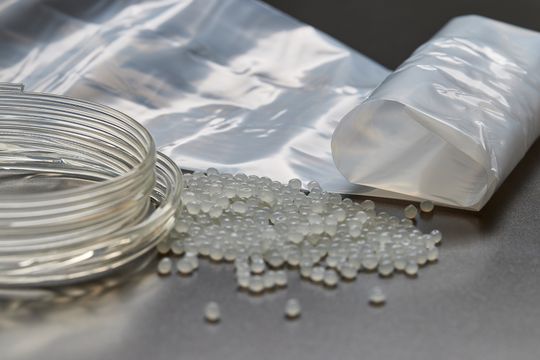
This innovative PLA material can be processed into film on standard processing equipment in a manner similar to LDPE.
(Bild: Fraunhofer IAP - Piotr Banczerowski)
A key trend is the increased use of second-generation feedstocks to minimize competition for land with food production. “Purchasing managers who secure off-take agreements directly with PLA and PHA producers will achieve measurable cost stability,” says Shambhu Nath Jha, Principal Consultant for Chemicals at Fact.MR. Such off-take agreements allow processors to circumvent the volatility of the spot market for recycled materials and virgin fossil-based feedstock.
The Path to Price Parity in Specific Market Segments
For many plastics processors, the issue of cost remains the main hurdle. On average, production costs for biopolymers in 2026 will still be 1.5 to 2 times higher than those of their fossil-based counterparts. For specialized, compostable grades, the price premiums often range from 50% to 100%. Nevertheless, a convergence is emerging: Rising regulatory costs for fossil-based plastics—such as CO2 levies and plastic taxes—are narrowing the price gap.
A turning point is projected to occur between 2026 and 2028, particularly for polylactic acid (PLA). The current price premium of 20% to 30% compared to standard fossil-based polymers is shrinking dramatically due to economies of scale and technological maturity. Bio-polyethylene (Bio-PE) already carries a premium of only 10% to 20% today, as it can be efficiently integrated into existing PE production facilities. Starch blends have already partially achieved price parity in some applications, aided by low raw material costs for waste starch.
Material
Preisaufschlag zu ähnlichen fossilen Anwendungen (2025)
Prognostizierte Preisparität
Hauptfaktor
PLA
20–30 %
2026–2028
Skalierung der Produktion, Reife der Technologie
PHA
50–100 %
2030–2035
Fermentationsoptimierung, Nischenanwendungen
Bio-PE
10–20 %
2027–2030
Integration in bestehende PE-Anlagen
Stärkeblends
5–15 %
Bereits teilweise erreicht
Geringe Rohstoffkosten für Abfallstärke
PPWR and ELVR Expected to Provide a Boost
The implementation of the European Packaging Regulation (PPWR) and the End-of-Life Vehicles Regulation (ELVR) redefines the material requirements for the next two decades. The PPWR (Regulation 2025/40) took effect in February 2025 and will become largely mandatory as of August 12, 2026. By 2030, all packaging on the EU market must be recyclable, with bio-based drop-in solutions such as bio-PE and bio-PET having an advantage because they utilize existing infrastructure.
Date: 08.12.2025
Naturally, we always handle your personal data responsibly. Any personal data we receive from you is processed in accordance with applicable data protection legislation. For detailed information please see our privacy policy.
Consent to the use of data for promotional purposes
I hereby consent to Vogel Communications Group GmbH & Co. KG, Max-Planck-Str. 7-9, 97082 Würzburg including any affiliated companies according to §§ 15 et seq. AktG (hereafter: Vogel Communications Group) using my e-mail address to send editorial newsletters. A list of all affiliated companies can be found here
Newsletter content may include all products and services of any companies mentioned above, including for example specialist journals and books, events and fairs as well as event-related products and services, print and digital media offers and services such as additional (editorial) newsletters, raffles, lead campaigns, market research both online and offline, specialist webportals and e-learning offers. In case my personal telephone number has also been collected, it may be used for offers of aforementioned products, for services of the companies mentioned above, and market research purposes.
Additionally, my consent also includes the processing of my email address and telephone number for data matching for marketing purposes with select advertising partners such as LinkedIn, Google, and Meta. For this, Vogel Communications Group may transmit said data in hashed form to the advertising partners who then use said data to determine whether I am also a member of the mentioned advertising partner portals. Vogel Communications Group uses this feature for the purposes of re-targeting (up-selling, cross-selling, and customer loyalty), generating so-called look-alike audiences for acquisition of new customers, and as basis for exclusion for on-going advertising campaigns. Further information can be found in section “data matching for marketing purposes”.
In case I access protected data on Internet portals of Vogel Communications Group including any affiliated companies according to §§ 15 et seq. AktG, I need to provide further data in order to register for the access to such content. In return for this free access to editorial content, my data may be used in accordance with this consent for the purposes stated here. This does not apply to data matching for marketing purposes.
Right of revocation
I understand that I can revoke my consent at will. My revocation does not change the lawfulness of data processing that was conducted based on my consent leading up to my revocation. One option to declare my revocation is to use the contact form found at https://contact.vogel.de. In case I no longer wish to receive certain newsletters, I have subscribed to, I can also click on the unsubscribe link included at the end of a newsletter. Further information regarding my right of revocation and the implementation of it as well as the consequences of my revocation can be found in the data protection declaration, section editorial newsletter.
At the same time, the PPWR mandates minimum percentages of post-consumer recycled content (PCR): 30% for PET beverage bottles and 35% for other plastic packaging by 2030. The regulation guarantees a specific market segment for biodegradable plastics: tea bags, fruit stickers, and very lightweight plastic carrier bags must be industrially compostable. In addition, the ban on PFAS in food packaging, effective August 2026, is driving the development of bio-based barrier coatings made from PHA or cellulose.
In the automotive industry, the new ELVR (End-of-Life Vehicles Regulation) is driving change. A political compromise reached in December 2025 calls for a 25% recycled content requirement for plastics in new vehicles. Bio-based plastics are not yet directly counted toward these targets, but the European Commission is required to assess their environmental performance by 2032.
This could pave the way for high-performance biopolymers such as bio-polyamides (Bio-PA) to be used in technical components in the automotive industry. The market for automotive bioplastics is projected to grow to $4.39 billion by 2033. Price parity is primarily achieved in high-end segments, where Bio-PA 11 or Bio-PA 6.10 replace specialty fossil-based polymers, as they offer comparable or better technical properties (e.g., chemical resistance) with a lower CO2 footprint.
François de Bie, Senior Marketing Director at Total Energies Corbion: “The future of plastics does not lie in one material replacing another.”
(Bild: Total Energies Corbion)
“Competitive differentiation has shifted from mere sustainability claims to performance parity,” says Nikhil Kaitwade, Principal Consultant for Sustainable Materials at Future Market Insights. François de Bie, Senior Marketing Director at Total Energies Corbion, adds: “The future of plastics does not lie in one material replacing another—it’s about building a smarter, more balanced system.”
Substitution Check: Where Biopolymers Are Making a Difference Now
For processors, the transition to bioplastics involves technological considerations. Drop-in solutions such as bio-PE and bio-PP pose the least risk, as they can be processed on standard injection molding machines without tooling modifications and are fully recyclable. The situation is different for specialized polymers such as PLA or PHA, which require a narrower processing window and precise pre-drying. And when designing injection molding tools, the different shrinkage rates of PLA compared to polypropylene or polystyrene must be taken into account.
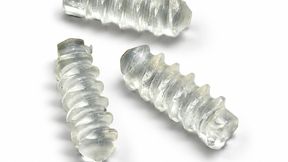
In the medical technology sector, PLA is already a leading material due to its biocompatibility. The market for bio-based medical devices is is expected to grow to $6.6 billion by 2035. Top applications include bioresorbable implants, surgical sutures, and 3D-printed scaffolds for bone regeneration. The latter achieve mechanical strength superior to that of fossil-based polymers through the combination of PLA, PHA, and hydroxyapatite.
In the packaging sector, the focus is on active systems and high-performance barriers. Researchers have demonstrated that PLA-PHA spray coatings on paper drastically reduce oxygen permeability and double mechanical strength. In agriculture, biodegradable mulch films are increasingly replacing PE films because they can be plowed back into the soil after harvest, thereby saving on expensive collection and cleanup costs.
Strategic Importance for European Processors
An analysis of the market situation in 2026 makes it clear: Bioplastics are no longer just an environmental gimmick, but an economic factor. Major players such as BASF, Total Energies Corbion, and Nature Works will continue to expand their capacities, while startups in the field of PHA production (e.g., through CO2 sequestration or waste recycling) are tapping into new sources of raw materials.
A new PPSU from BASF is designed to incorporate biogenic residues into applications such as medical technology and baby products using a certified mass balance approach. BASF
(Bild: BASF)
Achieving price parity will not be an abrupt event, but rather a gradual process accelerated by rising CO2 costs for fossil-based plastics and falling production costs for biopolymers. And in the long term, decoupling from fossil-based supply chains offers a level of planning certainty that conventional plastics can no longer provide.
Companies in the automotive and packaging sectors should view bioplastics not merely as a substitute material, but as an enabler for new, circular business models that meet the requirements of a climate-neutral economy by 2050.
8th International BIOPOLYMER Congress
(Source: PlastXnow/Polykum)
The International Congress on the Future of the Plastics Industry will take place on June 15 and 16 June 2026 at the Georg-Friedrich-Händel-Halle in Halle (Saale) and is considered the leading platform for bio-based and biodegradable plastics. The event brings together decision-makers, end-users, and experts from industry and research to discuss current developments across the entire value chain. Participants benefit from international networking with stakeholders from over 40 countries, as well as technical presentations by leading industry experts that demonstrate how sustainable materials and technologies are already being successfully used today—not as a vision of the future, but as real solutions for industrial applications. In addition, the congress offers a first-class exchange of knowledge and experience, as well as an accompanying field trip where participants can experience the processing, production, and application of biopolymers firsthand.