Additive TransformationHow Additive Manufacturing Turns a Technology into a Business Model
A guest post by
Ralf Anderhofstadt, Head of CSP Sourcing & Center of Competence for Additive Manufacturing (3D Printing), Daimler Trucks & Buses | Translated by AI
6 min Reading Time
From the prototype workshop to the digital supply chain: Why industrial 3D printing today is less about manufacturing and more about data—and what companies can learn from a mass-production operation that has incorporated over 150,000 3D-printed production and replacement parts.
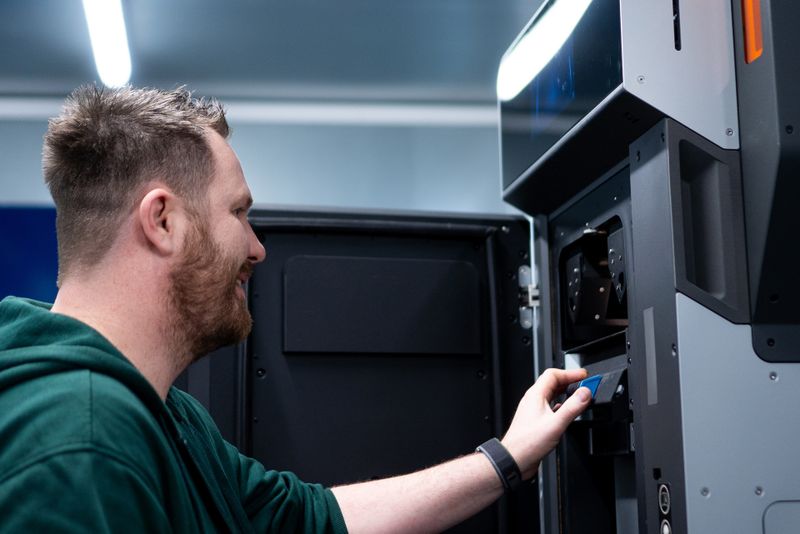
Where traditional tool manufacturing reaches its economic limits, that is often where the added value of industrial 3D printing begins.
(Bild: Daimler Trucks & Buses)
Anyone who has followed the evolution of 3D printing along the Gartner Hype Cycle is familiar with the well-known pattern: the technological breakthrough was followed by a peak of inflated expectations. The vision was that, in the future, virtually any component could be printed anytime, anywhere. Then disillusionment set in, and many observers declared the technology a failure.
A Technology Comes of Age
Today, however, the picture is different. It is only after passing through this “valley of disappointment” that a technology realizes its industrial value. That is exactly where additive manufacturing stands today. What began as a tool for prototypes has evolved into a robust production technology. Between these two stages of development lie years of material development, process qualification, and standardization, as well as the establishment of quality and liability systems. The decisive shift is this: away from rapid prototyping and toward direct manufacturing.
At Daimler Truck & Buses, the portfolio now includes high-strength production parts, replacement parts, assembly aids, fixtures, custom solutions, classic car components, and so-called emergency parts. However, another development is particularly exciting: the sale of manufacturing licenses. The focus here is not on the physical component itself, but on the right to manufacture that component (decentrally).
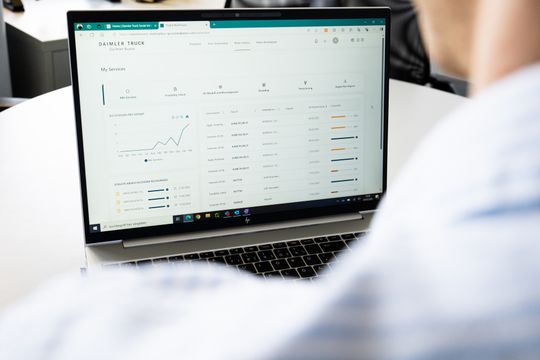
Digital models are stored in the Digital Warehouse and made available in a protected manner through various digital rights management solutions.
(Bild: Daimler Trucks & Buses)
Why the Time Is Right
The operating environment for manufacturing companies is changing rapidly. A shortage of skilled workers is increasing the pressure to automate. Sustainability goals require a more efficient use of resources. Uncertain markets make flexible supply chains essential. At the same time, demands for product customization and the pace of innovation are on the rise.
Additive manufacturing does not solve these challenges on its own, but it does address several of them at once. The advantages are clear: no minimum order quantities, tool-free manufacturing, high design freedom, shorter development times, and on-demand production.
There are also environmental benefits. The additive manufacturing process reduces material waste, enables decentralized production, and shortens transportation distances. The greatest potential, however, lies in the digitization of inventory.
AdditivX | September 22, 2026
Additive Manufacturing as a Tool for Supply Chain, Production, and Service
(Source: Vogel Communications Group / WIN Publishing)
The conference aims to demonstrate how 3D printing with plastics and metals can be used as a strategic tool for spare parts—regardless of the industry. The focus will be on materials, processes, cost-effectiveness, and integration into existing production and maintenance structures, including those from other areas of additive manufacturing.
This is particularly evident in the spare parts business. Over the course of a vehicle’s entire lifespan, it is difficult to forecast demand for many spare parts. To ensure a steady supply, components are often manufactured in advance and stored for years. As a result, a significant proportion of the parts produced are never needed.
At the same time, inventory management, tied-up capital, and logistics incur significant costs. This is precisely where additive manufacturing really shines. Low-volume items, small production runs, discontinued parts, or custom customer requests can be produced on demand. The added value of industrial 3D printing often begins where traditional tooling reaches its economic limits.
Real-world evidence instead of a pilot project
The figures from Daimler Buses’ ongoing operations demonstrate that this model works. More than 150,000 3D-printed parts have already been sold and installed in Mercedes-Benz and Setra buses. Over 800 different production parts have been approved and qualified. In addition, thousands more potential 3D-printed parts have been identified.
The economic benefits are measurable: significant savings on tooling, inventory, and scrap costs, as well as significantly shorter lead times. For selected slow-moving items, these can be reduced by up to 80%. At the same time, the 3D printing license shop is being gradually rolled out to additional markets.
The most important insight: It's not about the printer
Many companies still view additive manufacturing primarily as a machinery or technology project. However, practical experience shows that the biggest challenges lie elsewhere.
Date: 08.12.2025
Naturally, we always handle your personal data responsibly. Any personal data we receive from you is processed in accordance with applicable data protection legislation. For detailed information please see our privacy policy.
Consent to the use of data for promotional purposes
I hereby consent to Vogel Communications Group GmbH & Co. KG, Max-Planck-Str. 7-9, 97082 Würzburg including any affiliated companies according to §§ 15 et seq. AktG (hereafter: Vogel Communications Group) using my e-mail address to send editorial newsletters. A list of all affiliated companies can be found here
Newsletter content may include all products and services of any companies mentioned above, including for example specialist journals and books, events and fairs as well as event-related products and services, print and digital media offers and services such as additional (editorial) newsletters, raffles, lead campaigns, market research both online and offline, specialist webportals and e-learning offers. In case my personal telephone number has also been collected, it may be used for offers of aforementioned products, for services of the companies mentioned above, and market research purposes.
Additionally, my consent also includes the processing of my email address and telephone number for data matching for marketing purposes with select advertising partners such as LinkedIn, Google, and Meta. For this, Vogel Communications Group may transmit said data in hashed form to the advertising partners who then use said data to determine whether I am also a member of the mentioned advertising partner portals. Vogel Communications Group uses this feature for the purposes of re-targeting (up-selling, cross-selling, and customer loyalty), generating so-called look-alike audiences for acquisition of new customers, and as basis for exclusion for on-going advertising campaigns. Further information can be found in section “data matching for marketing purposes”.
In case I access protected data on Internet portals of Vogel Communications Group including any affiliated companies according to §§ 15 et seq. AktG, I need to provide further data in order to register for the access to such content. In return for this free access to editorial content, my data may be used in accordance with this consent for the purposes stated here. This does not apply to data matching for marketing purposes.
Right of revocation
I understand that I can revoke my consent at will. My revocation does not change the lawfulness of data processing that was conducted based on my consent leading up to my revocation. One option to declare my revocation is to use the contact form found at https://contact.vogel.de. In case I no longer wish to receive certain newsletters, I have subscribed to, I can also click on the unsubscribe link included at the end of a newsletter. Further information regarding my right of revocation and the implementation of it as well as the consequences of my revocation can be found in the data protection declaration, section editorial newsletter.
Effective processes for approvals, quality assurance, product liability, procurement, logistics, and sales are crucial. That is why additive manufacturing at Daimler Buses was established not as an isolated technology, but as a holistic business model. Specialized teams from development, procurement, logistics, quality, sales, and product management work closely together throughout the entire value chain. The most important lesson for other companies is therefore this: Additive manufacturing rarely fails because of the printer. It fails because of a lack of processes.
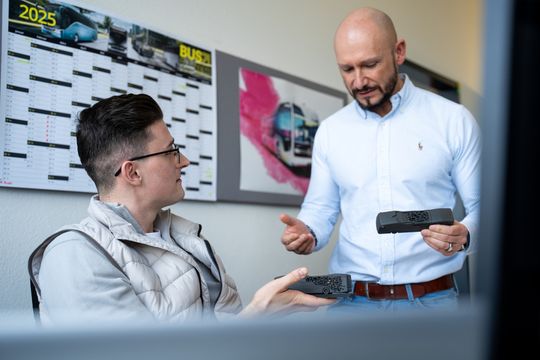
The key shift is this: moving away from rapid prototyping and toward direct manufacturing. At Daimler Truck & Buses, the portfolio now includes high-strength production parts, replacement parts, assembly aids, fixtures, custom solutions, classic car components, and so-called emergency parts.
(Bild: Daimler Trucks & Buses)
From a physical warehouse to a digital warehouse
The actual transformation takes place in three steps. First, suitable components are identified and digitized. The data models are then stored in a digital warehouse instead of maintaining a physical inventory. If a customer needs a part later on, it is produced in accordance with defined quality standards.
This fundamentally shifts the value chain. It is no longer the physical component that moves through global supply chains, but rather the digital twin for industrial 3D printing. A physical supply chain becomes a digital supply chain.
The Key Bottleneck: Data Security
This is precisely where the real innovation begins. After all, anyone who distributes design data without protection loses control over quality, liability, and intellectual property. Products could be manufactured or modified without authorization.
Daimler Buses was therefore one of the few companies in the automotive sector to develop the world’s first comprehensive license management system of its kind. Digital models are stored in the Digital Warehouse and made available in a protected manner via various digital rights management solutions. This creates a fully integrated end-to-end solution comprising a digital warehouse, license management, data security, and decentralized manufacturing.
The result: A physical replacement part becomes a digital product with controlled usage.
Rethinking Sustainability
The discussion about sustainability often focuses on the energy consumption of the printing process. However, the most significant impact occurs elsewhere. The greatest potential for savings lies in avoiding unnecessary production, reducing inventory, and eliminating numerous shipments. Digital warehousing can enable significant CO2 savings, as can the transmission of data instead of physical goods. It is not printing itself that significantly changes the carbon footprint, but rather the avoidance of overproduction and transportation.
Das Video ist eine Produktion des Digitalisierungszentrum Ulm I Alb-Donau I Biberach.
From a Center of Excellence to a New Business Model
The next stage of development is already underway. The internal Center of Competence is evolving into Additive Manufacturing Solutions (AMS) by Daimler Truck, an expanded offering for external customers. The experience gained in the bus business serves as a blueprint for other industries facing similar challenges, including classic cars, caravanning, agricultural technology, and maritime applications. The offerings range from part screening and component digitization to licensing models and customization, all the way through to series production and process consulting.
The Real Message
A look into the future shows that industrial 3D printing is just one component of a broader digital transformation. Digital twins, digital warehouses, automated supply chains, and data-driven business models will increasingly converge.
The most important message, therefore, is not: “Buy a 3D printer.” The crucial question is: Which components can be digitized, who owns the data, and how can quality, product liability, and usage rights be reliably managed?
The hardware is available today. The sustainable competitive advantage lies in the processes, data models, and business models surrounding additive manufacturing. That is precisely where the line is drawn between those who merely use industrial 3D printing—and those who are shaping the supply chains of the future with it.
Ralf Anderhofstadt Ralf Anderhofstadt ist Head of Additive Manufacturing & Additive Manufacturing Solutions (AMS) by Daimler Truck; Head of Customer Services & Parts Sourcing; Erweiterer Vorstand Verband 3DDruck e.V. für Digitalisierung & Logistik, Autor.



:quality(80)/p7i.vogel.de/wcms/78/ce/78ce24a7ba8343ef49bc3dbb49016443/pasja1000-the-bottle-5128607v1.jpeg "The new plastic tax would amount to 0.28 cents for a yogurt cup and 1.93 cents for a large PET bottle. (Bild: pasja1000)")
:quality(80)/p7i.vogel.de/wcms/cc/db/ccdb09d1d9b3fcabf147abba7fd9e3c5/pasja1000-the-bottle-5128607v1.jpeg "The new plastic tax would amount to 0.28 cents for a yogurt cup and 1.93 cents for a large PET bottle. (Bild: pasja1000)")
:quality(80)/p7i.vogel.de/wcms/be/0a/be0a2864a5f59b0c9bca685dd23bdf79/pasja1000-the-bottle-5128607v1.jpeg "The new plastic tax would amount to 0.28 cents for a yogurt cup and 1.93 cents for a large PET bottle. (Bild: pasja1000)")
:quality(80)/p7i.vogel.de/wcms/b6/fe/b6fe83997fc68192cf8cd8a89b0bab5f/pasja1000-the-bottle-5128607v1.jpeg "The new plastic tax would amount to 0.28 cents for a yogurt cup and 1.93 cents for a large PET bottle. (Bild: pasja1000)")
:quality(80)/p7i.vogel.de/wcms/ce/ee/ceeeef086bfb174ebdda31c0dfccaf9a/2-weiss-blick-in-produktion-dji-0095-kopiev1.jpeg "A look inside the injection molding shop at Weiss Kunststoffverarbeitung in Illertissen, Bavaria. (Bild: White)")
:quality(80)/p7i.vogel.de/wcms/33/08/3308710c85715e917ec1baf9767fe4a7/2026-ewikon-wago-hei-kanalv1.png "Ewikon's 48-cavity hot runner as a production mold. (Bild: Ewikon)")
:quality(80)/p7i.vogel.de/wcms/a2/a5/a2a516dc69b4c8f8ad6f475ae6746a08/sxkh-bei-hpf-gesamtwerkzeugv1.png "The HMG 70XS1510 trimming press from the Chinese manufacturer SXKH combines all the functions required by toolmakers at HPF in a very compact design. The deciding factors in the purchase were the purchase price—and confidence in the quality of established international key components. (Bild: Pergler Media)")
:quality(80)/p7i.vogel.de/wcms/19/5f/195fdb6e09629994f1d6e3cf94dac8d8/bild-1-exam510-ultem9085v1.jpeg "Granular printing (FGF) makes it cost-effective to produce large-format functional parts from high-performance polymers such as Ultem 9085. (Bild: NEW AIM3D)")
:quality(80)/p7i.vogel.de/wcms/d5/c4/d5c46d40e1ae062370d058e2c006c376/dimitrisvetsikas1969-belgium-3595351v1.jpeg "European Plastics Industry Calls for Immediate Action to Address the Industry Crisis (Bild: dimitrisvetsikas1969)")
:quality(80)/p7i.vogel.de/wcms/e6/63/e663f0e1dd8818fc501c6fb5c5d33712/19-5689-circular-economy-of-resourcesv1.jpeg "Plastic waste from the average household is very heterogeneous. Only the right mix of technologies can turn all types of plastic waste into a new source of raw materials. (Bild: BASF)")
:quality(80)/p7i.vogel.de/wcms/31/5b/315b714f653484179232fbc4d6d79543/sesotec-img-andreas-hanus-25-20-281-29v1.jpeg "Andreas Hanus, Head of AI Development at Sesotec: “AI will not replace traditional sorting technology, but will intelligently enhance it.” (Bild: Sesotec)")
:quality(80)/p7i.vogel.de/wcms/74/5f/745f512239689819275af39a82f59860/b-brenkenv1.jpeg "Dr. Benedikt Brenken, Director of R-Cycle: \"The digital product passport will fundamentally change plastic recycling.\" (Bild: R-Cycle)")
:quality(80)/p7i.vogel.de/wcms/40/6d/406d05534ab4d28194bd29699e023e67/2026-09-09-uni-kiel-aufmacherv1.jpeg "These self-polarizing polymer coatings could be used in a wide variety of electronic components in the future. (Bild: University of Kiel/C. Anders)")
:quality(80)/p7i.vogel.de/wcms/5d/46/5d46e098a7cfaebdd9643df47153c5af/aufmacherv1.png "The PPWR imposes new requirements on packaging: What impact does this have on mechanical engineering? (Bild: KI-generiert / Dall-E)")
:quality(80)/p7i.vogel.de/wcms/70/13/7013fe202fb4790708f62f69cd0c83d4/aufmacher-st-c3-a4rkeschaumfoliev1.png "Using thermoplastic starch as a base, researchers at the IKV successfully produced a flexible foam film using physical blowing agents. (Bild: IKV)")
:quality(80)/p7i.vogel.de/wcms/d1/2b/d12b536ba3b382d0d138e342ac1038e6/03--20pm-imm-mgsv1.jpeg "MGS Richfield Site (Bild: MGS)")
:quality(80)/p7i.vogel.de/wcms/90/9c/909cf6eb1b91a9a84ff535033ea9b048/honeycombv1.jpeg "The composite material made of epoxy and glass fibers not only protects against flames but is also fully recyclable. (Bild: Empa)")
:quality(80)/p7i.vogel.de/wcms/6a/d5/6ad5980b0c965409c71582fc59145e13/1920-covestro-new-covestro-headquartersv1.jpeg "Covestro's corporate headquarters in Leverkusen (Bild: Covestro)")
:quality(80)/p7i.vogel.de/wcms/db/74/db741079d26ad9e7a69278fde45e79c7/aufmacherv1.png "(Bild: KI-generiert / Dall-E)")
:quality(80)/p7i.vogel.de/wcms/b3/65/b3654df434f4d31e1fda3c79bc7bb4b0/nakura-20kunstrasenteppich-20ohne-20verf-c3-bcllungv1.jpeg "Tecnaro has developed synthetic turf fibers using a specially formulated Arboblend blend that offers high resistance to heat, UV rays, and weathering, and, because it is niobium-based, sequesters CO₂ over the long term. (Bild: Tecnaro)")

:quality(80)/p7i.vogel.de/wcms/19/5f/195fdb6e09629994f1d6e3cf94dac8d8/bild-1-exam510-ultem9085v1.jpeg "Granular printing (FGF) makes it cost-effective to produce large-format functional parts from high-performance polymers such as Ultem 9085. (Bild: NEW AIM3D)")
:quality(80)/p7i.vogel.de/wcms/b7/b9/b7b9e879b37c06934f568fc3e96daac7/unusual-20machines-copy-4000x2250v1v1.jpeg "Rotor Riot SkyLite FPV drone equipped with MJF-manufactured parts. (Bild: Unusual Machines)")