Additive Manufacturing in Vehicle InteriorsHeadrests made from printed monomaterial
From
Matthias Gutbrod
3 min Reading Time
As part of the Vision O circular strategy, Škoda Auto is demonstrating the potential of additive manufacturing for mass production. By using Ultrasint TPU in a honeycomb structure, the company is able to combine complex mechanical requirements—such as damping and dimensional stability—in a single component without relying on conventional composite solutions.
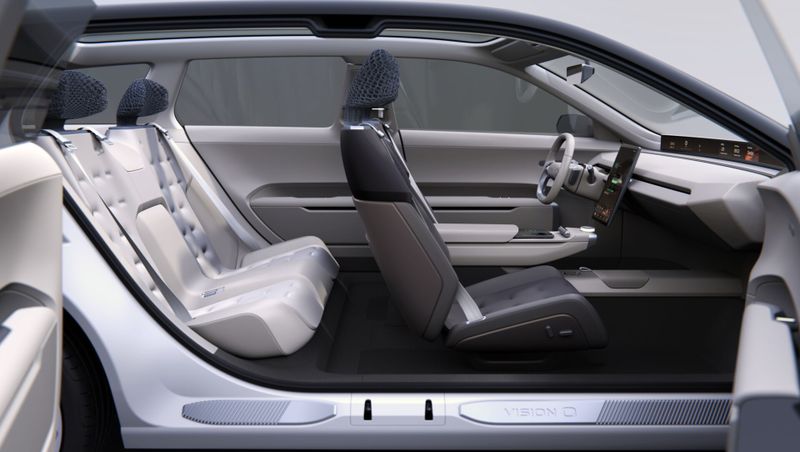
The interior of the Skoda Vision O concept car was designed specifically with the circular economy in mind. The TPU headrest, which was manufactured using additive manufacturing, can be sent directly for recycling at the end of its life cycle.
(Bild: Skoda)
At the heart of the newly developed headrest is Ultrasint TPU, a thermoplastic polyurethane that BASF developed specifically for powder-bed-based additive manufacturing processes such as the selective laser sintering (SLS)—and is marketed under the Forward AM brand by Mass Additive Manufacturing. For the user, the material offers the advantage of high process stability and excellent surface quality of the printed components.
High-Performance Polymer for Additive Mass Production
When used in the Vision O, the polymer meets all requirements for comfort and durability within a single material system. Since it is a single-material component, it can be sent directly for recycling at the end of its life cycle without first having to separate different plastics or foams. This significantly reduces the complexity of the disposal chain and supports efforts to achieve a higher recycling rate in the automotive sector.
Functional Integration Through Graded Honeycomb Structures
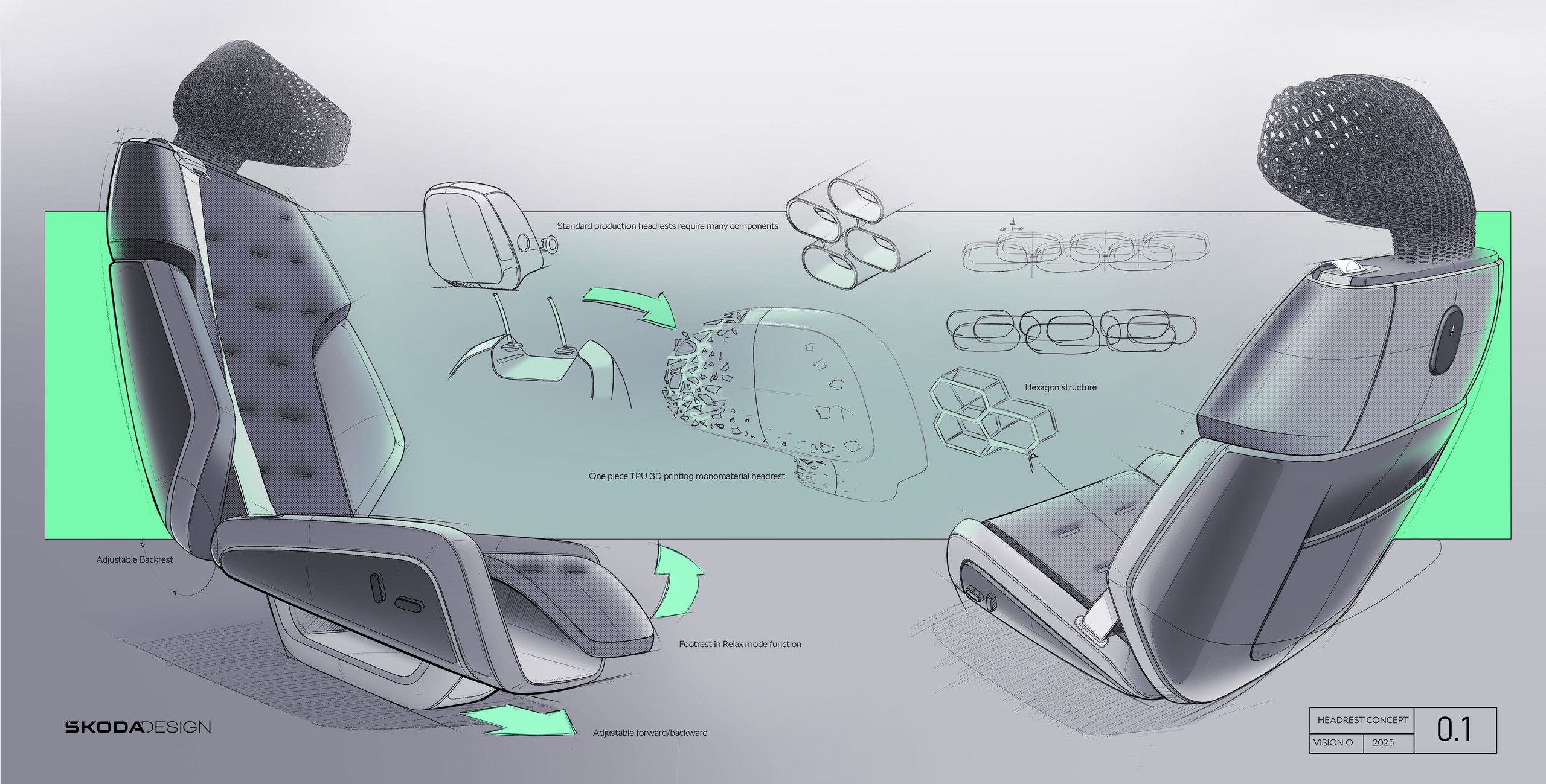
The headrest’s design takes advantage of the creative freedom offered by 3D printing to achieve a functional gradation. The chosen honeycomb geometry is not static but varies in density across the component. The structure gradually opens up from a solid, mechanically stable base at the bottom to a large-pored, airy architecture in the upper section.
Design and honeycomb structure of the headrest in the Skoda Vision O.
(Source: Skoda)
This structural design results in specific deformation behavior: The open structure responds precisely to compressive loads and offers a soft, cushion-like feel. “The goal was a single-material headrest, which means reducing the number of components to a single material that meets all requirements,” according to the project managers at Škoda. This eliminates the traditional combination of a load-bearing plastic core, foam padding, and a fabric cover.
Sustainability Through Zero-Waste Production
In addition to material recyclability, the process stands out for its resource-efficient manufacturing. The Ultrasint TPU printing process is designed as a zero-waste production process. Unused powder in the build volume can be reused in subsequent print jobs, which increases material efficiency compared to subtractive processes or traditional injection molding with gate losses.
Karsten Schnake, a member of the Škoda Auto Executive Board responsible for procurement, emphasizes the importance of this holistic approach: “We carefully examine how components are procured, manufactured, packaged, and transported. With the Vision O, we have worked on a closed-loop system that minimizes environmental impact.” This strategy demonstrates that additive manufacturing and TPU materials are key components for meeting upcoming regulatory requirements such as the End-of-Life Vehicles (ELV) Directive.
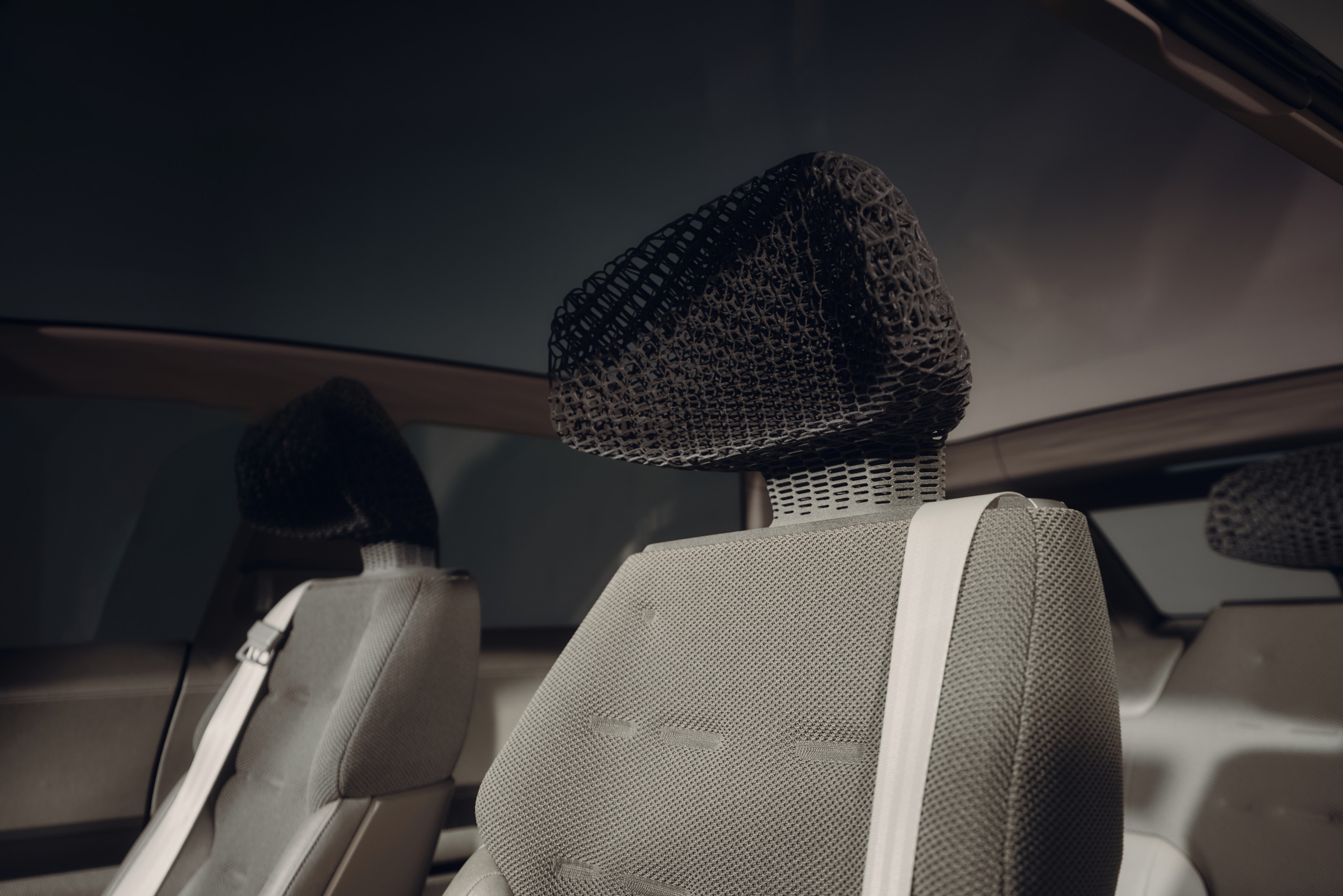
The seat covers are manufactured as flat-knit fabrics with different textures, all in one piece. This ensures a perfect fit. They are made from 100% recycled polyester.
(Source: Skoda)
The automaker is also utilizing new manufacturing techniques for the seat covers: The materials are produced in a single piece as flat-knit fabric with various integrated structures. This ensures an optimal fit while also increasing durability. The material used is 100% recycled polyester (Rec PES), which is derived from recycled PET bottles. The process involves cleaning, shredding, and melting the recycled material into yarns, which are then woven into textiles.
Conventional Manufacturing vs. the Single-Material Approach
Traditionally, headrests in automotive manufacturing are highly complex assemblies made up of a wide variety of different materials. Škoda’s new design breaks with these conventional manufacturing structures in order to optimize both production and subsequent recycling.
Typically, a headrest consists of an injection-molded base made of rigid plastic (e.g., PA or ABS), a cushion core made of polyurethane foam (PUR), and a cover made of fabric or leather. This multi-material construction requires a multi-step process: injection molding of the base, foaming of the core, and subsequent covering. Recycling is also complex: at the end of the product’s life cycle, these firmly bonded components can only be separated with great effort, which makes material recovery difficult.
In contrast, with the Vision O, Škoda has reduced the number of components to a single material. Additive manufacturing makes it possible to replicate the mechanical properties—which are otherwise achieved through the use of different materials (hard core, soft foam)—solely through the geometry of a 3D-printed honeycomb structure.
Date: 08.12.2025
Naturally, we always handle your personal data responsibly. Any personal data we receive from you is processed in accordance with applicable data protection legislation. For detailed information please see our privacy policy.
Consent to the use of data for promotional purposes
I hereby consent to Vogel Communications Group GmbH & Co. KG, Max-Planck-Str. 7-9, 97082 Würzburg including any affiliated companies according to §§ 15 et seq. AktG (hereafter: Vogel Communications Group) using my e-mail address to send editorial newsletters. A list of all affiliated companies can be found here
Newsletter content may include all products and services of any companies mentioned above, including for example specialist journals and books, events and fairs as well as event-related products and services, print and digital media offers and services such as additional (editorial) newsletters, raffles, lead campaigns, market research both online and offline, specialist webportals and e-learning offers. In case my personal telephone number has also been collected, it may be used for offers of aforementioned products, for services of the companies mentioned above, and market research purposes.
Additionally, my consent also includes the processing of my email address and telephone number for data matching for marketing purposes with select advertising partners such as LinkedIn, Google, and Meta. For this, Vogel Communications Group may transmit said data in hashed form to the advertising partners who then use said data to determine whether I am also a member of the mentioned advertising partner portals. Vogel Communications Group uses this feature for the purposes of re-targeting (up-selling, cross-selling, and customer loyalty), generating so-called look-alike audiences for acquisition of new customers, and as basis for exclusion for on-going advertising campaigns. Further information can be found in section “data matching for marketing purposes”.
In case I access protected data on Internet portals of Vogel Communications Group including any affiliated companies according to §§ 15 et seq. AktG, I need to provide further data in order to register for the access to such content. In return for this free access to editorial content, my data may be used in accordance with this consent for the purposes stated here. This does not apply to data matching for marketing purposes.
Right of revocation
I understand that I can revoke my consent at will. My revocation does not change the lawfulness of data processing that was conducted based on my consent leading up to my revocation. One option to declare my revocation is to use the contact form found at https://contact.vogel.de. In case I no longer wish to receive certain newsletters, I have subscribed to, I can also click on the unsubscribe link included at the end of a newsletter. Further information regarding my right of revocation and the implementation of it as well as the consequences of my revocation can be found in the data protection declaration, section editorial newsletter.
With this technological leap, the Vision O demonstrates that the plastics industry is on the verge of a transformation: moving away from tool-dependent assembly of complex hybrid components toward functionally integrated, one-piece manufacturing.



:quality(80)/p7i.vogel.de/wcms/8d/fd/8dfdc63153cce5816e7a371257b6bdff/nexofoam-epla-schaumv1.png "From compact EPLA granules to fully foamed insulation boards: This bio-based particle foam material can be processed as a drop-in solution on existing EPS molding machines. (Bild: Nexofoam)")
:quality(80)/p7i.vogel.de/wcms/91/39/91397ac53b2ca4d65d65f563ebdc12ea/nexofoam-epla-schaumv1.png "From compact EPLA granules to fully foamed insulation boards: This bio-based particle foam material can be processed as a drop-in solution on existing EPS molding machines. (Bild: Nexofoam)")
:quality(80)/p7i.vogel.de/wcms/2b/37/2b37601930b643d709629fa8005aade0/nexofoam-epla-schaumv1.png "From compact EPLA granules to finished foam insulation boards: This bio-based particle foam material can be processed as a drop-in solution on existing EPS molding machines. (Bild: Nexofoam)")
:quality(80)/p7i.vogel.de/wcms/97/0c/970c52fd142e10a3c4566168037ca637/materialloesungen-pressefoto-1890x1329v1.jpeg "rPET pellets: At Fraunhofer IAP, terephthalic acid is recovered from PET to produce new polymers for bottles, fibers, and films. The yellowish to grayish hues are due to the recycled raw material. Through the targeted addition of additives, the color can be adjusted to produce even colorless material. (Bild: Fraunhofer IAP / Romina Schönefeld)")
:quality(80)/p7i.vogel.de/wcms/ce/ee/ceeeef086bfb174ebdda31c0dfccaf9a/2-weiss-blick-in-produktion-dji-0095-kopiev1.jpeg "A look inside the injection molding shop at Weiss Kunststoffverarbeitung in Illertissen, Bavaria. (Bild: White)")
:quality(80)/p7i.vogel.de/wcms/33/08/3308710c85715e917ec1baf9767fe4a7/2026-ewikon-wago-hei-kanalv1.png "Ewikon's 48-cavity hot runner as a production mold. (Bild: Ewikon)")
:quality(80)/p7i.vogel.de/wcms/a2/a5/a2a516dc69b4c8f8ad6f475ae6746a08/sxkh-bei-hpf-gesamtwerkzeugv1.png "The HMG 70XS1510 trimming press from the Chinese manufacturer SXKH combines all the functions required by toolmakers at HPF in a very compact design. The deciding factors in the purchase were the purchase price—and confidence in the quality of established international key components. (Bild: Pergler Media)")
:quality(80)/p7i.vogel.de/wcms/19/5f/195fdb6e09629994f1d6e3cf94dac8d8/bild-1-exam510-ultem9085v1.jpeg "Granular printing (FGF) makes it cost-effective to produce large-format functional parts from high-performance polymers such as Ultem 9085. (Bild: NEW AIM3D)")
:quality(80)/p7i.vogel.de/wcms/d5/c4/d5c46d40e1ae062370d058e2c006c376/dimitrisvetsikas1969-belgium-3595351v1.jpeg "European Plastics Industry Calls for Immediate Action to Address the Industry Crisis (Bild: dimitrisvetsikas1969)")
:quality(80)/p7i.vogel.de/wcms/e6/63/e663f0e1dd8818fc501c6fb5c5d33712/19-5689-circular-economy-of-resourcesv1.jpeg "Plastic waste from the average household is very heterogeneous. Only the right mix of technologies can turn all types of plastic waste into a new source of raw materials. (Bild: BASF)")
:quality(80)/p7i.vogel.de/wcms/31/5b/315b714f653484179232fbc4d6d79543/sesotec-img-andreas-hanus-25-20-281-29v1.jpeg "Andreas Hanus, Head of AI Development at Sesotec: “AI will not replace traditional sorting technology, but will intelligently enhance it.” (Bild: Sesotec)")
:quality(80)/p7i.vogel.de/wcms/74/5f/745f512239689819275af39a82f59860/b-brenkenv1.jpeg "Dr. Benedikt Brenken, Director of R-Cycle: \"The digital product passport will fundamentally change plastic recycling.\" (Bild: R-Cycle)")
:quality(80)/p7i.vogel.de/wcms/40/6d/406d05534ab4d28194bd29699e023e67/2026-09-09-uni-kiel-aufmacherv1.jpeg "These self-polarizing polymer coatings could be used in a wide variety of electronic components in the future. (Bild: University of Kiel/C. Anders)")
:quality(80)/p7i.vogel.de/wcms/5d/46/5d46e098a7cfaebdd9643df47153c5af/aufmacherv1.png "The PPWR imposes new requirements on packaging: What impact does this have on mechanical engineering? (Bild: KI-generiert / Dall-E)")
:quality(80)/p7i.vogel.de/wcms/70/13/7013fe202fb4790708f62f69cd0c83d4/aufmacher-st-c3-a4rkeschaumfoliev1.png "Using thermoplastic starch as a base, researchers at the IKV successfully produced a flexible foam film using physical blowing agents. (Bild: IKV)")
:quality(80)/p7i.vogel.de/wcms/d1/2b/d12b536ba3b382d0d138e342ac1038e6/03--20pm-imm-mgsv1.jpeg "MGS Richfield Site (Bild: MGS)")
:quality(80)/p7i.vogel.de/wcms/90/9c/909cf6eb1b91a9a84ff535033ea9b048/honeycombv1.jpeg "The composite material made of epoxy and glass fibers not only protects against flames but is also fully recyclable. (Bild: Empa)")
:quality(80)/p7i.vogel.de/wcms/6a/d5/6ad5980b0c965409c71582fc59145e13/1920-covestro-new-covestro-headquartersv1.jpeg "Covestro's corporate headquarters in Leverkusen (Bild: Covestro)")
:quality(80)/p7i.vogel.de/wcms/db/74/db741079d26ad9e7a69278fde45e79c7/aufmacherv1.png "(Bild: KI-generiert / Dall-E)")
:quality(80)/p7i.vogel.de/wcms/b3/65/b3654df434f4d31e1fda3c79bc7bb4b0/nakura-20kunstrasenteppich-20ohne-20verf-c3-bcllungv1.jpeg "Tecnaro has developed synthetic turf fibers using a specially formulated Arboblend blend that offers high resistance to heat, UV rays, and weathering, and, because it is niobium-based, sequesters CO₂ over the long term. (Bild: Tecnaro)")
:quality(80)/p7i.vogel.de/wcms/9f/95/9f9597d1b9d71b9e882f411d85f01247/ikv-kolloquium-26-1761-1536x1023v1.webp "IKV Institute Director Prof. Dr.-Ing. Christian Hopmann will welcome approximately 460 experts from research and industry in the plastics sector to the 33rd IKV Colloquium in Aachen in early March. (Bild: DF.Photography)")
:quality(80)/p7i.vogel.de/wcms/b7/b9/b7b9e879b37c06934f568fc3e96daac7/unusual-20machines-copy-4000x2250v1v1.jpeg "Rotor Riot SkyLite FPV drone equipped with MJF-manufactured parts. (Bild: Unusual Machines)")