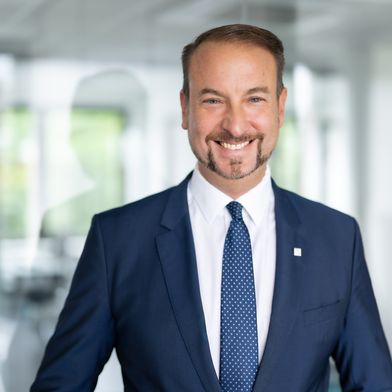
Germany excels in patents and basic research in polymer chemistry. Yet all too often, industrial breakthroughs are thwarted by domestic conditions. Why do innovations in Germany often fail to make the leap from the laboratory to industrial application?
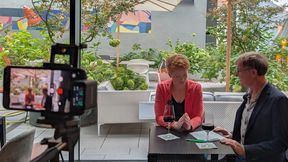
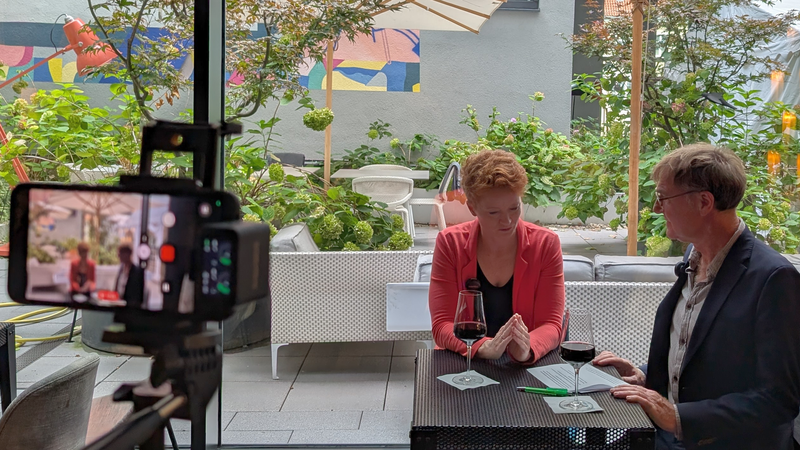
Dr. Christine Bunte (left), Executive Director of Plastics Europe Germany, in an off-the-record conversation with PlastXnow.
(Bild: PlastXnow/Melanie Ehrhardt)
Berlin, Motel One at Alexanderplatz: On the occasion of an innovation press conference hosted by Plastics Europe Germany, PlastXnow met with CEO Dr. Christine Bunte for an in-depth interview. Over a glass of wine, the polymer chemist with a Ph.D. discusses the underestimated role of plastics in modern, future-oriented technologies, the paralyzing effect of excessive reporting requirements, and the urgency of consistently protecting Germany’s integrated industrial ecosystem.
Dr. Bunte, Plastics Europe Germany hosted a press conference in Berlin in late September to discuss the role of plastics in innovation. Does such a well-established material really need its own platform to explain its importance to policymakers and the public?
Dr. Christine Bunte: Step out onto the street in front of the hotel at Alexanderplatz and ask passersby what they associate with plastics: The word “innovation” is guaranteed not to come up. A one-sided perception dominates. Furthermore, policymakers and the media are currently being inundated with an endless flood of issues. Amid all this noise, we must clearly demonstrate why it’s worth listening to the plastics industry and providing it with targeted support here in Germany. We need to illustrate exactly that with concrete, real-world examples.
Traditional materials such as metal and glass have been around for centuries. Why do you consider plastics, of all things, to be an indispensable key material for future technologies?
Bunte: Because plastics combine a set of properties that no other material offers. In addition to strengths such as durability, moldability, light weight, and high stability, we are breaking into new functional areas. Consider the specific optical properties required for autonomous driving or the high biocompatibility needed in medical technology. Whether in robotics, aviation, modern living, or energy grids: Plastics play key functional roles in nearly all future technologies.
Traditional materials such as metal and glass have been around for centuries. Why do you consider plastics, of all things, to be an indispensable key material for future technologies?
Bunte: Because plastics combine a set of properties that no other material offers. In addition to strengths such as durability, moldability, light weight, and high stability, we are breaking into new functional areas. Consider specific optical properties for autonomous driving or high biocompatibility in medical technology. Whether in robotics, aviation, modern living, or energy grids: Plastics play key functional roles in nearly all future technologies.
Aren't you exaggerating that a bit? Can we really derive the sweeping statement that "without plastic, there is simply no innovation"?
Bunte: As a scientist, my first thought is, of course, to consider which fields can manage without plastics altogether. But even metalworking machines contain polymers. In a modern industrial society, it is simply impossible to achieve technological progress without plastics.
For years now, the industry has been complaining about excessively high energy costs. Some economists don’t see the problem. Germany should simply relocate the energy-intensive production of standard virgin polymers to countries with low energy and raw material prices and focus instead on high-value-added compounding, specialty machinery manufacturing, and precision processing. Why does Germany need its own plastics production?
Bunte: This is a key issue for the future of all energy-intensive industries. There are two compelling arguments in favor of preserving the value chain. First: The more specialized a high-end application is, the more precisely the interplay between materials, processing methods, and mechanical engineering must be coordinated. Our strength in Germany lies precisely in this integrated ecosystem of producers, processors, machine builders, and recyclers. Second, it’s a matter of strategic resilience and industrial independence. Recent years have shown where relying on imports leads. Such imports seem inexpensive until complete dependence sets in—after that, they become costly, and we become vulnerable to geopolitical blackmail.
Imports seem inexpensive until we become completely dependent on them—after that, they suddenly become expensive, and we become vulnerable to geopolitical blackmail.
In addition to excessive energy costs, industry representatives complain about excessive bureaucracy and slow approval processes. How can the region remain competitive if these fundamental problems remain unresolved?
Bunte: If we don’t take tangible action on energy costs, the availability of raw materials, bureaucracy, and the speed of administrative processes, no industry in Germany will be able to survive in the long run—whether it’s the plastics industry or robotics. There’s no point in trying to build new, forward-looking industries if the industrial foundation is crumbling. I’m aware of the federal government’s current reform packages, but the pace isn’t fast enough. My appeal to policymakers is this: Push through these reforms with full determination and even greater speed. People aren’t frustrated because too much is happening, but because far too little is happening.
People and companies aren't annoyed because too much is happening, but because it's painfully obvious that far too little is happening.
In the debate over the circular economy, regulation often seems like a paradox: Is regulation a lifeline or a millstone for innovation?
Bunte: It’s clearly both—what matters is the technical quality of the legislation. Take the European Packaging and Packaging Waste Regulation (PPWR) as an example. The goals—such as recyclability, the use of recycled materials, and reuse—are good. However, the regulation has become so complex that even experts were unable for a long time to define who has which obligations. Companies had to devote enormous resources just to clarify what role they play in the system. That is unnecessary bureaucracy with no environmental benefit.
What are the implications of this uncertainty for specific investments in recycling technologies?
Bunte: Absolutely prohibitive. If it is still not clear beyond a doubt how recycling rates are calculated or whether targets will be revised, there is no basis for any business case. No company will invest tens of millions in innovative recycling processes if it’s unclear whether regulatory incentives will still exist four years from now. We need laws that create a reliable market foundation, reward early action, and quickly implement instruments such as the eco-modulation of license fees.
If you could propose a single law to policymakers tomorrow to promote innovation and investment, what would it be?
Bunte: Tomorrow I will introduce a bill that will mandatorily reduce government and corporate system costs by 50 percent. By that I mean the systematic elimination of inefficiencies. In companies, bureaucratic reporting requirements tie up enormous resources—often with the knowledge that there’s no one on the government side who can even read or evaluate the reports. People write these reports just to be on the safe side—truly in the spirit of “cover my ass.” If we cut this paralysis and the government’s administrative costs in half, we’ll unlock enormous potential for creative processes and genuine innovation.
People write just to cover their bases, true to the motto “cover my ass.” If we reduce this bureaucratic paralysis by 50 percent, we’ll unlock enormous potential for creative processes.
Which specific innovation projects by your member companies are currently of particular interest to you?
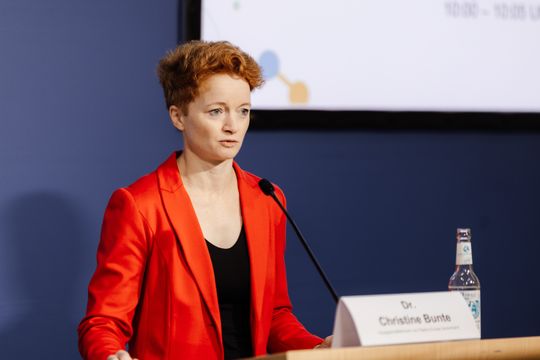
Dr. Christine Bunte at the innovation press conference in Berlin: “Innovation made in Germany must not get stuck at the pilot plant stage; rather, it must become a reality here on an industrial scale.”
(Bild: Plastics Europe Germany)
Bunte: We see fascinating applications for plastics in sensor technology, robotics, medical technology, and renewable energy. In the field of the circular economy, companies are developing state-of-the-art concepts to recover high-quality chemical raw materials from waste that was previously non-recyclable. In addition, companies are demonstrating how they use AI and digitalization to efficiently develop novel materials.
German companies and institutions file patents for cutting-edge technologies, but the industrial application of these technologies often ends up elsewhere. How can we bring that scaling back to Germany?
Bunte: We have excellent research, but we don’t pay enough attention to the scaling phase. Government funding programs are far too focused on basic research. There is a lack of programs that systematically support the further development of technologies and their scaling up into market-ready products.
Do companies also lack entrepreneurial courage and a willingness to take risks in this regard?
Bunte: This is also a societal question: How much risk are we willing to take? In Germany, we’re currently strongly focused on preservation rather than change. Corporate culture reflects this attitude. Nevertheless, plastics companies are currently investing substantial sums in high-risk projects at their sites. But if it becomes clear that companies will be operating at a loss indefinitely with large-scale facilities, they will not take this step. What is needed is a combination of a willingness to take risks and a reliable framework that allows innovations to give rise to sustainable business models.
About the Person
Dr. Christine Bunte holds a Ph.D. in polymer chemistry and has been representing the interests of plastics manufacturers in Germany as CEO of Plastics Europe Deutschland e. V. for nearly two years. Before being appointed to lead the association, she gained many years of leadership experience at the intersection of chemical research, industrial policy, and sustainability strategies. She is strongly committed to accelerating the industry’s transition toward a circular, climate-neutral materials economy and to strengthening Germany’s position as a hub for innovation.
Here's what it's all about
Materials for Innovation: Plastics provide key functions for medical technology, autonomous driving, and the energy transition that no other material can match.
Protecting Integrated Value Creation: The close integration of producers, processors, machinery manufacturers, and recyclers in Germany also lays the foundation for new high-end applications.
Streamlining Regulation: Reducing government and corporate rules governing systems and bureaucracy is essential to making innovative business models economically viable.
Date: 08.12.2025
Naturally, we always handle your personal data responsibly. Any personal data we receive from you is processed in accordance with applicable data protection legislation. For detailed information please see our privacy policy.
Consent to the use of data for promotional purposes
I hereby consent to Vogel Communications Group GmbH & Co. KG, Max-Planck-Str. 7-9, 97082 Würzburg including any affiliated companies according to §§ 15 et seq. AktG (hereafter: Vogel Communications Group) using my e-mail address to send editorial newsletters. A list of all affiliated companies can be found here
Newsletter content may include all products and services of any companies mentioned above, including for example specialist journals and books, events and fairs as well as event-related products and services, print and digital media offers and services such as additional (editorial) newsletters, raffles, lead campaigns, market research both online and offline, specialist webportals and e-learning offers. In case my personal telephone number has also been collected, it may be used for offers of aforementioned products, for services of the companies mentioned above, and market research purposes.
Additionally, my consent also includes the processing of my email address and telephone number for data matching for marketing purposes with select advertising partners such as LinkedIn, Google, and Meta. For this, Vogel Communications Group may transmit said data in hashed form to the advertising partners who then use said data to determine whether I am also a member of the mentioned advertising partner portals. Vogel Communications Group uses this feature for the purposes of re-targeting (up-selling, cross-selling, and customer loyalty), generating so-called look-alike audiences for acquisition of new customers, and as basis for exclusion for on-going advertising campaigns. Further information can be found in section “data matching for marketing purposes”.
In case I access protected data on Internet portals of Vogel Communications Group including any affiliated companies according to §§ 15 et seq. AktG, I need to provide further data in order to register for the access to such content. In return for this free access to editorial content, my data may be used in accordance with this consent for the purposes stated here. This does not apply to data matching for marketing purposes.
Right of revocation
I understand that I can revoke my consent at will. My revocation does not change the lawfulness of data processing that was conducted based on my consent leading up to my revocation. One option to declare my revocation is to use the contact form found at https://contact.vogel.de. In case I no longer wish to receive certain newsletters, I have subscribed to, I can also click on the unsubscribe link included at the end of a newsletter. Further information regarding my right of revocation and the implementation of it as well as the consequences of my revocation can be found in the data protection declaration, section editorial newsletter.