Upcycling of PolyethyleneWidely used as a raw material for nylon
Source: Press release
Melanie Ehrhardt
| Translated by AI
4 min Reading Time
Upcycling involves transforming waste products into new, often higher-quality products. The concept is particularly popular among hobbyists. However, the idea can also be applied on an industrial scale—for example, by producing polyamide from polyethylene waste. Researchers in Rostock are working on exactly that.
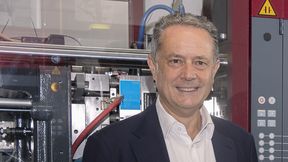
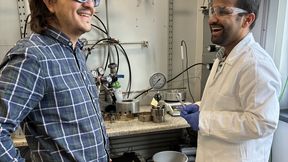
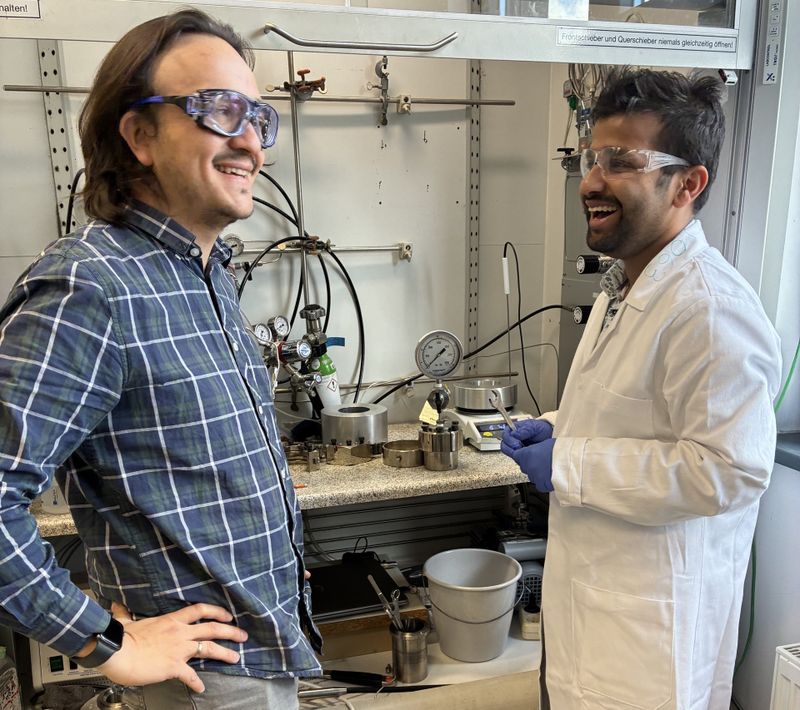
Dr. Esteban Mejía (right) and postdoctoral researcher Dr. Dr. Satyajit Panda are pioneering a new—and, above all, straightforward—approach to the chemical upcycling of polyethylene at LIKAT. The result is dicarboxylic acids, which are potential starting materials for nylon.
(Bild: LIKAT/R. Rachow)
It would greatly reduce the burden on the environment and climate if, in the future, nylon could be produced largely from plastic waste instead of from petroleum, as has been the norm until now. Chemists at the Leibniz Institute for Catalysis (LIKAT) are pursuing this approach. They have succeeded in selectively converting polyethylene—the main component of all plastic waste—into dicarboxylic acids, which can serve as chemical precursors for nylon.
The reaction proceeds under mild conditions and does not even require a catalyst. The goal is to develop a process on a pilot-plant scale. To that end, the team aims to increase selectivity and elucidate the reaction mechanisms.
Pyrolysis Is No Longer Feasible
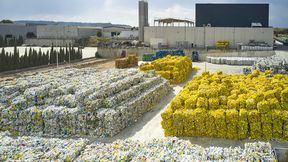
Polyethylene (PE), together with polypropylene (PP), account for four-fifths of plastic waste—an estimated 400 million metric tons per year worldwide. Pyrolysis has become the established method for chemically recycling these polyolefins, as Dr. Esteban Mejía, program director at LIKAT, explains: “The plastic is burned in a controlled manner at temperatures of up to 600 degrees Celsius.”
While the result is indeed “high-quality oil” and the process does not emit any CO₂, pyrolysis’s enormous energy consumption leaves such a large carbon footprint that environmental authorities are sounding the alarm. In the U.S., pyrolysis plants are already being shut down.
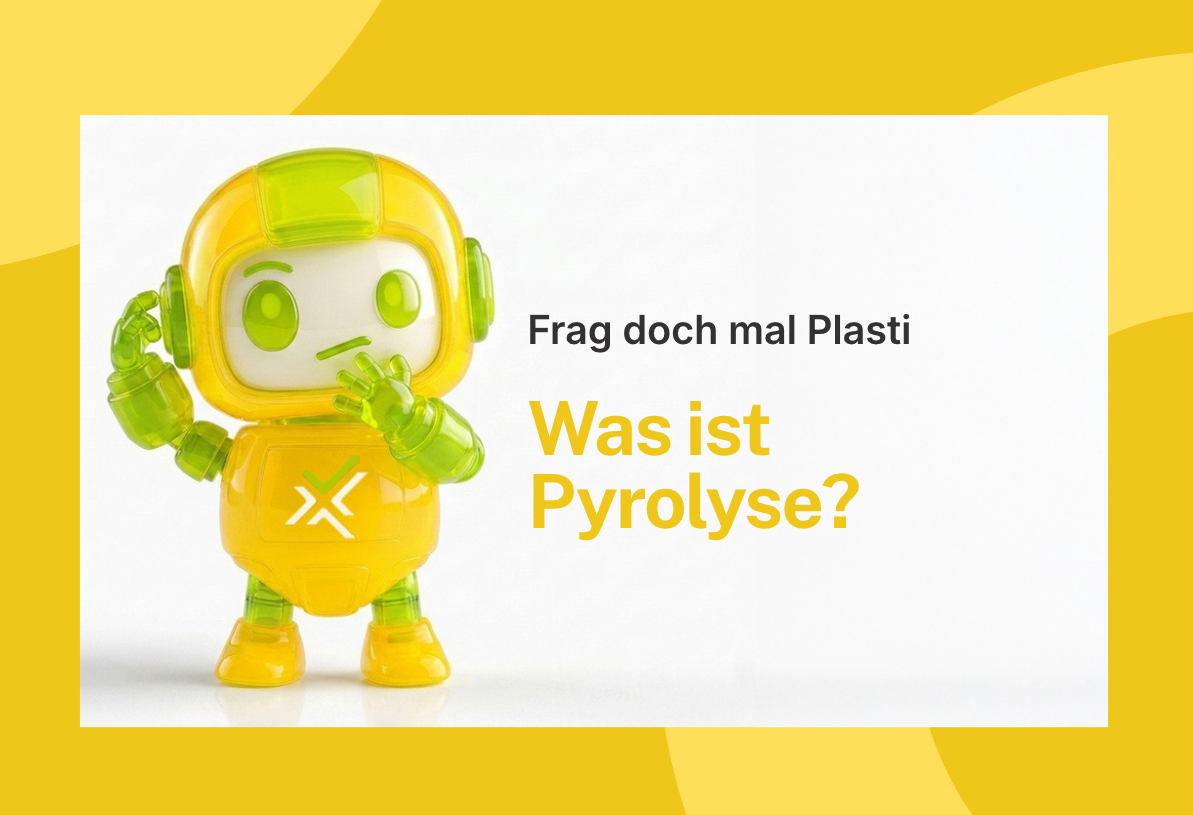
(Source: PXN)
Pyrolysis is a process used in the field of chemical recycling. In this process, plastic waste is not simply shredded and remelted, as in mechanical recycling, but rather broken down into its basic building blocks (monomers).
In pyrolysis, plastic is thermally decomposed at high temperatures in the absence of oxygen. This process produces oils, gases, and solid residues (coke/ash), which can be reused as raw materials. Pyrolysis is currently the predominant technology, particularly in Germany.
Reactive Oxygen Species as a Tool
This raises the question of alternatives. Researchers are aware of a number of catalytic processes that work through oxidation, similar to pyrolysis, says Esteban Mejía. “In these processes, a reactive oxygen species—which we call ROS—forms on the polyethylene surface.” As chemists now know, these are precisely what matter. ROS chemically break down the polyethylene. “They essentially eat away at the material,” Mejía sums it up.
However, this reaction requires high pressure, which makes the process explosive. “It cannot easily be scaled up to a level relevant for practical applications.” Furthermore, the catalysts are based on precious metals, which makes the whole process expensive and also dependent on the volatile raw materials market.
During their literature review, the group found reports from colleagues who had produced polyethylene dicarboxylic acid with non-specific chain lengths, using methods that included highly concentrated nitric acid at 180 degrees Celsius and in a microwave. “Those are pretty harsh processes,” says Mejía, “but we were intrigued by the idea of pursuing the nitric acid approach further and simplifying the process.”
"Simpler" means: diluted and mixed with H₂O₂
Since April 2026, a postdoctoral researcher, Dr. Satyajit Panda, has been working on the topic, occasionally assisted by a master’s student from the University of Rostock. Through further research and trial and error, the group ultimately arrived at a simple reaction. The effect was fascinating: “You put pieces of a plastic bag into a test tube containing highly diluted nitric acid and hydrogen peroxide, heat the mixture to a maximum of 120 degrees, and watch as the polyethylene dissolves,” said Mejía.
Controlling the reaction, however, is not quite so simple. “A specific heat input regime is important,” explains Mejía. This is because the conversion of PE to dicarboxylic acid involves several stages. If the intermediate products are allowed too much time, the reaction proceeds suboptimally and ultimately results in a complex mixture.
Selectivity and Reaction Mechanism
Dicarboxylic acid consists of chains of carbon atoms of varying lengths. Previous publications have reported reaction results involving chain lengths ranging from two to over 40 carbon atoms. “The authors used it as a surfactant in soap production,” says Mejía.
Date: 08.12.2025
Naturally, we always handle your personal data responsibly. Any personal data we receive from you is processed in accordance with applicable data protection legislation. For detailed information please see our privacy policy.
Consent to the use of data for promotional purposes
I hereby consent to Vogel Communications Group GmbH & Co. KG, Max-Planck-Str. 7-9, 97082 Würzburg including any affiliated companies according to §§ 15 et seq. AktG (hereafter: Vogel Communications Group) using my e-mail address to send editorial newsletters. A list of all affiliated companies can be found here
Newsletter content may include all products and services of any companies mentioned above, including for example specialist journals and books, events and fairs as well as event-related products and services, print and digital media offers and services such as additional (editorial) newsletters, raffles, lead campaigns, market research both online and offline, specialist webportals and e-learning offers. In case my personal telephone number has also been collected, it may be used for offers of aforementioned products, for services of the companies mentioned above, and market research purposes.
Additionally, my consent also includes the processing of my email address and telephone number for data matching for marketing purposes with select advertising partners such as LinkedIn, Google, and Meta. For this, Vogel Communications Group may transmit said data in hashed form to the advertising partners who then use said data to determine whether I am also a member of the mentioned advertising partner portals. Vogel Communications Group uses this feature for the purposes of re-targeting (up-selling, cross-selling, and customer loyalty), generating so-called look-alike audiences for acquisition of new customers, and as basis for exclusion for on-going advertising campaigns. Further information can be found in section “data matching for marketing purposes”.
In case I access protected data on Internet portals of Vogel Communications Group including any affiliated companies according to §§ 15 et seq. AktG, I need to provide further data in order to register for the access to such content. In return for this free access to editorial content, my data may be used in accordance with this consent for the purposes stated here. This does not apply to data matching for marketing purposes.
Right of revocation
I understand that I can revoke my consent at will. My revocation does not change the lawfulness of data processing that was conducted based on my consent leading up to my revocation. One option to declare my revocation is to use the contact form found at https://contact.vogel.de. In case I no longer wish to receive certain newsletters, I have subscribed to, I can also click on the unsubscribe link included at the end of a newsletter. Further information regarding my right of revocation and the implementation of it as well as the consequences of my revocation can be found in the data protection declaration, section editorial newsletter.
The target product of the Rostock chemists, on the other hand, is a viable starting material for polyamide (PA), better known as nylon. Dicarboxylic acid with a chain length of exactly six carbon atoms is suitable for this purpose. And that places higher demands on the selectivity of the reaction and on any separation processes.
In their experiment, the LIKAT chemists have already been able to narrow down the chain length of their product to between four and ten carbon atoms. They hope to further improve this in collaboration with Prof. Dr. Udo Kragl from the Department of Chemical Engineering at the University of Rostock. Among other things, they have applied for project funding from the DFG for this purpose.
In this project, they also plan to work with analysts at LIKAT to elucidate the reaction mechanism: The primary goal is to determine which intermediates are formed during the reaction process, when they are formed, and how quickly. There is also a collaboration with a colleague from the University of Guayaquil (Ecuador) who is investigating, through photochemical experiments, the influence of light on the function of ROS, the reactive oxygen species.