At Fakuma 2026, Milacron will unveil the third generation of its all-electric E-Series in Europe for the first time. During the trade show, two machines will demonstrate how the manufacturer addresses energy efficiency, process stability, and productivity in injection molding: The E180 produces a polypropylene container, while the E110 manufactures 200-μl pipette tips for medical applications.
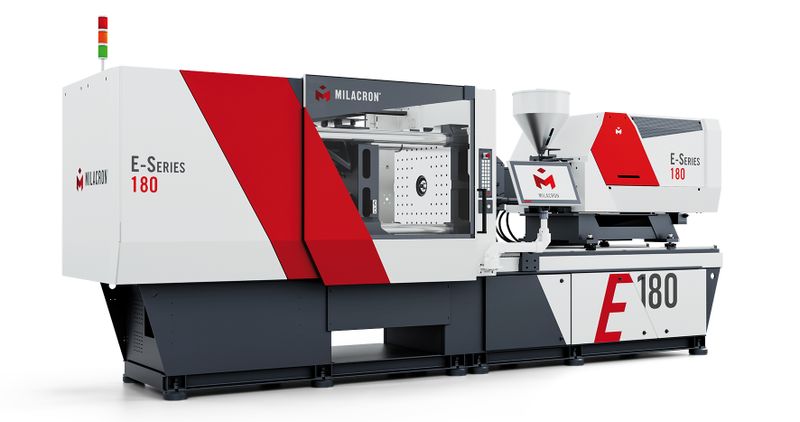
At Fakuma, the all-electric E180 produces a round-oval container made of polypropylene (PP).
(Bild: Milacron)
With the third generation of its all-electric E-Series, Milacron will showcase two injection molding machines with different application focuses at Fakuma 2026. The E180 is designed for packaging applications, while the E110 will demonstrate the production of pipette tips. Both machines will be in operation during the trade show to showcase the capabilities of the redesigned machine generation under production conditions.
According to the company, the goal of this further development is to increase productivity while maintaining consistent component quality and, at the same time, reducing operating costs. Features of the series include a compact design, higher injection speeds, greater mold flexibility, and reduced maintenance requirements.
One key focus is on electric drive technology. This is complemented by a redesigned clamping unit, a modular design for the injection unit, and the new Mosaic Xi machine control system. With these updates, Milacron combines mechanical and control system adjustments with the goal of enabling dynamic motion sequences, reproducible manufacturing processes, and improved analysis of production and energy data.
Regenerative servo drives feed energy back into the system
The third generation of the E-Series uses regenerative servo drives. According to Milacron, these enable high acceleration and peak currents. When the electric axes decelerate, energy is fed back into the power grid. This is intended to reduce the machine’s energy consumption. At the same time, the electric drive technology enables fast and precise motion sequences.
The clamping unit has also been redesigned. An increased tie-bar spacing creates room for molds with a high number of cavities and facilitates the integration of peripheral equipment. According to the manufacturer, the design is optimized for short cycle times and a long service life.
Automatic clamping force control is designed to support process stability. At the same time, the machine requires less lubricating grease. This is intended to contribute to a cleaner injection molding process—an aspect that Milacron emphasizes in particular in connection with the medical application showcased at the trade show.
The injection unit is based on a modular design that allows for multiple screw configurations within a single machine platform. Higher injection speeds are intended to expand the range of applications. According to the company, the centrally acting nozzle contact force ensures a uniform, reproducible connection between the nozzle and the mold, even at high injection pressures and speeds.
Analyzing Process and Energy Data Using Machine Control Systems
With Mosaic Xi, the E Series gains a new machine control system for networked production environments. The enhanced features include a molded part assistant, clamping force optimization, adaptive central lubrication, the intelligent material dosing system “Smart Charging,” and the PSSV system for ensuring consistent part weight.
The machine is operated via a 21.5-inch multitouch display. This display allows users to monitor more than 30 process parameters over the last 5,000 cycles. Production and energy data can be analyzed over the long term. In addition, the energy consumption of each individual machine axis per cycle can be evaluated directly on the control panel.
Milacron is thus placing an emphasis not only on the mechanical design of the machines but also on monitoring the injection molding process. The collected data is intended to enable users to analyze production processes and energy consumption more closely. However, this press release does not provide specific comparative figures regarding energy consumption or potential cost savings.
E180 manufactures polypropylene containers for packaging applications
At Fakuma, the all-electric E180 is producing a round-oval container made of polypropylene (PP). The machine has a clamping force of 180 metric tons and operates with a two-cavity hot-runner mold. The molded part weighs 23 grams.
Date: 08.12.2025
Naturally, we always handle your personal data responsibly. Any personal data we receive from you is processed in accordance with applicable data protection legislation. For detailed information please see our privacy policy.
Consent to the use of data for promotional purposes
I hereby consent to Vogel Communications Group GmbH & Co. KG, Max-Planck-Str. 7-9, 97082 Würzburg including any affiliated companies according to §§ 15 et seq. AktG (hereafter: Vogel Communications Group) using my e-mail address to send editorial newsletters. A list of all affiliated companies can be found here
Newsletter content may include all products and services of any companies mentioned above, including for example specialist journals and books, events and fairs as well as event-related products and services, print and digital media offers and services such as additional (editorial) newsletters, raffles, lead campaigns, market research both online and offline, specialist webportals and e-learning offers. In case my personal telephone number has also been collected, it may be used for offers of aforementioned products, for services of the companies mentioned above, and market research purposes.
Additionally, my consent also includes the processing of my email address and telephone number for data matching for marketing purposes with select advertising partners such as LinkedIn, Google, and Meta. For this, Vogel Communications Group may transmit said data in hashed form to the advertising partners who then use said data to determine whether I am also a member of the mentioned advertising partner portals. Vogel Communications Group uses this feature for the purposes of re-targeting (up-selling, cross-selling, and customer loyalty), generating so-called look-alike audiences for acquisition of new customers, and as basis for exclusion for on-going advertising campaigns. Further information can be found in section “data matching for marketing purposes”.
In case I access protected data on Internet portals of Vogel Communications Group including any affiliated companies according to §§ 15 et seq. AktG, I need to provide further data in order to register for the access to such content. In return for this free access to editorial content, my data may be used in accordance with this consent for the purposes stated here. This does not apply to data matching for marketing purposes.
Right of revocation
I understand that I can revoke my consent at will. My revocation does not change the lawfulness of data processing that was conducted based on my consent leading up to my revocation. One option to declare my revocation is to use the contact form found at https://contact.vogel.de. In case I no longer wish to receive certain newsletters, I have subscribed to, I can also click on the unsubscribe link included at the end of a newsletter. Further information regarding my right of revocation and the implementation of it as well as the consequences of my revocation can be found in the data protection declaration, section editorial newsletter.
The machine on display is equipped with the IU 25_50 injection unit and a 45-mm screw. The maximum injection speed is 350 mm/s. The 570 × 570 mm column spacing provides room for larger molds and applications with a high number of cavities.
With this application, Milacron aims to demonstrate the synergy between dynamic injection technology, consistent part quality, and a fully electric drive system. By producing parts during the trade show, the E180 brings the ongoing process to life.
E110 produces 200-μl pipette tips in a 64-well plate
The second trade show application is aimed at the medical sector. At E110, Milacron manufactures polypropylene pipette tips with a volume of 200 μl. A 64-cavity hot-runner mold is used for this process.
The machine has a clamping force of 110 metric tons and is equipped with the IU 18_40 injection unit and a 35-mm screw. Here, too, the maximum injection speed is 350 mm/s.
The production of small components in a mold with a high number of cavities is intended to demonstrate the precision, repeatability, and process stability of the E Series. Milacron also cites the reduced need for lubricating grease and the fully electric machine technology as features that support a clean production environment.
The two demonstrations thus have different focuses: While the E180 showcases a packaging application featuring a 23-gram molded part, the E110 focuses on the production of small medical components using a 64-cavity mold.
European premiere at Fakuma 2026
With the third generation of the E-Series, Milacron aims to combine higher productivity, consistent quality, energy efficiency, and lower operating costs. Based on this press release, it is not possible to quantify the extent to which these goals have been achieved compared to the previous generation. There is no information provided on specific cycle time reductions, energy savings, or reductions in operating costs.
“With the third generation of the E-Series, we have consistently advanced our all-electric machine technology. The focus is on productivity, consistent quality, energy efficiency, and low operating costs,” says Alexander Boos, Managing Director of Milacron Europe.
service
Milacron at Fakuma 2026: Hall A3, Booth 3208
Want to attend Fakuma with PlastXnow? Simply enter the code SUAGL-L28JU on the registration page.



:quality(80)/p7i.vogel.de/wcms/fa/14/fa14a4e4d74ba7e397550ebedf83dc3b/2026-0068-tc-fakuma-relaisboxv1.jpeg "Relay box with a housing made of electrically insulating recycled PA (CTI rating of 600 V). (Bild: Techno-Compound)")
:quality(80)/p7i.vogel.de/wcms/ee/94/ee9486c548f28fc3b89d90e49d47641b/zwischenablage-10-09-2026-02v1.png "The new Leistritz Feed Aid (LEH) increases extrusion throughput for materials with low bulk density. (Bild: Leistritz)")
:quality(80)/p7i.vogel.de/wcms/f2/42/f2420a4d9189ef89b1b81ff07e9a621d/b-schall-008v1.jpeg "Bettina Schall, Managing Director of P. E. Schall GmbH & Co. KG. (Bild: Sound)")
:quality(80)/p7i.vogel.de/wcms/03/20/0320f4826c95d1b87db9a1ae523c2505/e-series-e180-milacronv1.jpeg "At Fakuma, the all-electric E180 produces a round-oval container made of polypropylene (PP). (Bild: Milacron)")
:quality(80)/p7i.vogel.de/wcms/22/99/2299a50e76f4df434c4319db5a81b500/2026-0096-hellweg-fakuma-soft-imagev1.jpeg "Visitors to the Hellweg Maschinenbau booth at Fakuma can test their own high-performance plastics on grinders with working widths of 230 mm or 600 mm. (Bild: Hellweg)")
:quality(80)/p7i.vogel.de/wcms/2b/37/2b37601930b643d709629fa8005aade0/nexofoam-epla-schaumv1.png "From compact EPLA granules to finished foam insulation boards: This bio-based particle foam material can be processed as a drop-in solution on existing EPS molding machines. (Bild: Nexofoam)")
:quality(80)/p7i.vogel.de/wcms/ce/ee/ceeeef086bfb174ebdda31c0dfccaf9a/2-weiss-blick-in-produktion-dji-0095-kopiev1.jpeg "A look inside the injection molding shop at Weiss Kunststoffverarbeitung in Illertissen, Bavaria. (Bild: White)")
:quality(80)/p7i.vogel.de/wcms/33/08/3308710c85715e917ec1baf9767fe4a7/2026-ewikon-wago-hei-kanalv1.png "Ewikon's 48-cavity hot runner as a production mold. (Bild: Ewikon)")
:quality(80)/p7i.vogel.de/wcms/a2/a5/a2a516dc69b4c8f8ad6f475ae6746a08/sxkh-bei-hpf-gesamtwerkzeugv1.png "The HMG 70XS1510 trimming press from the Chinese manufacturer SXKH combines all the functions required by toolmakers at HPF in a very compact design. The deciding factors in the purchase were the purchase price—and confidence in the quality of established international key components. (Bild: Pergler Media)")
:quality(80)/p7i.vogel.de/wcms/19/5f/195fdb6e09629994f1d6e3cf94dac8d8/bild-1-exam510-ultem9085v1.jpeg "Granular printing (FGF) makes it cost-effective to produce large-format functional parts from high-performance polymers such as Ultem 9085. (Bild: NEW AIM3D)")
:quality(80)/p7i.vogel.de/wcms/d5/c4/d5c46d40e1ae062370d058e2c006c376/dimitrisvetsikas1969-belgium-3595351v1.jpeg "European Plastics Industry Calls for Immediate Action to Address the Industry Crisis (Bild: dimitrisvetsikas1969)")
:quality(80)/p7i.vogel.de/wcms/e6/63/e663f0e1dd8818fc501c6fb5c5d33712/19-5689-circular-economy-of-resourcesv1.jpeg "Plastic waste from the average household is very heterogeneous. Only the right mix of technologies can turn all types of plastic waste into a new source of raw materials. (Bild: BASF)")
:quality(80)/p7i.vogel.de/wcms/31/5b/315b714f653484179232fbc4d6d79543/sesotec-img-andreas-hanus-25-20-281-29v1.jpeg "Andreas Hanus, Head of AI Development at Sesotec: “AI will not replace traditional sorting technology, but will intelligently enhance it.” (Bild: Sesotec)")
:quality(80)/p7i.vogel.de/wcms/74/5f/745f512239689819275af39a82f59860/b-brenkenv1.jpeg "Dr. Benedikt Brenken, Director of R-Cycle: \"The digital product passport will fundamentally change plastic recycling.\" (Bild: R-Cycle)")
:quality(80)/p7i.vogel.de/wcms/7f/0a/7f0a7bdd4ad6cbd65466726bd0beeba0/0131548279v1.jpeg "The importance of plastics in medicine has steadily increased over the past few decades—they are used in a wide variety of applications. (Image: ©Titolino - stock.adobe.com)")
:quality(80)/p7i.vogel.de/wcms/95/23/95237a455d822e6c152c91406193a2fb/0129232430v1.jpeg "Medical infusion tubing is often made of polyurethanes. A novel production process developed by Fraunhofer IAP makes it possible to manufacture polyurethanes of the highest quality without the use of toxic isocyanates. (Image:Fraunhofer IAP)")
:quality(80)/p7i.vogel.de/wcms/40/6d/406d05534ab4d28194bd29699e023e67/2026-09-09-uni-kiel-aufmacherv1.jpeg "These self-polarizing polymer coatings could be used in a wide variety of electronic components in the future. (Bild: University of Kiel/C. Anders)")
:quality(80)/p7i.vogel.de/wcms/5d/46/5d46e098a7cfaebdd9643df47153c5af/aufmacherv1.png "The PPWR imposes new requirements on packaging: What impact does this have on mechanical engineering? (Bild: KI-generiert / Dall-E)")
:quality(80)/p7i.vogel.de/wcms/90/9c/909cf6eb1b91a9a84ff535033ea9b048/honeycombv1.jpeg "The composite material made of epoxy and glass fibers not only protects against flames but is also fully recyclable. (Bild: Empa)")
:quality(80)/p7i.vogel.de/wcms/6a/d5/6ad5980b0c965409c71582fc59145e13/1920-covestro-new-covestro-headquartersv1.jpeg "Covestro's corporate headquarters in Leverkusen (Bild: Covestro)")
:quality(80)/p7i.vogel.de/wcms/db/74/db741079d26ad9e7a69278fde45e79c7/aufmacherv1.png "(Bild: KI-generiert / Dall-E)")
:quality(80)/p7i.vogel.de/wcms/b3/65/b3654df434f4d31e1fda3c79bc7bb4b0/nakura-20kunstrasenteppich-20ohne-20verf-c3-bcllungv1.jpeg "Tecnaro has developed synthetic turf fibers using a specially formulated Arboblend blend that offers high resistance to heat, UV rays, and weathering, and, because it is niobium-based, sequesters CO₂ over the long term. (Bild: Tecnaro)")
:quality(80)/p7i.vogel.de/wcms/1e/f4/1ef48a056eb328c77758f4b0439a51d2/grundlagen-20spritzgie-c3-9fmaschinen-20--20aufmacherv1.jpeg "Macropower 500/3400 injection molding machine from Wittmann Battenfeld (Bild: Wittmann)")
:quality(80)/p7i.vogel.de/wcms/d1/2b/d12b536ba3b382d0d138e342ac1038e6/03--20pm-imm-mgsv1.jpeg "MGS Richfield Site (Bild: MGS)")