PlastXnow ExplainsInjection Molding Machines: Function, Advantages, and Applications
From
Melanie Ehrhardt
6 min Reading Time
Injection molding machines are at the heart of modern plastics production. They enable the precise, efficient, and repeatable manufacturing of plastic parts for a wide range of industries—from automotive to medical to packaging.
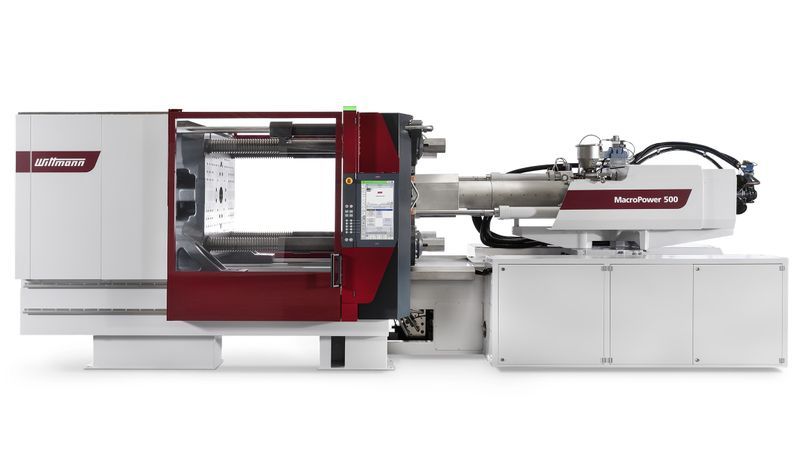
Macropower 500/3400 injection molding machine from Wittmann Battenfeld
(Bild: Wittmann)
Injection molding machines are used for the industrial production of plastic parts. They form components by injecting molten plastic into a mold (tool) under high pressure.
The injection molding process, which is very popular in many industries today, experienced a massive surge in development during World War II as the demand for mass-produced goods rose. Its origins, however, date back much further. As early as 1872, the American inventor John Wesley Hyatt and his brother Jesaja developed the first machine for plastic injection molding.
How does the injection molding process work?
The injection molding process consists of several precisely coordinated steps. The goal is to produce large quantities of precision molded parts from plastic pellets. The process depends on many factors, though there is a basic outline:
Metering & Plasticizing: The plastic pellets are fed into the hopper, where a rotating screw conveys the material forward, melting it through heat and friction.
Close the mold: The clamping unit moves closed, and the mold is tightly sealed with high force to prevent plastic from leaking out.
Injection: The screw moves axially forward, and the molten plastic is injected into the mold under high pressure—until the cavity is completely filled.
Hold-pressure phase: After the molten material has filled the mold cavity, hold pressure is applied to prevent voids caused by solidification shrinkage or weak spots at the gate location. This ensures that the part has sufficient strength.
Cooling: The plastic solidifies inside the mold, and the cooling channels in the mold dissipate heat. This step often takes the longest.
Opening and Ejecting the Mold: Once the mold has cooled sufficiently, the machine opens it, and ejector pins push the finished part out of the mold.
All these steps combined make up the cycle time, which is usually only a few seconds to minutes—depending on the component size and material.
Design and Main Components
An injection molding machine is generally composed of several subassemblies that together enable the injection molding process. The most important components include:
Closing unit: It keeps the mold closed during injection.
Injection unit (plasticizing unit): This is where the plastic is melted and injected.
Mold: Gives the part its shape.
Drive system: Generates the machine's movements and forces.
Control System: The "brain" of the machine.
What types of injection molding machines are there?
Injection molding machines can be classified according to various criteria, primarily by drive type, design, number of injection units, and application.
Depending on the drive system, injection molding machines are classified as hydraulic, electric, or hybrid:
Hydraulic machines operate using hydraulic oil and can generate very high clamping forces. They are robust and proven, but consume more energy and are comparatively noisy.
Electric injection molding machines use servo motors for all movements, which makes them particularly precise, energy-efficient, and quiet.
Hybrid machines combine hydraulic and electric drives, offering high power output and good energy efficiency.
Based on the construction method, machines are classified as either frame-type or frameless:
Four-beam machines, the classic design, have four beams and are very sturdy and versatile.
Columnless machines, on the other hand, do not have columns, offer better access to the mold, and provide even clamping force distribution, which is particularly advantageous for large or complex molds.
Another distinguishing feature is the number of injection units:
Most machines are single-screw machines with a single injection unit, which is sufficient for standard parts.
Multi-component or 2K/3K machines have two or more injection units and enable the production of parts made from multiple plastics or colors, such as hard-soft combinations.
Finally, injection molding machines can be classified based on the plastic they process:
Thermoplastic injection molding machines are designed for processing thermoplastics such as polypropylene, polyamide, or ABS.
Thermoset machines are used for thermosets and operate with heated molds.
Elastomer or LSR machines are designed specifically for rubber or silicone and feature special screws and molds.
In addition, there are special-purpose machines, such as micro-injection molding machines for very small parts, vertical injection molding machines for insert molding or overmolding, and machines for reaction injection molding (RIM).
K 2025: These injection molding machines caused a stir
The theme of K 2025—“The Power of Plastics! Green – Smart – Responsible” – was addressed at the VDMA Forum. There, Wittmann presented two systems that embody this motto, including a all-electric Ecopower in DC configuration.
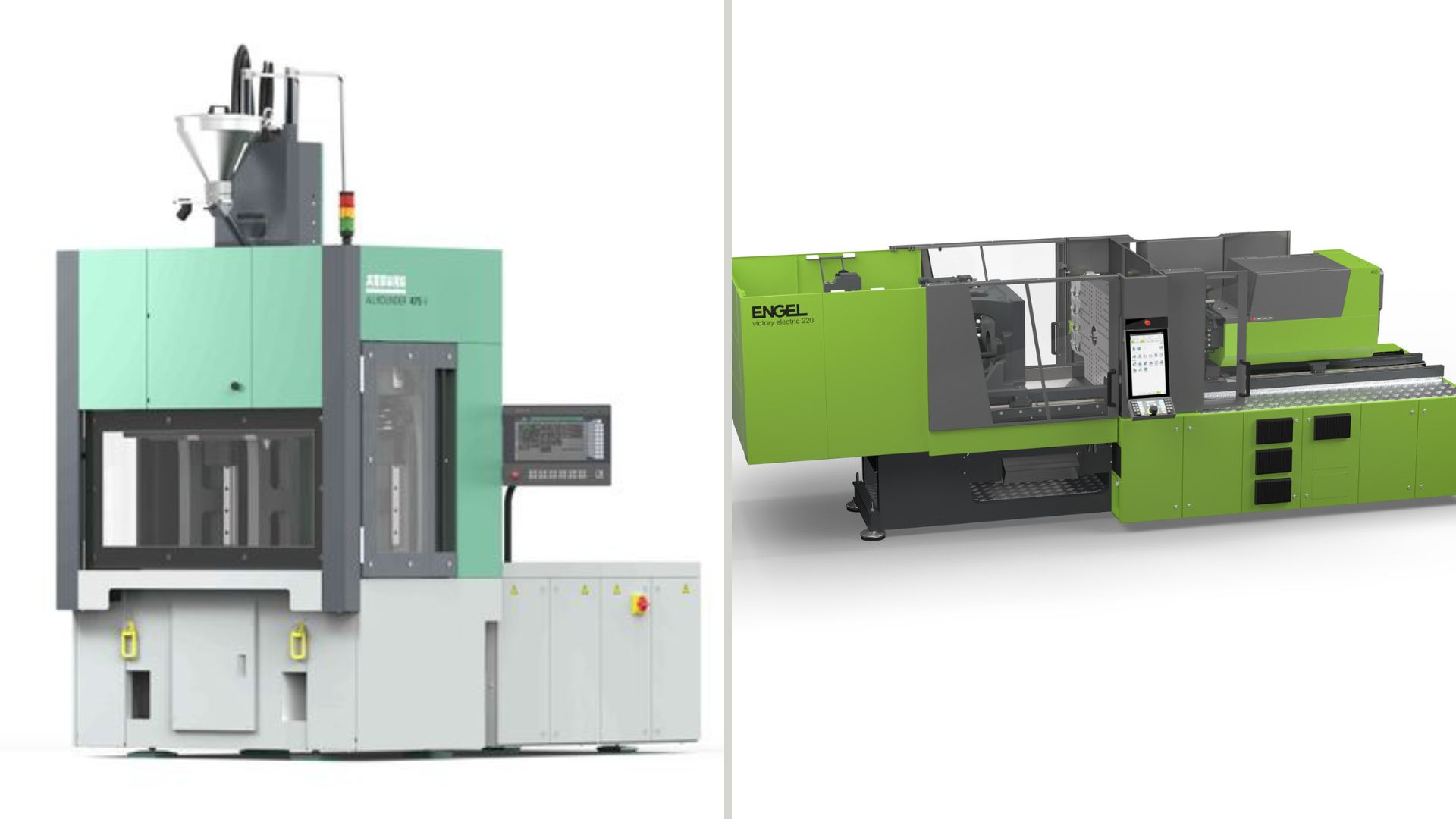
With the new Victory Electric, Engel launched a world-first in electric technology: The completely redesigned suspension concept combines the advantages of strutless technology with the dynamics of electric drive technology.
At the Arburg booth Arburg celebrated the premiere of the Allrounder 475 V, among other things. According to the manufacturer, the machine is characterized by high energy efficiency, a small footprint, and an attractive price-performance ratio.
Advantages & & Disadvantages of Injection Molding
Injection molding is a widely used process for manufacturing plastic parts and offers numerous advantages. Its high precision and repeatability are particularly noteworthy. It has a high production speed, making the process especially well-suited for mass production.
In addition, injection molding results in minimal material loss, as excess plastic can often be recycled. The surface quality of the finished parts is also very good, and it is possible to produce complex geometries and integrated features such as undercuts, ribs, or hinges. The process is also highly versatile, as many different plastics can be processed on injection molding machines.
(Source: Arburg/Engel)
Left: Arburg Allrounder 475 V vertical injection molding machine
Right: Beamless electric clamps, Victory Electric 220, with a clamping force of 2,200 kN
On the other hand, injection molding also has some disadvantages. The initial costs for machines and molds are high, especially for multi-component or high-precision machines. Mold manufacturing is time-consuming and expensive, which makes the process less economical for small production runs.
In addition, the process requires precise process control, as even small deviations in temperature, pressure, or cooling can lead to dimensional or quality defects. Flexibility in adapting to design changes is also limited, since the mold must be remade for each new part.
Applications & Products
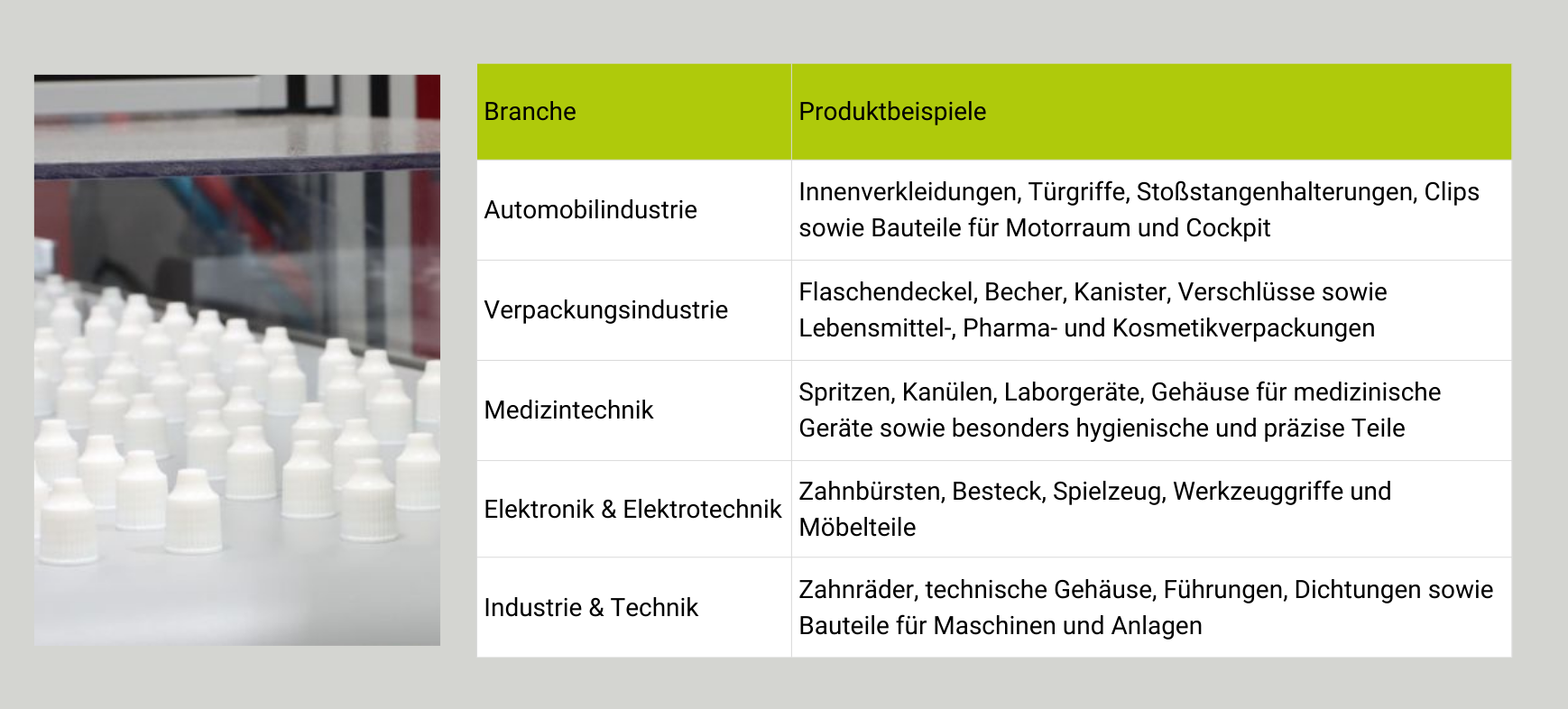
Injection molding machines are used wherever large quantities of identical plastic parts are needed. They are one of the most important processes in plastics processing because they are fast, precise, and versatile.
(Source: Wittmann; Graphic: PlastXnow)
Real-World Examples
The bicycle handlebars for Canyon Bicycles are manufactured on an Engel Victory 180 column-less injection molding machine. Read more
Sustainable Packaging Meets Design: Thomriss Relys on Wittmann Technology for Precise, Efficient, and Eco-Friendly Cosmetics Packaging. Read more
It took skateboarder Peter Karacsonyi more than ten years of development: With the help of Krauss Maffei, he has created the perfect skateboard. Read more (+)
Conclusion
Injection molding machines are among the most important pieces of production equipment in modern industry, as they enable the cost-effective production of plastic parts in large quantities. A key advantage of injection molding is its high precision and repeatability, which allow even complex components to be manufactured with consistent quality. In addition, the process enables short cycle times, resulting in very high productivity and making it particularly attractive for mass production.
Date: 08.12.2025
Naturally, we always handle your personal data responsibly. Any personal data we receive from you is processed in accordance with applicable data protection legislation. For detailed information please see our privacy policy.
Consent to the use of data for promotional purposes
I hereby consent to Vogel Communications Group GmbH & Co. KG, Max-Planck-Str. 7-9, 97082 Würzburg including any affiliated companies according to §§ 15 et seq. AktG (hereafter: Vogel Communications Group) using my e-mail address to send editorial newsletters. A list of all affiliated companies can be found here
Newsletter content may include all products and services of any companies mentioned above, including for example specialist journals and books, events and fairs as well as event-related products and services, print and digital media offers and services such as additional (editorial) newsletters, raffles, lead campaigns, market research both online and offline, specialist webportals and e-learning offers. In case my personal telephone number has also been collected, it may be used for offers of aforementioned products, for services of the companies mentioned above, and market research purposes.
Additionally, my consent also includes the processing of my email address and telephone number for data matching for marketing purposes with select advertising partners such as LinkedIn, Google, and Meta. For this, Vogel Communications Group may transmit said data in hashed form to the advertising partners who then use said data to determine whether I am also a member of the mentioned advertising partner portals. Vogel Communications Group uses this feature for the purposes of re-targeting (up-selling, cross-selling, and customer loyalty), generating so-called look-alike audiences for acquisition of new customers, and as basis for exclusion for on-going advertising campaigns. Further information can be found in section “data matching for marketing purposes”.
In case I access protected data on Internet portals of Vogel Communications Group including any affiliated companies according to §§ 15 et seq. AktG, I need to provide further data in order to register for the access to such content. In return for this free access to editorial content, my data may be used in accordance with this consent for the purposes stated here. This does not apply to data matching for marketing purposes.
Right of revocation
I understand that I can revoke my consent at will. My revocation does not change the lawfulness of data processing that was conducted based on my consent leading up to my revocation. One option to declare my revocation is to use the contact form found at https://contact.vogel.de. In case I no longer wish to receive certain newsletters, I have subscribed to, I can also click on the unsubscribe link included at the end of a newsletter. Further information regarding my right of revocation and the implementation of it as well as the consequences of my revocation can be found in the data protection declaration, section editorial newsletter.
Another major advantage is the high degree of design freedom. Injection molding machines can be used to produce both simple and highly complex geometries, including components with integrated features such as clips, hinges, or reinforcing ribs. At the same time, material loss is minimal, as excess plastic can often be recycled. The ability to process different plastics as well as multi-component or hard-soft combinations makes the process extremely versatile.
Because of these characteristics, injection molding machines are used in numerous industries, such as the automotive industry, the packaging industry, medical technology, electrical engineering, and the household and consumer goods sectors. In any application where precise, durable, and cost-effective plastic parts are needed in large quantities, injection molding machines are the preferred solution.



:quality(80)/p7i.vogel.de/wcms/8d/fd/8dfdc63153cce5816e7a371257b6bdff/nexofoam-epla-schaumv1.png "From compact EPLA granules to fully foamed insulation boards: This bio-based particle foam material can be processed as a drop-in solution on existing EPS molding machines. (Bild: Nexofoam)")
:quality(80)/p7i.vogel.de/wcms/91/39/91397ac53b2ca4d65d65f563ebdc12ea/nexofoam-epla-schaumv1.png "From compact EPLA granules to fully foamed insulation boards: This bio-based particle foam material can be processed as a drop-in solution on existing EPS molding machines. (Bild: Nexofoam)")
:quality(80)/p7i.vogel.de/wcms/2b/37/2b37601930b643d709629fa8005aade0/nexofoam-epla-schaumv1.png "From compact EPLA granules to finished foam insulation boards: This bio-based particle foam material can be processed as a drop-in solution on existing EPS molding machines. (Bild: Nexofoam)")
:quality(80)/p7i.vogel.de/wcms/97/0c/970c52fd142e10a3c4566168037ca637/materialloesungen-pressefoto-1890x1329v1.jpeg "rPET pellets: At Fraunhofer IAP, terephthalic acid is recovered from PET to produce new polymers for bottles, fibers, and films. The yellowish to grayish hues are due to the recycled raw material. Through the targeted addition of additives, the color can be adjusted to produce even colorless material. (Bild: Fraunhofer IAP / Romina Schönefeld)")
:quality(80)/p7i.vogel.de/wcms/ce/ee/ceeeef086bfb174ebdda31c0dfccaf9a/2-weiss-blick-in-produktion-dji-0095-kopiev1.jpeg "A look inside the injection molding shop at Weiss Kunststoffverarbeitung in Illertissen, Bavaria. (Bild: White)")
:quality(80)/p7i.vogel.de/wcms/33/08/3308710c85715e917ec1baf9767fe4a7/2026-ewikon-wago-hei-kanalv1.png "Ewikon's 48-cavity hot runner as a production mold. (Bild: Ewikon)")
:quality(80)/p7i.vogel.de/wcms/a2/a5/a2a516dc69b4c8f8ad6f475ae6746a08/sxkh-bei-hpf-gesamtwerkzeugv1.png "The HMG 70XS1510 trimming press from the Chinese manufacturer SXKH combines all the functions required by toolmakers at HPF in a very compact design. The deciding factors in the purchase were the purchase price—and confidence in the quality of established international key components. (Bild: Pergler Media)")
:quality(80)/p7i.vogel.de/wcms/19/5f/195fdb6e09629994f1d6e3cf94dac8d8/bild-1-exam510-ultem9085v1.jpeg "Granular printing (FGF) makes it cost-effective to produce large-format functional parts from high-performance polymers such as Ultem 9085. (Bild: NEW AIM3D)")
:quality(80)/p7i.vogel.de/wcms/d5/c4/d5c46d40e1ae062370d058e2c006c376/dimitrisvetsikas1969-belgium-3595351v1.jpeg "European Plastics Industry Calls for Immediate Action to Address the Industry Crisis (Bild: dimitrisvetsikas1969)")
:quality(80)/p7i.vogel.de/wcms/e6/63/e663f0e1dd8818fc501c6fb5c5d33712/19-5689-circular-economy-of-resourcesv1.jpeg "Plastic waste from the average household is very heterogeneous. Only the right mix of technologies can turn all types of plastic waste into a new source of raw materials. (Bild: BASF)")
:quality(80)/p7i.vogel.de/wcms/31/5b/315b714f653484179232fbc4d6d79543/sesotec-img-andreas-hanus-25-20-281-29v1.jpeg "Andreas Hanus, Head of AI Development at Sesotec: “AI will not replace traditional sorting technology, but will intelligently enhance it.” (Bild: Sesotec)")
:quality(80)/p7i.vogel.de/wcms/74/5f/745f512239689819275af39a82f59860/b-brenkenv1.jpeg "Dr. Benedikt Brenken, Director of R-Cycle: \"The digital product passport will fundamentally change plastic recycling.\" (Bild: R-Cycle)")
:quality(80)/p7i.vogel.de/wcms/40/6d/406d05534ab4d28194bd29699e023e67/2026-09-09-uni-kiel-aufmacherv1.jpeg "These self-polarizing polymer coatings could be used in a wide variety of electronic components in the future. (Bild: University of Kiel/C. Anders)")
:quality(80)/p7i.vogel.de/wcms/5d/46/5d46e098a7cfaebdd9643df47153c5af/aufmacherv1.png "The PPWR imposes new requirements on packaging: What impact does this have on mechanical engineering? (Bild: KI-generiert / Dall-E)")
:quality(80)/p7i.vogel.de/wcms/70/13/7013fe202fb4790708f62f69cd0c83d4/aufmacher-st-c3-a4rkeschaumfoliev1.png "Using thermoplastic starch as a base, researchers at the IKV successfully produced a flexible foam film using physical blowing agents. (Bild: IKV)")
:quality(80)/p7i.vogel.de/wcms/d1/2b/d12b536ba3b382d0d138e342ac1038e6/03--20pm-imm-mgsv1.jpeg "MGS Richfield Site (Bild: MGS)")
:quality(80)/p7i.vogel.de/wcms/90/9c/909cf6eb1b91a9a84ff535033ea9b048/honeycombv1.jpeg "The composite material made of epoxy and glass fibers not only protects against flames but is also fully recyclable. (Bild: Empa)")
:quality(80)/p7i.vogel.de/wcms/6a/d5/6ad5980b0c965409c71582fc59145e13/1920-covestro-new-covestro-headquartersv1.jpeg "Covestro's corporate headquarters in Leverkusen (Bild: Covestro)")
:quality(80)/p7i.vogel.de/wcms/db/74/db741079d26ad9e7a69278fde45e79c7/aufmacherv1.png "(Bild: KI-generiert / Dall-E)")
:quality(80)/p7i.vogel.de/wcms/b3/65/b3654df434f4d31e1fda3c79bc7bb4b0/nakura-20kunstrasenteppich-20ohne-20verf-c3-bcllungv1.jpeg "Tecnaro has developed synthetic turf fibers using a specially formulated Arboblend blend that offers high resistance to heat, UV rays, and weathering, and, because it is niobium-based, sequesters CO₂ over the long term. (Bild: Tecnaro)")
:quality(80)/p7i.vogel.de/wcms/64/46/644676e770e55e885d5dbb2423df0feb/-mg-4831v1.jpeg "In automotive sealing systems, many processes must be perfectly coordinated. Here, an interdisciplinary team is discussing ways to optimize a component. (Bild: Pfaff)")
:quality(80)/p7i.vogel.de/wcms/85/18/8518f38a6166ef1be49aa2cc4ddbeba1/pr-20bild-20srgb-475v-20keyfob-20k2025-20de-dsc6736v1.jpeg "The high-quality surface of the key fob cover, made from recycled PC/ABS, is created using IMD film technology and a textured mold insert. The rectangular injection-molded part, complete with film, is milled to its final shape in a subsequent station. (Bild: Arburg)")