PlastXnow Explains – Multi Jet FusionSpeed and Precision for Additive Series Production
From
Melanie Ehrhardt (in charge) | Translated by AI
5 min Reading Time
For a long time, additive manufacturing was not considered suitable for mass production. Multi Jet Fusion is changing that. It allows designs to be implemented more quickly and components to be transferred directly to mass production.
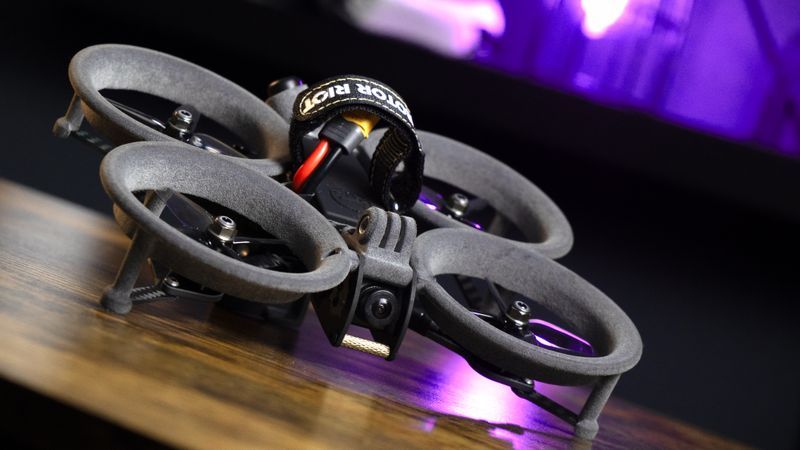
Rotor Riot SkyLite FPV drone equipped with MJF-manufactured parts.
(Bild: Unusual Machines)
For a long time, additive manufacturing was not considered suitable for mass production. That changed with the development of Multi Jet Fusion (MJF). The process bridges the gap between prototyping and mass production because it allows for the cost-effective production of both individual prototypes and small- to medium-sized production runs.
In addition, the high printing speed, consistent component quality, and the elimination of the need for tools enable flexible and cost-effective production. This allows companies to bring new designs to market faster and transition components directly to mass production without the need for time-consuming retooling.
What is Multi Jet Fusion?
Multi Jet Fusion is an industrial 3D printing process for plastic parts developed by HP. It belongs to the family of powder-bed processes and is particularly well-suited for the rapid production of functional prototypes and small- to medium-volume production runs.
Differences from Laser Sintering
Multi Jet Fusion differs from selective laser sintering (SLS) in that the plastic powder is not fused point by point with a laser, but rather using applied melting and detailing agents as well as infrared energy. As a result, the printing process is faster and often yields better surface quality and more consistent part properties.
How does the MJF process work?
The MJF printing process consists of several steps:
A thin layer thermoplastic powder —often nylon or TPU—is spread across a build platform.
The inkjet print heads can then begin printing the first layer. To do this, they selectively apply a binder to the powder, tracing the contours of the part layer by layer. At the same time, an insulating liquid is applied to the contours of the object to define them more clearly.
Then the build plate lowers slightly, and another layer of powder is applied. This process is repeated until all layers are complete.
After printing, the part cools in the powder bed before the excess powder is removed and the finished part is retrieved. The part undergoes semi-manual cleaning at a post-processing station.
In the final step, the components are glass bead blasted. During this process, a high-pressure jet propels fine glass beads onto the components to smooth the surface and remove any remaining powder.
The World of Materials in MJF
One of the most common MJF materials is polyamide 12 (PA12 or nylon). This high-performance plastic offers balanced mechanical properties and a high-quality surface finish. It also exhibits good chemical resistance and can be water-dyed. PA12 can be used to print waterproof MJF parts.
In addition, there are other possible materials, such as PA11 (better suited for ductile components) and polypropylene (PP).
FAQ
What are the benefits of Multi Jet Fusion?
MJF enables high print speeds, good surface quality, and durable parts. In addition, no support structures are required, making it easy to produce complex geometries.
What materials can be processed with Multi Jet Fusion?
The most commonly processed plastics are PA12 (Nylon 12) and PA11 (Nylon 11). These materials are characterized by high strength and good durability.
Is post-processing of the components necessary?
Yes. After printing, the excess powder is first removed from the parts. Depending on the intended use, additional post-processing steps such as dyeing, sanding, or coating may then be performed.
Comparison: MJF vs. SLS
A key difference is that MJF is faster, which tends to result in lower manufacturing costs. While cost is an important factor, other aspects must also be taken into account, such as resolution, surface quality, material and color selection, and mechanical properties:
Resolution: With MJF, it is possible to produce smaller features down to 0.5 mm. With SLS, on the other hand, depending on the material, “only” features between 0.75 mm and 1.0 mm are possible.
Surface quality: Theoretically, MJF is the preferred choice here, although both technologies produce parts with a grainy texture that may require post-processing.
Materials: Nylon is the primary material used in both processes. However, SLS can also process other materials, such as carbon- or glass-filled PA, which offer additional mechanical properties.
Color: SLS is clearly the favorite here, as it allows parts to be produced in virtually any color. MJF, on the other hand, has limitations in this regard. As a result, parts manufactured using MJF have a slight grayish tint, but the manufacturer can color them black upon request.
Mechanical Properties: Here, too, MJF appears to be the preferred technology at first glance, as it generally yields more consistent mechanical properties. For parts with critical features on multiple surfaces, MJF may be the better choice.
AdditivX | September 22, 2026
Additive Manufacturing as a Tool for Supply Chain, Production, and Service
(Source: Vogel Communications Group / WIN Publishing)
The conference aims to demonstrate how 3D printing with plastics and metals can be used as a strategic tool for spare parts—regardless of the industry. The focus will be on materials, processes, cost-effectiveness, and integration into existing production and maintenance structures, including those from other areas of additive manufacturing.
Multi Jet Fusion is used in any application where strength and moderate heat resistance are required. These include: functional prototypes, housings and covers, brackets and assembly aids, replacement parts, small-batch production, and customized products, as well as medical and industrial components.
Real-World Example: FPV Drones
The U.S.-based drone manufacturer Unusual Machines is using the HP Multi Jet Fusion for the production of its FPV drones. The company plans to use this technology to shift the manufacturing of components such as housings, connectors, and smaller parts for its SkyLite series to the United States. Read more at www.autocad-magazin.de
Summary
Multi Jet Fusion is a fast and precise industrial 3D printing process for plastics. It is particularly well-suited for durable functional parts and the cost-effective production of small- to medium-volume runs, and often offers a better combination of speed, surface quality, and mechanical properties than many other plastic 3D printing processes.
Transparency: This text was also written with the help of AI.
Date: 08.12.2025
Naturally, we always handle your personal data responsibly. Any personal data we receive from you is processed in accordance with applicable data protection legislation. For detailed information please see our privacy policy.
Consent to the use of data for promotional purposes
I hereby consent to Vogel Communications Group GmbH & Co. KG, Max-Planck-Str. 7-9, 97082 Würzburg including any affiliated companies according to §§ 15 et seq. AktG (hereafter: Vogel Communications Group) using my e-mail address to send editorial newsletters. A list of all affiliated companies can be found here
Newsletter content may include all products and services of any companies mentioned above, including for example specialist journals and books, events and fairs as well as event-related products and services, print and digital media offers and services such as additional (editorial) newsletters, raffles, lead campaigns, market research both online and offline, specialist webportals and e-learning offers. In case my personal telephone number has also been collected, it may be used for offers of aforementioned products, for services of the companies mentioned above, and market research purposes.
Additionally, my consent also includes the processing of my email address and telephone number for data matching for marketing purposes with select advertising partners such as LinkedIn, Google, and Meta. For this, Vogel Communications Group may transmit said data in hashed form to the advertising partners who then use said data to determine whether I am also a member of the mentioned advertising partner portals. Vogel Communications Group uses this feature for the purposes of re-targeting (up-selling, cross-selling, and customer loyalty), generating so-called look-alike audiences for acquisition of new customers, and as basis for exclusion for on-going advertising campaigns. Further information can be found in section “data matching for marketing purposes”.
In case I access protected data on Internet portals of Vogel Communications Group including any affiliated companies according to §§ 15 et seq. AktG, I need to provide further data in order to register for the access to such content. In return for this free access to editorial content, my data may be used in accordance with this consent for the purposes stated here. This does not apply to data matching for marketing purposes.
Right of revocation
I understand that I can revoke my consent at will. My revocation does not change the lawfulness of data processing that was conducted based on my consent leading up to my revocation. One option to declare my revocation is to use the contact form found at https://contact.vogel.de. In case I no longer wish to receive certain newsletters, I have subscribed to, I can also click on the unsubscribe link included at the end of a newsletter. Further information regarding my right of revocation and the implementation of it as well as the consequences of my revocation can be found in the data protection declaration, section editorial newsletter.



:quality(80)/p7i.vogel.de/wcms/78/ce/78ce24a7ba8343ef49bc3dbb49016443/pasja1000-the-bottle-5128607v1.jpeg "The new plastic tax would amount to 0.28 cents for a yogurt cup and 1.93 cents for a large PET bottle. (Bild: pasja1000)")
:quality(80)/p7i.vogel.de/wcms/cc/db/ccdb09d1d9b3fcabf147abba7fd9e3c5/pasja1000-the-bottle-5128607v1.jpeg "The new plastic tax would amount to 0.28 cents for a yogurt cup and 1.93 cents for a large PET bottle. (Bild: pasja1000)")
:quality(80)/p7i.vogel.de/wcms/be/0a/be0a2864a5f59b0c9bca685dd23bdf79/pasja1000-the-bottle-5128607v1.jpeg "The new plastic tax would amount to 0.28 cents for a yogurt cup and 1.93 cents for a large PET bottle. (Bild: pasja1000)")
:quality(80)/p7i.vogel.de/wcms/b6/fe/b6fe83997fc68192cf8cd8a89b0bab5f/pasja1000-the-bottle-5128607v1.jpeg "The new plastic tax would amount to 0.28 cents for a yogurt cup and 1.93 cents for a large PET bottle. (Bild: pasja1000)")
:quality(80)/p7i.vogel.de/wcms/ce/ee/ceeeef086bfb174ebdda31c0dfccaf9a/2-weiss-blick-in-produktion-dji-0095-kopiev1.jpeg "A look inside the injection molding shop at Weiss Kunststoffverarbeitung in Illertissen, Bavaria. (Bild: White)")
:quality(80)/p7i.vogel.de/wcms/33/08/3308710c85715e917ec1baf9767fe4a7/2026-ewikon-wago-hei-kanalv1.png "Ewikon's 48-cavity hot runner as a production mold. (Bild: Ewikon)")
:quality(80)/p7i.vogel.de/wcms/a2/a5/a2a516dc69b4c8f8ad6f475ae6746a08/sxkh-bei-hpf-gesamtwerkzeugv1.png "The HMG 70XS1510 trimming press from the Chinese manufacturer SXKH combines all the functions required by toolmakers at HPF in a very compact design. The deciding factors in the purchase were the purchase price—and confidence in the quality of established international key components. (Bild: Pergler Media)")
:quality(80)/p7i.vogel.de/wcms/19/5f/195fdb6e09629994f1d6e3cf94dac8d8/bild-1-exam510-ultem9085v1.jpeg "Granular printing (FGF) makes it cost-effective to produce large-format functional parts from high-performance polymers such as Ultem 9085. (Bild: NEW AIM3D)")
:quality(80)/p7i.vogel.de/wcms/d5/c4/d5c46d40e1ae062370d058e2c006c376/dimitrisvetsikas1969-belgium-3595351v1.jpeg "European Plastics Industry Calls for Immediate Action to Address the Industry Crisis (Bild: dimitrisvetsikas1969)")
:quality(80)/p7i.vogel.de/wcms/e6/63/e663f0e1dd8818fc501c6fb5c5d33712/19-5689-circular-economy-of-resourcesv1.jpeg "Plastic waste from the average household is very heterogeneous. Only the right mix of technologies can turn all types of plastic waste into a new source of raw materials. (Bild: BASF)")
:quality(80)/p7i.vogel.de/wcms/31/5b/315b714f653484179232fbc4d6d79543/sesotec-img-andreas-hanus-25-20-281-29v1.jpeg "Andreas Hanus, Head of AI Development at Sesotec: “AI will not replace traditional sorting technology, but will intelligently enhance it.” (Bild: Sesotec)")
:quality(80)/p7i.vogel.de/wcms/74/5f/745f512239689819275af39a82f59860/b-brenkenv1.jpeg "Dr. Benedikt Brenken, Director of R-Cycle: \"The digital product passport will fundamentally change plastic recycling.\" (Bild: R-Cycle)")
:quality(80)/p7i.vogel.de/wcms/40/6d/406d05534ab4d28194bd29699e023e67/2026-09-09-uni-kiel-aufmacherv1.jpeg "These self-polarizing polymer coatings could be used in a wide variety of electronic components in the future. (Bild: University of Kiel/C. Anders)")
:quality(80)/p7i.vogel.de/wcms/5d/46/5d46e098a7cfaebdd9643df47153c5af/aufmacherv1.png "The PPWR imposes new requirements on packaging: What impact does this have on mechanical engineering? (Bild: KI-generiert / Dall-E)")
:quality(80)/p7i.vogel.de/wcms/70/13/7013fe202fb4790708f62f69cd0c83d4/aufmacher-st-c3-a4rkeschaumfoliev1.png "Using thermoplastic starch as a base, researchers at the IKV successfully produced a flexible foam film using physical blowing agents. (Bild: IKV)")
:quality(80)/p7i.vogel.de/wcms/d1/2b/d12b536ba3b382d0d138e342ac1038e6/03--20pm-imm-mgsv1.jpeg "MGS Richfield Site (Bild: MGS)")
:quality(80)/p7i.vogel.de/wcms/90/9c/909cf6eb1b91a9a84ff535033ea9b048/honeycombv1.jpeg "The composite material made of epoxy and glass fibers not only protects against flames but is also fully recyclable. (Bild: Empa)")
:quality(80)/p7i.vogel.de/wcms/6a/d5/6ad5980b0c965409c71582fc59145e13/1920-covestro-new-covestro-headquartersv1.jpeg "Covestro's corporate headquarters in Leverkusen (Bild: Covestro)")
:quality(80)/p7i.vogel.de/wcms/db/74/db741079d26ad9e7a69278fde45e79c7/aufmacherv1.png "(Bild: KI-generiert / Dall-E)")
:quality(80)/p7i.vogel.de/wcms/b3/65/b3654df434f4d31e1fda3c79bc7bb4b0/nakura-20kunstrasenteppich-20ohne-20verf-c3-bcllungv1.jpeg "Tecnaro has developed synthetic turf fibers using a specially formulated Arboblend blend that offers high resistance to heat, UV rays, and weathering, and, because it is niobium-based, sequesters CO₂ over the long term. (Bild: Tecnaro)")
:quality(80)/p7i.vogel.de/wcms/19/5f/195fdb6e09629994f1d6e3cf94dac8d8/bild-1-exam510-ultem9085v1.jpeg "Granular printing (FGF) makes it cost-effective to produce large-format functional parts from high-performance polymers such as Ultem 9085. (Bild: NEW AIM3D)")
:quality(80)/p7i.vogel.de/wcms/a2/a5/a2a516dc69b4c8f8ad6f475ae6746a08/sxkh-bei-hpf-gesamtwerkzeugv1.png "The HMG 70XS1510 trimming press from the Chinese manufacturer SXKH combines all the functions required by toolmakers at HPF in a very compact design. The deciding factors in the purchase were the purchase price—and confidence in the quality of established international key components. (Bild: Pergler Media)")