Without innovative polymer materials, it would be virtually impossible to implement new key technologies in Germany. Plastics Europe Germany recently highlighted this point at an innovation conference in Berlin. However, the transition from the laboratory to mass production is crucial for Germany as a business location, and this requires competitive conditions.
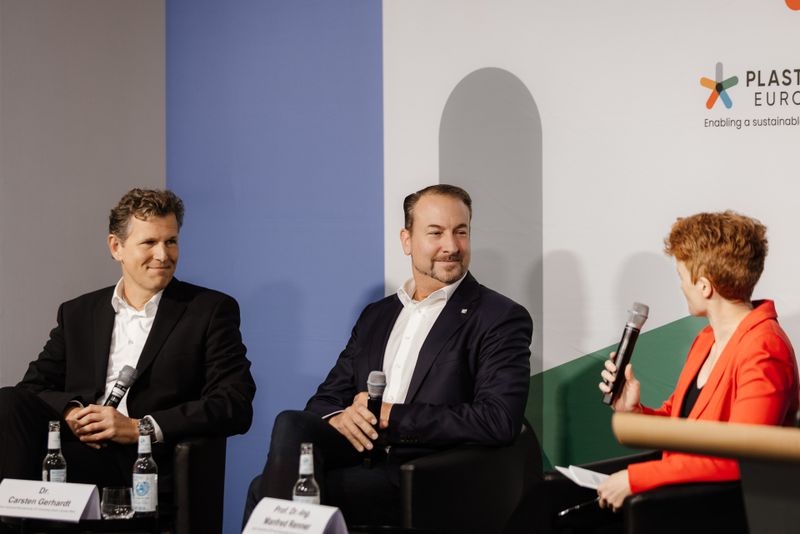
Panel discussion in Berlin on the importance of the plastics industry for Germany as a hub of innovation. From left: Dr. Carsten Gerhardt (EY), Prof. Manfred Renner (Fraunhofer CCPE), and Dr. Christine Bunte (Plastics Europe Germany).
(Bild: Plastics Europe Germany)
The German federal government’s high-tech agenda focuses on strategic fields of the future such as sustainable mobility, climate-neutral energy, medical technology, robotics, artificial intelligence, microelectronics, and biotechnology. At an innovation conference held on September 11, 2026, in Berlin, Plastics Europe Germany, raw material manufacturers, and research institutes demonstrated the technological potential of plastics for these key technologies of the future.
High-Tech Agenda Requires Expertise in Materials
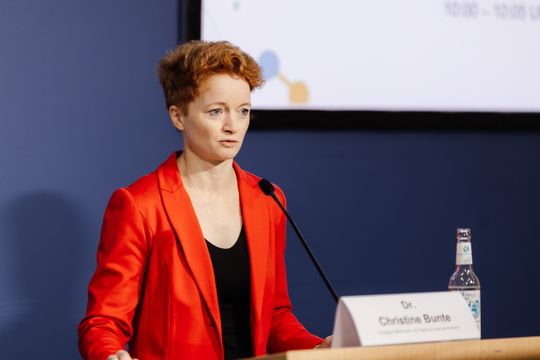
In her opening remarks, Dr. Christine Bunte, CEO of Plastics Europe Germany, emphasized that plastics are far more than just everyday materials; as a key and enabling technology, they are essential for wind turbines, power grids, lightweight construction, and medical technology.
Dr. Christine Bunte (CEO of Plastics Europe Germany): “Innovation Made in Germany must not get stuck at the pilot plant stage; rather, it must become a reality here on an industrial scale.”
(Bild: Plastics Europe Germany)
Germany has a dense network of universities, research institutions, established industrial companies, and startups, as well as a highly skilled workforce—essentially the best conditions for remaining an industrialized nation in the future. “What we too often lack is the leap from the idea to the market,” Dr. Bunte emphasized in Berlin. “That is precisely why our country must not focus solely on social reforms, but also needs a new debate on innovation. Innovation ‘Made in Germany’ must not get stuck in laboratories or pilot plants; rather, it must become a reality here on an industrial scale. Investment decisions are being made now, but this urgently requires reliable framework conditions.”
Promote Industrial Scaling
Dr. Bunte also views the plastics industry’s transition toward climate neutrality and a circular economy as a key innovation and resilience initiative for Germany as a business hub. However, he notes that future success in this area will also depend largely on the framework conditions under which the next major investments are made.
Dr. Bunte outlined three key prerequisites for a successful transformation process. “First, international competitiveness must be ensured through affordable energy, infrastructure expansion, and expedited permitting processes, since new technologies are also subject to the same economic laws as traditional industries.”
Second, the circular economy requires functioning markets through reliable recycled content targets, eco-modulated licensing fees, and sustainable public procurement. Third, the region demands a faster pace of scaling up, which is why transformation funds must be directed specifically toward industrial pilot projects and must not be diverted from the federal budget.
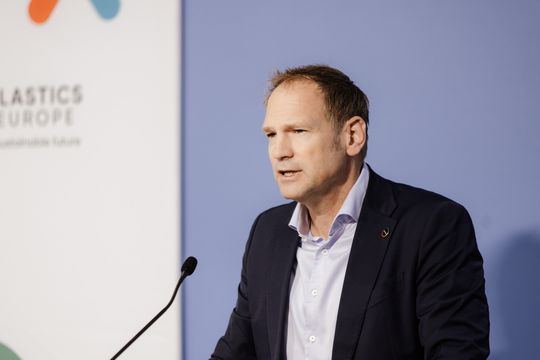
Dr. Thorsten Dreier (CTO, Covestro): “The industrial sectors of the future have one thing in common: they require a high level of expertise in plastics.”
(Bild: Plastics Europe Germany)
“The future fields of the high-tech agenda have one thing in common: they require a high level of materials expertise,” emphasized Dr. Thorsten Dreier, Chief Technology Officer at Covestro, in his keynote address: “Without tailor-made plastics, technological advances would be impossible. Anyone striving for technological leadership must therefore also secure the necessary materials, production, and value chains within their own country.”
Panel Discussion: Strengthening Value Chains
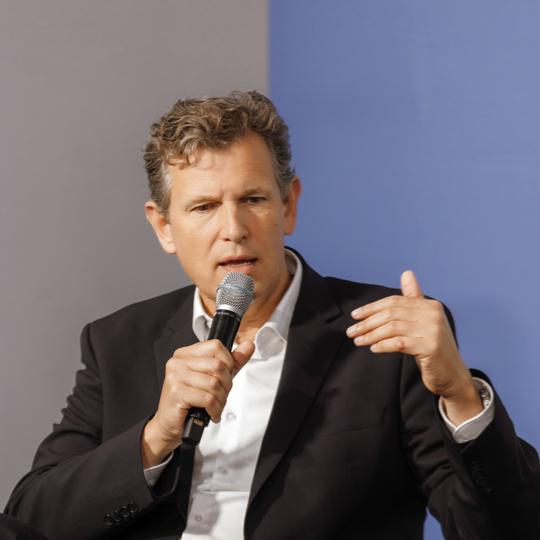
During a panel discussion, Dr. Carsten Gerhardt, a partner at the consulting firm EY, highlighted the importance of collaboration between academia, industry, startups, investors, and policymakers for high-performing innovation ecosystems: “Overall, Germany should think more in terms of complete value chains and concrete scaling projects.”
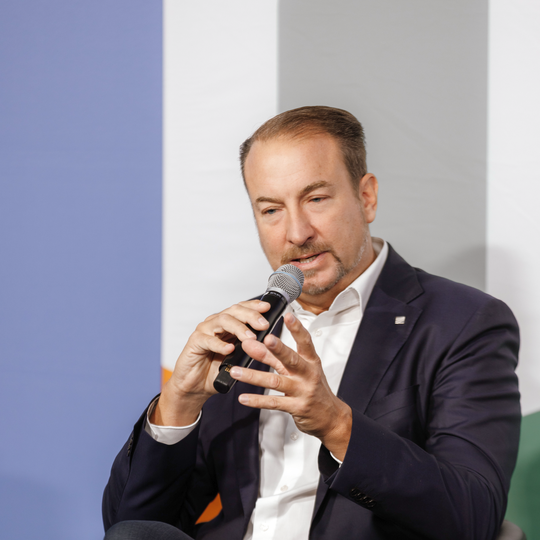
Prof. Manfred Renner (Director of Fraunhofer CCPE and Director of Fraunhofer Umsicht): “Those who master pilot plants and industrial scaling ultimately determine where value is created and jobs are generated.”
(Bild: Plastics Europe Germany)
Also Prof. Manfred Renner, Director of the Fraunhofer Cluster of Excellence Circular Plastics Economy (CCPE) and Director of Fraunhofer Umsicht, emphasized during the panel discussion that the greatest risk lies in other regions industrializing new technologies more quickly. “Whoever masters pilot plants, demonstration projects, and industrial scaling will ultimately determine where value is created and jobs are generated—and who will lead the way in the technologies of tomorrow.”
Date: 08.12.2025
Naturally, we always handle your personal data responsibly. Any personal data we receive from you is processed in accordance with applicable data protection legislation. For detailed information please see our privacy policy.
Consent to the use of data for promotional purposes
I hereby consent to Vogel Communications Group GmbH & Co. KG, Max-Planck-Str. 7-9, 97082 Würzburg including any affiliated companies according to §§ 15 et seq. AktG (hereafter: Vogel Communications Group) using my e-mail address to send editorial newsletters. A list of all affiliated companies can be found here
Newsletter content may include all products and services of any companies mentioned above, including for example specialist journals and books, events and fairs as well as event-related products and services, print and digital media offers and services such as additional (editorial) newsletters, raffles, lead campaigns, market research both online and offline, specialist webportals and e-learning offers. In case my personal telephone number has also been collected, it may be used for offers of aforementioned products, for services of the companies mentioned above, and market research purposes.
Additionally, my consent also includes the processing of my email address and telephone number for data matching for marketing purposes with select advertising partners such as LinkedIn, Google, and Meta. For this, Vogel Communications Group may transmit said data in hashed form to the advertising partners who then use said data to determine whether I am also a member of the mentioned advertising partner portals. Vogel Communications Group uses this feature for the purposes of re-targeting (up-selling, cross-selling, and customer loyalty), generating so-called look-alike audiences for acquisition of new customers, and as basis for exclusion for on-going advertising campaigns. Further information can be found in section “data matching for marketing purposes”.
In case I access protected data on Internet portals of Vogel Communications Group including any affiliated companies according to §§ 15 et seq. AktG, I need to provide further data in order to register for the access to such content. In return for this free access to editorial content, my data may be used in accordance with this consent for the purposes stated here. This does not apply to data matching for marketing purposes.
Right of revocation
I understand that I can revoke my consent at will. My revocation does not change the lawfulness of data processing that was conducted based on my consent leading up to my revocation. One option to declare my revocation is to use the contact form found at https://contact.vogel.de. In case I no longer wish to receive certain newsletters, I have subscribed to, I can also click on the unsubscribe link included at the end of a newsletter. Further information regarding my right of revocation and the implementation of it as well as the consequences of my revocation can be found in the data protection declaration, section editorial newsletter.
The transition to a circular and climate-neutral plastics economy can only succeed if existing production structures are maintained while new technologies, infrastructure, and business models are developed. Jens Hambricht, Strategy Coordinator for Plastics Recycling at BASF, emphasized: “To truly achieve this transformation, we need the legal certainty provided by laws that set clear goals.”
Examples of Plastic Innovations
At the conference, participating industrial companies demonstrated field-proven material and process innovations across the entire value chain. Covestro presented lightweight polycarbonates for robotics as well as specialty polyurethane films for wearables in medical technology. “Plastics have a very special ability: they can integrate things,” affirmed Stefan Mechnik, coordinator for political communications at Covestro.
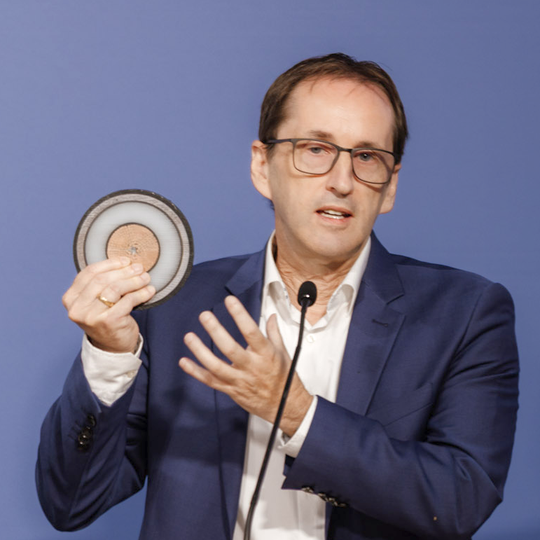
Matthias Pursch (Dow) demonstrated a fully cross-linked XLPE insulation system for direct-current cables that significantly increases transmission capacity.
(Bild: Plastics Europe Germany)
Dow showcased a fully cross-linked XLPE insulation system for 525-kV direct-current cables that enables higher operating temperatures and increases transmission capacity by 20 to 25 percent. Borouge International is investing over 150 million euros at its Burghausen site to triple its production capacity for recyclable high-melt-strength polypropylene (HMS-PP) and showcased a PP bumper bracket with 65% PCR content as well as running shoes with a CO2-based EVA midsole.
Evonik introduced an adhesive additive for PUR systems under the name “Debonding on Demand,” which can be selectively debonded at trigger temperatures ranging from 80 to 180 °C, as well as the de-inking co-binder Tego Res 1100 for removing ink from printed films. Polymaterials demonstrated virtual compounding using the AI platform X-Plorator, which enables the calculation of predictive formulations for plastic blends in minutes rather than months. BASF presented process engineering advances in the mechanical recycling of PUR foams, the chemical depolymerization of polyamide textiles, and the mass-balanced Ultramid Ccycled with a net-zero CO₂ footprint.
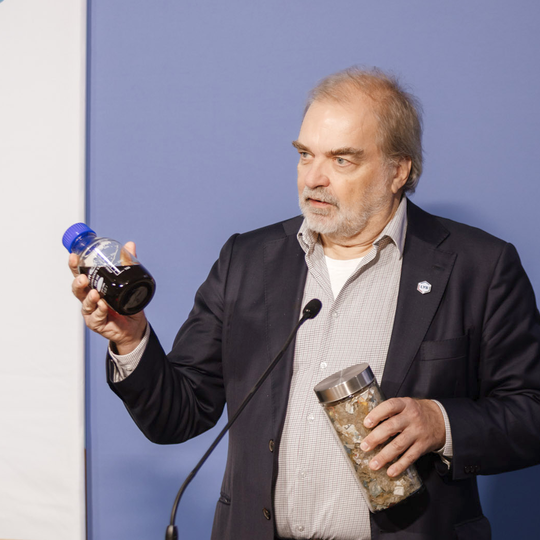
Andreas Anker (LyondellBasell): “We convert mixed household plastic waste into high-quality pyrolysis oil. Our technology guarantees a yield of at least 80 percent.”
(Bild: Plastics Europe Germany)
In the field of chemical recycling, Arcus Greencycling Technologies operates an industrial pyrolysis demonstration plant in Frankfurt-Höchst with a capacity of 4,000 jato for mixed waste. Lyondell Basell is building a Moretec plant in Wesseling with a capacity of 50,000 metric tons per year to produce high-quality drop-in feedstocks, with an investment of over 250 million euros.
Matterr is scaling up a hydrolysis technology at the Knapsack Chemical Park to break down complex polyester waste into ultra-pure monomers. “Thanks to the recycled material, polyester manufacturers can gradually supplement their products in the value chain with sustainable variants,” explains Melanie Hackler, CEO of Matterr. In Worms, Röhm is developing a chemical depolymerization process for post-consumer PMMA with a yield of over 90%. And Vinyl Plus Germany highlighted established closed-loop recycling systems for PVC window profiles with a recovery rate of 78%.
Prospects for Germany as a Hub for Innovation
Dr. Carsten Gerhardt (partner at the consulting firm EY): “Overall, Germany should focus more on complete value chains and concrete scaling projects.”
(Bild: Plastics Europe Germany)
All of these examples show that Germany has an abundance of innovation expertise. The field-tested developments—ranging from AI-supported compounding and removable adhesive systems to large-scale pyrolysis and hydrolysis plants—demonstrate that the process engineering foundations for this transformation are in place.
If the industry’s economic policy demands are implemented, the rapid transition of these pilot projects to large-scale commercial production can ensure a stable supply of raw materials for processors and sustain industrial value creation in Germany over the long term.



:quality(80)/p7i.vogel.de/wcms/c3/d8/c3d8da8c6ac6ac13c98801915339572b/aufmacherv1.png "The complete solution consisting of the Wintec e-win 1800 and the new Viper 6 combines an injection molding machine and automation into a seamlessly integrated production cell. (Bild: Angels)")
:quality(80)/p7i.vogel.de/wcms/95/39/95398364aea36832bde2bcdb1378d514/arburg-medaillev1.jpeg "Bettina Schall, Managing Director of P. E. Schall GmbH & Co. KG, Juliane Hehl, Managing Partner for Global Marketing at Arburg, and Prof. Dr.-Ing. Martin Bastian, Chairman of the Board of SKZ, at the awards ceremony held during the opening press conference. (Bild: PlastXnow)")
:quality(80)/p7i.vogel.de/wcms/fa/14/fa14a4e4d74ba7e397550ebedf83dc3b/2026-0068-tc-fakuma-relaisboxv1.jpeg "Relay box with a housing made of electrically insulating recycled PA (CTI rating of 600 V). (Bild: Techno-Compound)")
:quality(80)/p7i.vogel.de/wcms/ee/94/ee9486c548f28fc3b89d90e49d47641b/zwischenablage-10-09-2026-02v1.png "The new Leistritz Feed Aid (LEH) increases extrusion throughput for materials with low bulk density. (Bild: Leistritz)")
:quality(80)/p7i.vogel.de/wcms/f2/42/f2420a4d9189ef89b1b81ff07e9a621d/b-schall-008v1.jpeg "Bettina Schall, Managing Director of P. E. Schall GmbH & Co. KG. (Bild: Sound)")
:quality(80)/p7i.vogel.de/wcms/03/20/0320f4826c95d1b87db9a1ae523c2505/e-series-e180-milacronv1.jpeg "At Fakuma, the all-electric E180 produces a round-oval container made of polypropylene (PP). (Bild: Milacron)")
:quality(80)/p7i.vogel.de/wcms/65/64/656464510bce2fe756c03adaac1d2a60/ralf1403-chess-9536049v1.jpeg "Borouge International is expanding its recycling capacity in Germany and Austria by approximately 14,000 metric tons per year. There is more to this expansion than just an increase in capacity (Image:Ralf1403)")
:quality(80)/p7i.vogel.de/wcms/22/99/2299a50e76f4df434c4319db5a81b500/2026-0096-hellweg-fakuma-soft-imagev1.jpeg "Visitors to the Hellweg Maschinenbau booth at Fakuma can test their own high-performance plastics on grinders with working widths of 230 mm or 600 mm. (Bild: Hellweg)")
:quality(80)/p7i.vogel.de/wcms/14/3f/143f694aa37af1a16e0d6eb7dc33dfc4/additiv-gefertigte-werkzeugeins-tze-und-spritzgussbauteile-aus-polypropylenv1.jpeg "Additively manufactured tool inserts and injection-molded parts made of polypropylene. (Bild: SKZ)")
:quality(80)/p7i.vogel.de/wcms/ce/ee/ceeeef086bfb174ebdda31c0dfccaf9a/2-weiss-blick-in-produktion-dji-0095-kopiev1.jpeg "A look inside the injection molding shop at Weiss Kunststoffverarbeitung in Illertissen, Bavaria. (Bild: White)")
:quality(80)/p7i.vogel.de/wcms/33/08/3308710c85715e917ec1baf9767fe4a7/2026-ewikon-wago-hei-kanalv1.png "Ewikon's 48-cavity hot runner as a production mold. (Bild: Ewikon)")
:quality(80)/p7i.vogel.de/wcms/a2/a5/a2a516dc69b4c8f8ad6f475ae6746a08/sxkh-bei-hpf-gesamtwerkzeugv1.png "The HMG 70XS1510 trimming press from the Chinese manufacturer SXKH combines all the functions required by toolmakers at HPF in a very compact design. The deciding factors in the purchase were the purchase price—and confidence in the quality of established international key components. (Bild: Pergler Media)")
:quality(80)/p7i.vogel.de/wcms/0d/5b/0d5b6983818f154631e410609d4e5763/6ac90c07f65f7262faf193d5-cyclize-founder-team-2026-copyright-jens-vollev1.jpeg "Cyclize's founding team at the pilot plant in Stuttgart (from left to right): Domnik Novakovic (CFO), Maike Lambart (CEO), Jan Stein (COO), Dr. Stephan Renninger (CTO) (Bild: Jens Volle / Cyclize)")
:quality(80)/p7i.vogel.de/wcms/d5/c4/d5c46d40e1ae062370d058e2c006c376/dimitrisvetsikas1969-belgium-3595351v1.jpeg "European Plastics Industry Calls for Immediate Action to Address the Industry Crisis (Bild: dimitrisvetsikas1969)")
:quality(80)/p7i.vogel.de/wcms/e6/63/e663f0e1dd8818fc501c6fb5c5d33712/19-5689-circular-economy-of-resourcesv1.jpeg "Plastic waste from the average household is very heterogeneous. Only the right mix of technologies can turn all types of plastic waste into a new source of raw materials. (Bild: BASF)")
:quality(80)/p7i.vogel.de/wcms/31/5b/315b714f653484179232fbc4d6d79543/sesotec-img-andreas-hanus-25-20-281-29v1.jpeg "Andreas Hanus, Head of AI Development at Sesotec: “AI will not replace traditional sorting technology, but will intelligently enhance it.” (Bild: Sesotec)")
:quality(80)/p7i.vogel.de/wcms/7f/0a/7f0a7bdd4ad6cbd65466726bd0beeba0/0131548279v1.jpeg "The importance of plastics in medicine has steadily increased over the past few decades—they are used in a wide variety of applications. (Image: ©Titolino - stock.adobe.com)")
:quality(80)/p7i.vogel.de/wcms/95/23/95237a455d822e6c152c91406193a2fb/0129232430v1.jpeg "Medical infusion tubing is often made of polyurethanes. A novel production process developed by Fraunhofer IAP makes it possible to manufacture polyurethanes of the highest quality without the use of toxic isocyanates. (Image:Fraunhofer IAP)")
:quality(80)/p7i.vogel.de/wcms/40/6d/406d05534ab4d28194bd29699e023e67/2026-09-09-uni-kiel-aufmacherv1.jpeg "These self-polarizing polymer coatings could be used in a wide variety of electronic components in the future. (Bild: University of Kiel/C. Anders)")
:quality(80)/p7i.vogel.de/wcms/5d/46/5d46e098a7cfaebdd9643df47153c5af/aufmacherv1.png "The PPWR imposes new requirements on packaging: What impact does this have on mechanical engineering? (Bild: KI-generiert / Dall-E)")
:quality(80)/p7i.vogel.de/wcms/c5/ad/c5ad7ada1e3368f1d1f4b1a74f117222/2026-10-12-hereon-aufmacherv1.jpeg "Mini Petri dishes made from the new polystyrene—other applications are possible. (Bild: Hereon/Marcel Schwickerath)")
:quality(80)/p7i.vogel.de/wcms/90/9c/909cf6eb1b91a9a84ff535033ea9b048/honeycombv1.jpeg "The composite material made of epoxy and glass fibers not only protects against flames but is also fully recyclable. (Bild: Empa)")
:quality(80)/p7i.vogel.de/wcms/6a/d5/6ad5980b0c965409c71582fc59145e13/1920-covestro-new-covestro-headquartersv1.jpeg "Covestro's corporate headquarters in Leverkusen (Bild: Covestro)")
:quality(80)/p7i.vogel.de/wcms/db/74/db741079d26ad9e7a69278fde45e79c7/aufmacherv1.png "(Bild: KI-generiert / Dall-E)")
:quality(80)/p7i.vogel.de/wcms/b4/36/b436026c6db9eeda4824b3997821a663/1920-220024-thorsten-dreier-124v1.jpeg "Dr. Thorsten Dreier has been Chief Technology Officer at Covestro since 2023. (Bild: Covestro)")
:quality(80)/p7i.vogel.de/wcms/bc/2d/bc2d0b0eea87c0b2526ba0da6755c40a/plastxnow5v1.png "The participants in the PPWR roundtable and PlastXNow editor Melanie Ehrhardt. (Bild: Jacob Lohring; PED)")