Chinaplas 2026: Asia's Plastics Industry in TransitionGreen Tech and the Circular Economy
From
Matthias Gutbrod
8 min Reading Time
Asia’s plastics industry is facing a strategic shift shaped by the launch of China’s 15th Five-Year Plan. While European machinery manufacturers are focusing on “local-to-local” strategies, stricter recycling requirements and China’s “AI+” initiative are accelerating the transition to smart and circular production.
With over 4,900 exhibitors across approximately 390,000 square meters of exhibition space, Chinaplas 2026 will take place this year from April 21 to 24 at the National Exhibition and Convention Center (NECC) in Shanghai.
(Bild: NECC)
The Chinaplas 2026 trade show, taking place April 21–24 at the National Exhibition and Convention Center (NECC) in Shanghai, serves as a central showcase for Asia’s industrial transformation. With over 4,900 exhibitors across approximately 390,000 m², the event is themed “Transformation, Collaboration, Sustainability.” It marks the beginning of China’s 15th Five-Year Plan, which prioritizes strategic clusters in the areas of new energy, sustainable materials, and the implementation of artificial intelligence in manufacturing.
For plastics processors, this policy agenda means greater integration of digital solutions, the use of sustainable materials, and highly efficient machinery. The trade show serves as a “living laboratory” for the practical implementation of China’s new industrial policy goals.
"Local-to-Local" Strategy of Leading Machinery Manufacturers
A defining trend in the Asian market is the “local-to-local” strategy adopted by leading machine builders and material manufacturers. At the heart of this strategy is local production. The goal is to combine global technology platforms with local production for the local market, drawing on expertise directly from the target markets. Companies such as Arburg, Wittmann, Engel, and Hennecke now produce key technologies locally to shorten supply chains and respond more quickly to regional requirements.
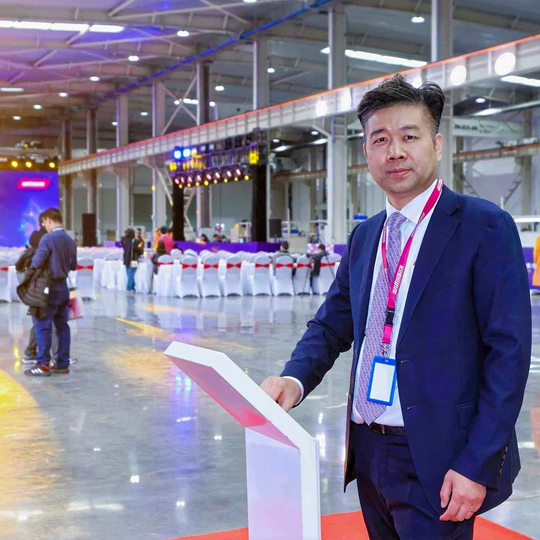
Kevin Wang, Managing Director of Wittmann at its Kunshan plant in China: “We can meet local requirements even more quickly and effectively.”
(Bild: Wittmann)
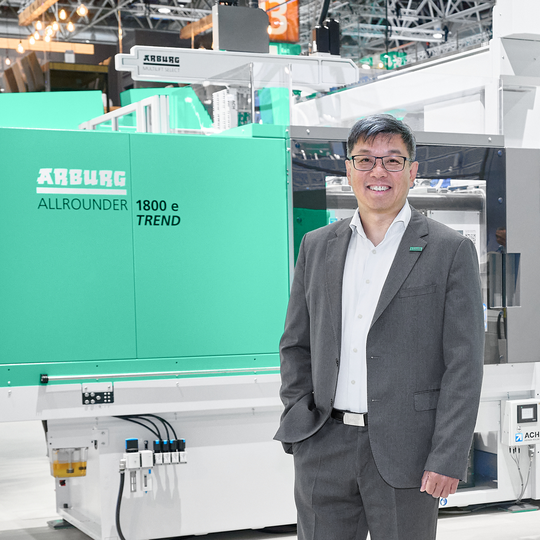
“Chinaplas is the most important platform for presenting our ‘local-to-local’ strategy to Asian customers,” explains Zhao Tong, Managing Director of Arburg’s operations in China. Kevin Wang, Managing Director of Wittmann in Kunshan, emphasizes: “This allows us to meet local requirements even more quickly and effectively.” Hennecke is also following this path. The company offers machines for PUR processing with performance specifications that are identical worldwide, but specifically adapts the technical design to regional standards.
Advantages of the Local-to-Local Strategy
The “Local-to-Local” strategy offers local plastics processors a range of strategic and operational advantages. At its core, it involves linking global technology platforms with local production and expertise.
A key factor is the significant shortening of supply chains and delivery times. By manufacturing directly in the target markets—such as at the Arburg plant in Pinghu or the Wittmann plant in Kunshan—machines and peripheral equipment can be delivered more quickly. This gives processors greater flexibility in planning their production capacities and enables them to respond more quickly to market changes.
Arburg is making a big splash at Chinaplas with the Asian premiere of the Allrounder Trend. “Chinaplas is the most important platform for presenting our ‘local-to-local’ strategy to Asian customers,” explains Zhao Tong, managing director of Arburg’s operations in China.
(Arburg)
Through local manufacturing and the use of locally available, high-quality components that meet regional standards, manufacturers can offer more competitive prices. This lowers the barriers to investment for processors without requiring them to compromise on product quality. In addition, complex logistics costs and import duties are eliminated or reduced. Despite being implemented locally, the solutions are based on the technology platform and expertise of the parent companies.
At Chinaplas 2026, Arburg will even be placing its “Local-to-Local” strategy front and center. A central pillar of the offering is the Arburg Technology Factory (ATF) in Pinghu. Not only are Allrounder machines there equipped with automation systems from local partners, but—as of recently—machines from the Allrounder Trend series are also being assembled there specifically for the Asian market.
The "Low-Altitude Economy" as a Market of the Future
A future growth area in China is the low-altitude economy, which includes drones and electric vertical takeoff and landing (eVTOL) aircraft. China’s Civil Aviation Administration forecasts that this market will reach a volume of approximately 438 million euros by 2035. Since lightweight construction, safety, and range are critical for these aircraft, they require plastics and high-performance composites.
Date: 08.12.2025
Naturally, we always handle your personal data responsibly. Any personal data we receive from you is processed in accordance with applicable data protection legislation. For detailed information please see our privacy policy.
Consent to the use of data for promotional purposes
I hereby consent to Vogel Communications Group GmbH & Co. KG, Max-Planck-Str. 7-9, 97082 Würzburg including any affiliated companies according to §§ 15 et seq. AktG (hereafter: Vogel Communications Group) using my e-mail address to send editorial newsletters. A list of all affiliated companies can be found here
Newsletter content may include all products and services of any companies mentioned above, including for example specialist journals and books, events and fairs as well as event-related products and services, print and digital media offers and services such as additional (editorial) newsletters, raffles, lead campaigns, market research both online and offline, specialist webportals and e-learning offers. In case my personal telephone number has also been collected, it may be used for offers of aforementioned products, for services of the companies mentioned above, and market research purposes.
Additionally, my consent also includes the processing of my email address and telephone number for data matching for marketing purposes with select advertising partners such as LinkedIn, Google, and Meta. For this, Vogel Communications Group may transmit said data in hashed form to the advertising partners who then use said data to determine whether I am also a member of the mentioned advertising partner portals. Vogel Communications Group uses this feature for the purposes of re-targeting (up-selling, cross-selling, and customer loyalty), generating so-called look-alike audiences for acquisition of new customers, and as basis for exclusion for on-going advertising campaigns. Further information can be found in section “data matching for marketing purposes”.
In case I access protected data on Internet portals of Vogel Communications Group including any affiliated companies according to §§ 15 et seq. AktG, I need to provide further data in order to register for the access to such content. In return for this free access to editorial content, my data may be used in accordance with this consent for the purposes stated here. This does not apply to data matching for marketing purposes.
Right of revocation
I understand that I can revoke my consent at will. My revocation does not change the lawfulness of data processing that was conducted based on my consent leading up to my revocation. One option to declare my revocation is to use the contact form found at https://contact.vogel.de. In case I no longer wish to receive certain newsletters, I have subscribed to, I can also click on the unsubscribe link included at the end of a newsletter. Further information regarding my right of revocation and the implementation of it as well as the consequences of my revocation can be found in the data protection declaration, section editorial newsletter.
A completely new growth area in China is the low-altitude economy, which includes drones and electric air taxis. Covestro and GAC are collaborating to make air taxis a part of everyday life.
(Bild: GAC)
Carbon fiber and glass fiber composites are used in load-bearing structures. There is growing demand for thermoplastic composites based on modified polyamide (PA) and polyetheretherketone (PEEK) for fastener components. Specialty plastics such as polyphenylene sulfide (PPS) are essential for fire protection and battery management.
In the field of processing, technologies such as Krauss Maffei’s Fiberform reduce the production time for complex structures. Fiberform combines the thermoforming of organic sheets with injection molding: “This method reduces production time to about two minutes while maintaining structural strength and safety,” explained a spokesperson for Krauss Maffei. Previously, metallic rib structures required over 100 hours of processing time.
Sustainability in Packaging and Construction
China’s 15th Five-Year Plan calls for the comprehensive implementation of a “green transformation.” As a result, the Chinese packaging sector is also entering a new phase of sustainability. Mono-material designs, particularly those made of PE and PP, are becoming the standard to improve recyclability. This is leading to massive investments in mechanical and chemical recycling capacities, as well as in high-performance sorting facilities and post-consumer recycled (PCR) plastics, whose properties closely resemble those of virgin materials.
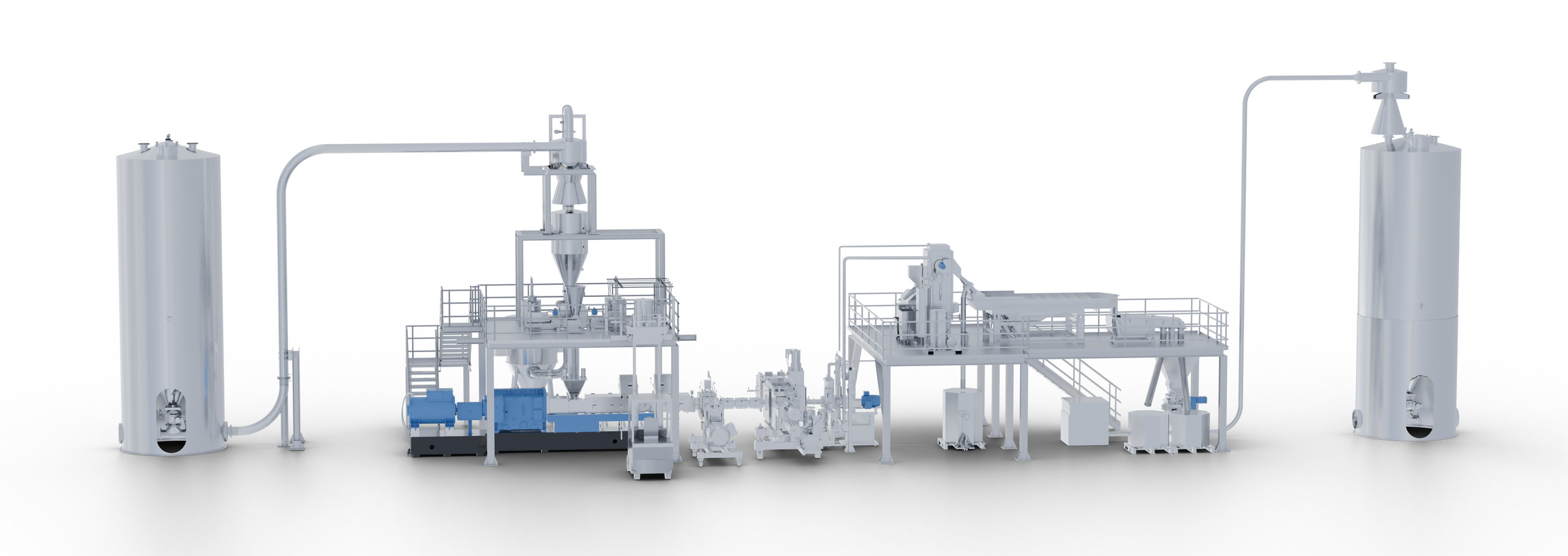
At Chinaplas 2026, Coperion, in collaboration with Herbold Meckesheim, will present comprehensive solutions for plastics recycling, with a particular focus on a new system for PET recycling.
The packaging sector in China is entering a new era of sustainability. With new recycling solutions from Coperion, high-quality PET recompounds can be produced at an attractive price-performance ratio.
(Coperion)
Recycled materials are also gaining ground in the construction sector. Driven by national sustainability goals, post-consumer recycled (PCR) plastics are increasingly being used in exterior cladding, facades, and urban infrastructure. Wood-plastic composites (WPC) are experiencing a surge in demand due to their durability and low maintenance costs.
Growth Markets: Vietnam and Indonesia
The emerging markets of Vietnam and Indonesia have become key strategic partners and sales markets for the Chinese plastics industry. While Vietnam is considered the fastest-growing plastics hub in Southeast Asia, Indonesia is positioning itself as the largest economy within the Association of Southeast Asian Nations (ASEAN).
Chinaplas serves as a strategic hub for the ASEAN market. 4,900 global exhibitors use the platform to showcase new solutions for the rapidly expanding industries in Southeast Asia. As a result, Chinaplas 2026 will function less as a mere sales show and more as a “living laboratory” for the industrial transformation of the entire ASEAN region under Chinese leadership.
Vietnam is emerging as the fastest-growing plastics market in Southeast Asia. Production rose to 11.84 million metric tons in 2025 and is projected to grow to over 17 million metric tons by 2030, at a compound annual growth rate (CAGR) of 8.44%. Massive foreign direct investment from corporations such as Samsung, LG, and Microsoft is driving demand for engineering plastics.
The country is also experiencing very dynamic growth in the packaging sector. Tetra Pak has expanded its plant in Binh Duong to increase its food packaging capacity from 12 to 30 billion units. SCG Packaging (SCGP) has significantly expanded its presence in the ASEAN market through the complete acquisition of Duy Tan Plastics. “Vietnam is our most important strategic market after Thailand, and this acquisition aims to deepen our presence in consumer goods packaging in the ASEAN region,” explained a representative from SCGP.
Another key focus in Vietnam is the expansion of recycling capacity, driven by extended producer responsibility (EPR) laws. Chemetall (BASF) is supplying innovative PET washing solutions for a recycling plant in Vung Tau.
Indonesia, Southeast Asia’s largest economy, is also experiencing steady growth in its plastics market of approximately 6% annually. The market value is projected to rise to $14 billion by 2033. The country has set particularly ambitious goals in the field of electric mobility: By 2030, there are expected to be 2 million electric cars and 12 million electric two-wheelers on the roads. This is fueling demand for lightweight plastic materials that can replace metals.
Technology Drivers from the DACH Region
Companies from Germany and Austria are using Chinaplas 2026 as a platform to showcase cutting-edge technology, with a clear focus on process integration, increased efficiency, and specialized material solutions.
In the field of mechanical engineering, Arburg is making a big splash with the Asian premiere of the electric “Allrounder Trend.” The injection molding machine, available in four sizes ranging from 500 to 2,000 kN of clamping force, features the new Gestica Lite control system, which emphasizes intuitive operation and a modern dashboard. Another highlight is a turnkey system based on an Allrounder 1600 T, which fully automatically manufactures high-voltage modules for automotive connectors by overmolding metal inserts with glass-fiber-reinforced PBT.
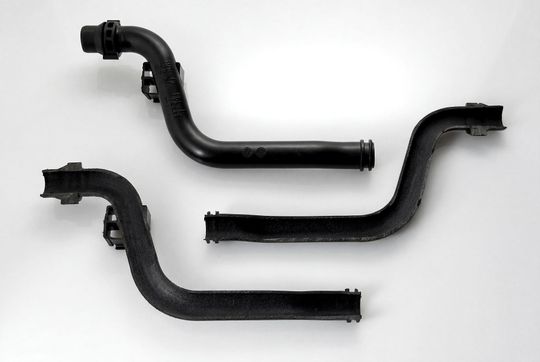
Hollow-body structures produced by gas injection
(Bild: Angels)
The Engel Group demonstrates its expertise in surface finishing with Clearmelt technology. A B-pillar trim made of PC is produced on a Duo 700 injection molding machine and overmolded with polyurethane directly in the mold, eliminating the need for additional painting steps. For lightweight construction applications, Engel is showcasing Fluidmelt technology, which creates hollow structures through gas injection, thereby reducing material usage and weight. In the packaging sector, the company is presenting an E-Mac 380 that uses a 48-cavity mold to produce flip-top closures in cycle times of just over 10 seconds.
Wittmann focuses on precision on a small scale. The Micropower concept enables the production of micro-components in a footprint of just 2 m². At the trade show, POM vein clamps weighing just 0.003 g each will be produced in a Class 7 cleanroom cell. In addition, the new Primus 118 linear robot is making its debut, now offering an increased payload of up to 8 kg for machines with a clamping force of up to 250 t.
Dr. Boy focuses on specialized medical technology solutions. A Boy XS E machine produces resorbable tissue clips made of PPDO for surgical procedures, with a part weight of just 0.105 g. The high dimensional accuracy is also demonstrated in the production of threaded rods for insulin injection pens on a Boy 25 E machine.
In the field of processing technology, Coperion is showcasing the ZSK 58 Mc18 twin-screw extruder with a transparent process section that provides a direct view of the mixing and dispersion behavior at throughput rates of up to 2,500 kg/h. For recycling, the company is introducing a new system for PET re-compounds that covers throughput ranges of up to 10 metric tons per hour and can be flexibly adapted for applications ranging from bottle-to-bottle to tray recycling.
A new TPU outsole reduces the product carbon footprint (PCF) by more than 40% compared to conventional rubber soles.
(Source: BASF)
On the materials page, BASF presents the new Elastollan Griptec TPU series for the sporting goods industry. This outsole material system not only offers greater design flexibility—ranging from transparent to black—but also reduces the product carbon footprint (PCF) during manufacturing by 41% compared to conventional rubber soles.
Mocom is expanding its materials portfolio with innovative infrared solutions. The Alcom LIR portfolio offers high transmission in the near-infrared range while maintaining a deep black appearance. This makes it possible to integrate sensors and cameras invisibly behind component surfaces without compromising vehicle design. The distributor Albis rounds out the lineup with a wide range of engineering plastics that are specifically tailored to the stringent regulatory requirements in the healthcare sector and the thermal stresses encountered in electric mobility.
Conclusion for Fabricators
Developments in Asia clearly show that the focus is shifting away from pure volume growth toward high-tech solutions and the circular economy. For European processors and manufacturers, Chinaplas 2026 an opportunity to learn about new material developments, efficient machinery, and innovative recycling technologies that will increasingly influence global supply chains as well. The trade show serves as a “living laboratory” for the practical implementation of China’s new industrial policy goals.



:quality(80)/p7i.vogel.de/wcms/8d/fd/8dfdc63153cce5816e7a371257b6bdff/nexofoam-epla-schaumv1.png "From compact EPLA granules to fully foamed insulation boards: This bio-based particle foam material can be processed as a drop-in solution on existing EPS molding machines. (Bild: Nexofoam)")
:quality(80)/p7i.vogel.de/wcms/91/39/91397ac53b2ca4d65d65f563ebdc12ea/nexofoam-epla-schaumv1.png "From compact EPLA granules to fully foamed insulation boards: This bio-based particle foam material can be processed as a drop-in solution on existing EPS molding machines. (Bild: Nexofoam)")
:quality(80)/p7i.vogel.de/wcms/2b/37/2b37601930b643d709629fa8005aade0/nexofoam-epla-schaumv1.png "From compact EPLA granules to finished foam insulation boards: This bio-based particle foam material can be processed as a drop-in solution on existing EPS molding machines. (Bild: Nexofoam)")
:quality(80)/p7i.vogel.de/wcms/97/0c/970c52fd142e10a3c4566168037ca637/materialloesungen-pressefoto-1890x1329v1.jpeg "rPET pellets: At Fraunhofer IAP, terephthalic acid is recovered from PET to produce new polymers for bottles, fibers, and films. The yellowish to grayish hues are due to the recycled raw material. Through the targeted addition of additives, the color can be adjusted to produce even colorless material. (Bild: Fraunhofer IAP / Romina Schönefeld)")
:quality(80)/p7i.vogel.de/wcms/ce/ee/ceeeef086bfb174ebdda31c0dfccaf9a/2-weiss-blick-in-produktion-dji-0095-kopiev1.jpeg "A look inside the injection molding shop at Weiss Kunststoffverarbeitung in Illertissen, Bavaria. (Bild: White)")
:quality(80)/p7i.vogel.de/wcms/33/08/3308710c85715e917ec1baf9767fe4a7/2026-ewikon-wago-hei-kanalv1.png "Ewikon's 48-cavity hot runner as a production mold. (Bild: Ewikon)")
:quality(80)/p7i.vogel.de/wcms/a2/a5/a2a516dc69b4c8f8ad6f475ae6746a08/sxkh-bei-hpf-gesamtwerkzeugv1.png "The HMG 70XS1510 trimming press from the Chinese manufacturer SXKH combines all the functions required by toolmakers at HPF in a very compact design. The deciding factors in the purchase were the purchase price—and confidence in the quality of established international key components. (Bild: Pergler Media)")
:quality(80)/p7i.vogel.de/wcms/19/5f/195fdb6e09629994f1d6e3cf94dac8d8/bild-1-exam510-ultem9085v1.jpeg "Granular printing (FGF) makes it cost-effective to produce large-format functional parts from high-performance polymers such as Ultem 9085. (Bild: NEW AIM3D)")
:quality(80)/p7i.vogel.de/wcms/d5/c4/d5c46d40e1ae062370d058e2c006c376/dimitrisvetsikas1969-belgium-3595351v1.jpeg "European Plastics Industry Calls for Immediate Action to Address the Industry Crisis (Bild: dimitrisvetsikas1969)")
:quality(80)/p7i.vogel.de/wcms/e6/63/e663f0e1dd8818fc501c6fb5c5d33712/19-5689-circular-economy-of-resourcesv1.jpeg "Plastic waste from the average household is very heterogeneous. Only the right mix of technologies can turn all types of plastic waste into a new source of raw materials. (Bild: BASF)")
:quality(80)/p7i.vogel.de/wcms/31/5b/315b714f653484179232fbc4d6d79543/sesotec-img-andreas-hanus-25-20-281-29v1.jpeg "Andreas Hanus, Head of AI Development at Sesotec: “AI will not replace traditional sorting technology, but will intelligently enhance it.” (Bild: Sesotec)")
:quality(80)/p7i.vogel.de/wcms/74/5f/745f512239689819275af39a82f59860/b-brenkenv1.jpeg "Dr. Benedikt Brenken, Director of R-Cycle: \"The digital product passport will fundamentally change plastic recycling.\" (Bild: R-Cycle)")
:quality(80)/p7i.vogel.de/wcms/40/6d/406d05534ab4d28194bd29699e023e67/2026-09-09-uni-kiel-aufmacherv1.jpeg "These self-polarizing polymer coatings could be used in a wide variety of electronic components in the future. (Bild: University of Kiel/C. Anders)")
:quality(80)/p7i.vogel.de/wcms/5d/46/5d46e098a7cfaebdd9643df47153c5af/aufmacherv1.png "The PPWR imposes new requirements on packaging: What impact does this have on mechanical engineering? (Bild: KI-generiert / Dall-E)")
:quality(80)/p7i.vogel.de/wcms/70/13/7013fe202fb4790708f62f69cd0c83d4/aufmacher-st-c3-a4rkeschaumfoliev1.png "Using thermoplastic starch as a base, researchers at the IKV successfully produced a flexible foam film using physical blowing agents. (Bild: IKV)")
:quality(80)/p7i.vogel.de/wcms/d1/2b/d12b536ba3b382d0d138e342ac1038e6/03--20pm-imm-mgsv1.jpeg "MGS Richfield Site (Bild: MGS)")
:quality(80)/p7i.vogel.de/wcms/90/9c/909cf6eb1b91a9a84ff535033ea9b048/honeycombv1.jpeg "The composite material made of epoxy and glass fibers not only protects against flames but is also fully recyclable. (Bild: Empa)")
:quality(80)/p7i.vogel.de/wcms/6a/d5/6ad5980b0c965409c71582fc59145e13/1920-covestro-new-covestro-headquartersv1.jpeg "Covestro's corporate headquarters in Leverkusen (Bild: Covestro)")
:quality(80)/p7i.vogel.de/wcms/db/74/db741079d26ad9e7a69278fde45e79c7/aufmacherv1.png "(Bild: KI-generiert / Dall-E)")
:quality(80)/p7i.vogel.de/wcms/b3/65/b3654df434f4d31e1fda3c79bc7bb4b0/nakura-20kunstrasenteppich-20ohne-20verf-c3-bcllungv1.jpeg "Tecnaro has developed synthetic turf fibers using a specially formulated Arboblend blend that offers high resistance to heat, UV rays, and weathering, and, because it is niobium-based, sequesters CO₂ over the long term. (Bild: Tecnaro)")



:quality(80)/p7i.vogel.de/wcms/c0/44/c044342660c3d07a7f96e9816874a246/adobestock-62863749-3008x1692v1v1.jpeg "Bioplastics are no longer just an environmental fad, but an economic factor. (Bild: stock.adobe.com - thingamajiggs)")
:quality(80)/p7i.vogel.de/wcms/77/dc/77dc0c904a39c15ad54e62e330ae6b68/snow-foundersv1.png "The founders of Snow Polymers (from left): Alex Braun, Dr. Shai Garty, Sharon Raymond. The startup develops biodegradable plastics from organic waste. (Bild: Snow Polymers)")