Using the production of a multi-well plate as an example, Engel demonstrates how process validation in injection molding can be planned more effectively and completed more quickly. In the described use case, the effort required for qualification and validation decreased, while the cycle time was reduced. The key is an approach that starts with the functional requirements of the part and uses digital assistance systems to evaluate process stability and ensure critical settings are correct.
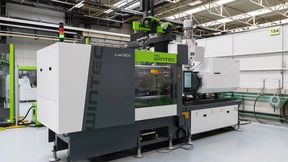
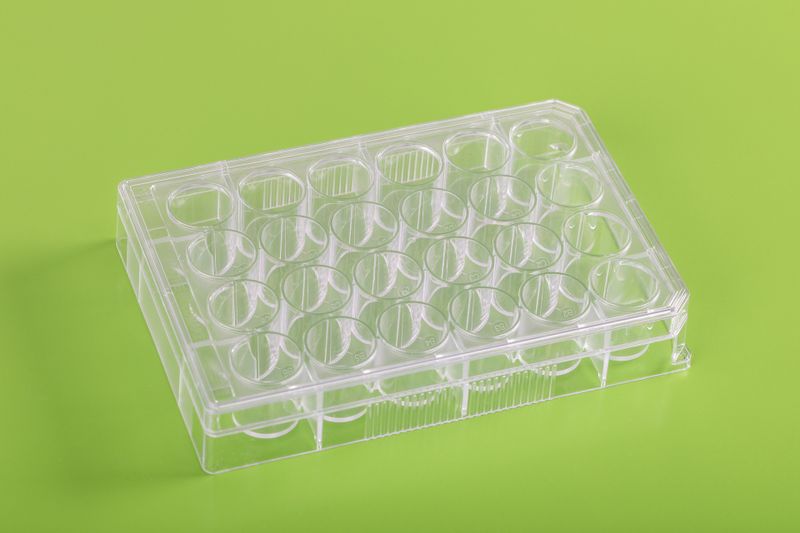
Validated, transparent, secure: The complex cell culture plate is produced on an Engel e-motion 280 combi M. The validation assistant supports reproducible process control and traceable monitoring.
(Bild: Angels)
A multi-well plate is used, among other things, for cell culture. Its lid must allow for adequate gas exchange while minimizing evaporation as much as possible. At first glance, this may seem like a matter of application, but it has direct implications for manufacturing: the dimensions, flatness, and parallelism of the contact surfaces must be precise so that the plate and lid function together as intended.
This is where risk-based validation comes into play. Instead of considering all available machine parameters equally, the approach moves from the requirements for use, through the critical quality attributes of the component, to the process variables that influence these attributes. In technical terminology, this means: from the User Requirements Specification (URS) through Critical Quality Attributes (CQA) to Critical Process Parameters (CPP). Behind these abbreviations lies a simple question: What must be right in the end—and what factors in the process determine that?
When a requirement becomes an inspection characteristic
For the Multi Well Plate, tolerances of ±0.25 mm apply in both the X and Y directions, and ±0.15 mm in the Z direction. The contact surfaces are also inspected. Factors relevant to dimensional accuracy include holding pressure and internal mold pressure; uneven temperature control can cause warpage. Thus, the requirements for the interaction between the plate and the lid translate into a specific testing and monitoring task. Many factors can be measured—what matters most is what influences the function of the molded part.
Qualifying with a Clear Research Question
A targeted validation strategy can be derived from an understanding of the component requirements. Even during Design Qualification (DQ), simulations help to narrow down risks and potential process windows. In this early phase, it is still relatively easy to plan countermeasures—both for the hardware and the software. For example, the Engel iQ weight control system can be incorporated to compensate for material variations between batches during the process and to help ensure compliance with tight molded part tolerances. This can significantly increase process stability in production. However, it is crucial that this be taken into account from the very beginning.
Installation Qualification (IQ) verifies that the production cell is installed as intended and that its components are functioning properly. This includes documentation of sensor calibration and the cell’s operational capability. This documentation lays the foundation for reliably evaluating measurement data later on. The company can also provide ongoing support for such documentation through the everQ service. Operational Qualification (OQ) examines the limits within which the process meets the requirements; Performance Qualification (PQ) demonstrates reproducibility under intended production conditions.
Simulations help prepare experiments but do not replace testing on the actual component. Especially in the case of extensive test series, data analysis can save time and reduce scrap. For the multi-well plate, 60 settings were examined during the OQ as part of a Design of Experiments (DoE) . To ensure sampling is performed only after the process has stabilized, a standard wait time of 30 to 60 minutes is often observed following a process change—without considering whether the process has actually stabilized yet. This results in a waiting time of 30 to 60 hours per validation, which is often unnecessary. This is where the iQ process observer comes into play—it clearly displays measurement data and cell settings and assesses process stability. Instead of waiting for a fixed amount of time, samples can then be taken as soon as the process has stabilized. This allows the OQ to be significantly reduced.
Date: 08.12.2025
Naturally, we always handle your personal data responsibly. Any personal data we receive from you is processed in accordance with applicable data protection legislation. For detailed information please see our privacy policy.
Consent to the use of data for promotional purposes
I hereby consent to Vogel Communications Group GmbH & Co. KG, Max-Planck-Str. 7-9, 97082 Würzburg including any affiliated companies according to §§ 15 et seq. AktG (hereafter: Vogel Communications Group) using my e-mail address to send editorial newsletters. A list of all affiliated companies can be found here
Newsletter content may include all products and services of any companies mentioned above, including for example specialist journals and books, events and fairs as well as event-related products and services, print and digital media offers and services such as additional (editorial) newsletters, raffles, lead campaigns, market research both online and offline, specialist webportals and e-learning offers. In case my personal telephone number has also been collected, it may be used for offers of aforementioned products, for services of the companies mentioned above, and market research purposes.
Additionally, my consent also includes the processing of my email address and telephone number for data matching for marketing purposes with select advertising partners such as LinkedIn, Google, and Meta. For this, Vogel Communications Group may transmit said data in hashed form to the advertising partners who then use said data to determine whether I am also a member of the mentioned advertising partner portals. Vogel Communications Group uses this feature for the purposes of re-targeting (up-selling, cross-selling, and customer loyalty), generating so-called look-alike audiences for acquisition of new customers, and as basis for exclusion for on-going advertising campaigns. Further information can be found in section “data matching for marketing purposes”.
In case I access protected data on Internet portals of Vogel Communications Group including any affiliated companies according to §§ 15 et seq. AktG, I need to provide further data in order to register for the access to such content. In return for this free access to editorial content, my data may be used in accordance with this consent for the purposes stated here. This does not apply to data matching for marketing purposes.
Right of revocation
I understand that I can revoke my consent at will. My revocation does not change the lawfulness of data processing that was conducted based on my consent leading up to my revocation. One option to declare my revocation is to use the contact form found at https://contact.vogel.de. In case I no longer wish to receive certain newsletters, I have subscribed to, I can also click on the unsubscribe link included at the end of a newsletter. Further information regarding my right of revocation and the implementation of it as well as the consequences of my revocation can be found in the data protection declaration, section editorial newsletter.
How Driver Assistance Systems Keep the Process on Track
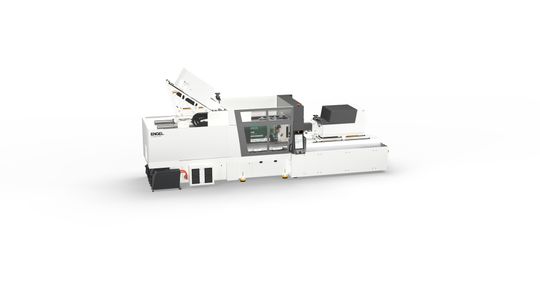
After qualification, the process must remain within the approved range during mass production. In this practical example, the multi-well plate is produced on a fully electric Engel e-motion 280 combi M. The Engel validation assistant links the component requirements with assistance and monitoring functions.
Fully Electric Precision for Validated MedTech Processes: The Engel e-motion 280 combi M in Use with the validation assistant.
(Bild: Angels)
The mold breathing curve recorded using iQ clamp control can reveal changes in injection and holding pressure behavior. If necessary, mold sensors can provide additional data on internal pressure and temperature trends—though this requires a corresponding amount of effort.
Parameter limits allow critical settings—such as the after-pressure profile or cooling time—to be restricted to approved ranges, and changes to be secured on a role-based basis. This ensures that the process—systematically safeguarded by the CC300—always remains within the defined process window. The iQ Process Observer helps identify anomalies in the process data and narrow down their causes. The systems support process control and monitoring; however, product inspection, evaluation, and approval are still required.
The numbers apply here. The method goes further.
In the use case described, the time required for qualification and validation was reduced by approximately 30%. The cycle time dropped from an industry-standard benchmark of 16 seconds to about 11 seconds. The extent of the savings for a different product geometry must be assessed in detail—depending on the geometry, material, tool, initial process, and requirements.
The method is certainly transferable. Those who first understand the product’s function can specifically define quality characteristics, examine their influence on the process, and ensure the qualified range during operation. This knowledge also helps to systematically evaluate subsequent changes or a process transfer. More advanced concepts, such as approval based on process parameters, remain a future prospect that requires specific prerequisites and supporting documentation.
It all started with a multi-well plate and the question of what the finished component needed to be capable of. The result is a process tailored precisely to that purpose—sometimes thinking in reverse is the most direct path to validation. (sl)