Figures, Trends, and OutlookPlastic Recycling in Germany
From
Melanie Ehrhardt
7 min Reading Time
Plastics recycling is considered a key component of the circular economy. But how efficiently is waste actually recycled in Germany? A look at the latest figures, trends, and future challenges.
It is hard to imagine modern daily life without plastics. According to the study “Material Flow Map of Plastics in Germany 2023,” which is conducted every two years, the industry processed a total of 12.8 million metric tons (Mio. t) of plastics in 2023 for material applications, such as packaging, automotive, medical technology, as well as sports and electronics.
At the same time, waste disposal poses a major challenge for the environment and society. In Germany, the plastic recycling therefore plays an important role in conserving resources and reducing environmental impact.
Plastic Waste in Germany
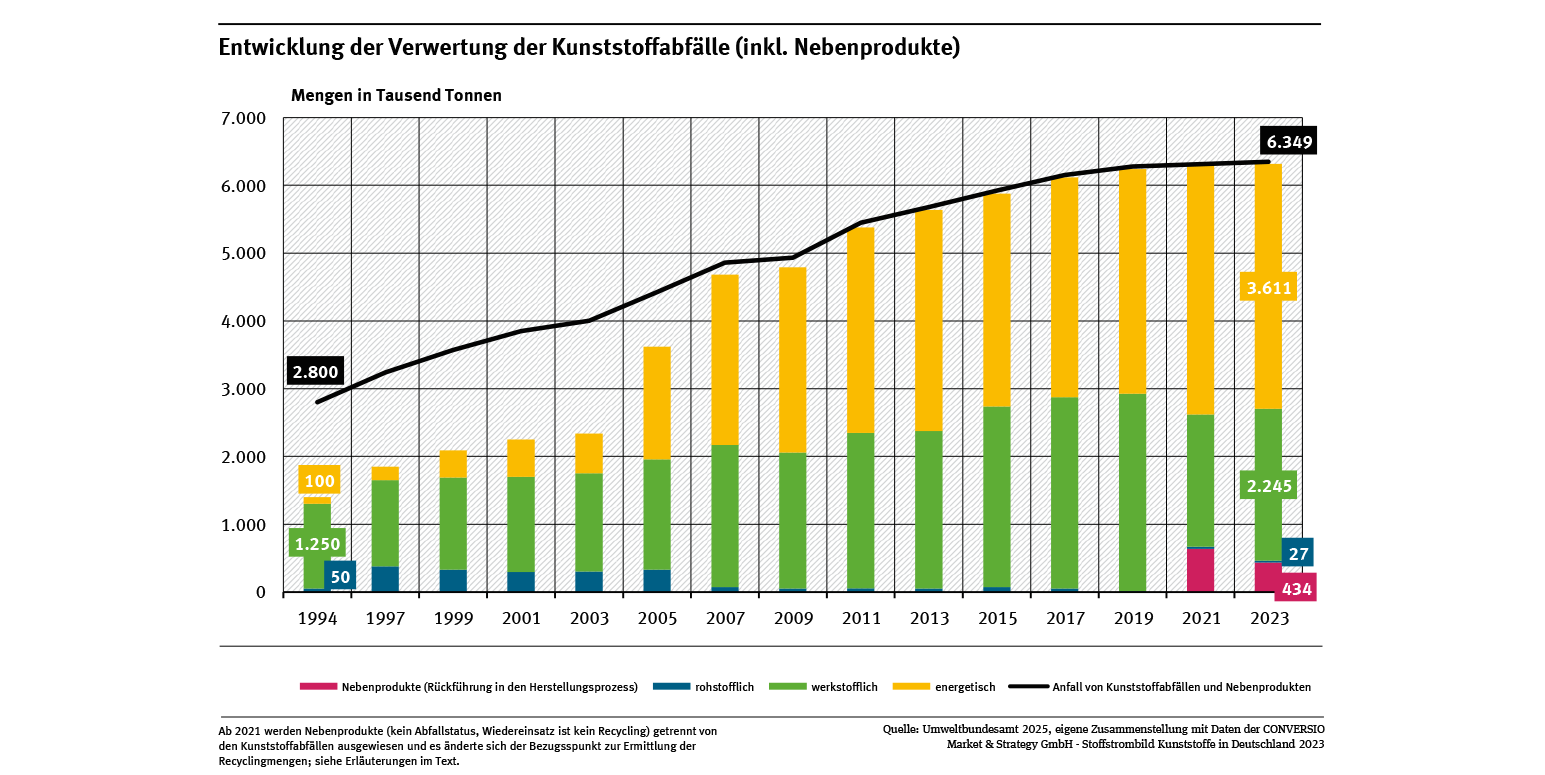
In 2023, 5.91 million metric tons of plastic waste were generated in Germany. About 94 percent of this waste was generated after the plastics had been used (post-consumer waste). The remaining six percent was generated during the production and, above all, the processing of plastics.
In 2023, nearly all of the collected plastic waste was recycled or used for energy recovery. In addition, there were slightly more than 0.4 million metric tons of byproducts from production and processing; however, these were not classified as waste but were returned to the manufacturing process.
(Source: Federal Environment Agency)
Trends in Plastic Waste Recycling: The recycling volumes reported refer to plastic waste generated in Germany—measured at the output-based calculation point—regardless of whether it was recycled in Germany or abroad.&They therefore do not represent the quantities processed by German recycling companies. The same applies to energy recovery volumes.
Source: Material Flow Map of Plastics in Germany 2023 -Facts and Figures on the Life Cycle of Plastics (Conversio)
Plastic Recycling in Germany
In 2023, 99.5 percent of all collected plastic waste was recycled:
Of the 5.91 million metric tons of total plastic waste, 2.27 million metric tons—or 38.4%—were used for industrial and raw material purposes or in chemical processes.
3.61 million metric tons, or 61.1 percent, were used for energy recovery—2.25 million metric tons of which were incinerated in waste-to-energy plants, while 1.36 million metric tons were used as substitute fuel to replace fossil fuels in facilities such as cement plants and power plants.
32,000 metric tons, or about 0.5 percent, were disposed of. This plastic waste was therefore sent to landfills or incinerated in facilities that did not recover sufficient energy.
These figures show that plastic recycling is the second most common method of waste disposal in Germany. Energy recovery ranks first—that is, the conversion of plastic waste into usable heat, electricity, or fuels through incineration or other processes.
In Detail
The State of Chemical Recycling in Germany
A recent study shows that Germany could recycle significantly more plastics. Chemical processes offer additional options to complement mechanical recycling—especially for waste that is difficult to recycle into high-quality products using traditional methods.
In 2024, however, only five facilities were in operation in this country, with a combined annual processing capacity of approximately 20,000 metric tons of scrap tires and 10,000 metric tons of plastic waste. This represents only a very small fraction of the total plastic waste in Germany, which amounts to over six million metric tons annually.
In plastic recycling, used plastics are collected, sorted, processed, and then turned into new material. The goal is to conserve raw materials and reduce the amount of plastic waste.
A distinction is generally made between mechanical and chemical recycling:
In mechanical recycling, the plastic is largely preserved and is simply cleaned and reshaped.
In chemical recycling, the plastic is broken down into its chemical components, which can then be used to produce new plastics.
Differences in Material Recycling
In 2023, the recycling rates for waste from plastic production and plastic processing were 85% and nearly 88%, respectively. Just under 33% of plastic waste from private households was recycled, while approximately 39% of plastic waste from commercial end-use was recycled.
The reason for these differing rates is that plastics generated by industry are usually very clean and sorted by type, whereas those from households and many commercial businesses are contaminated and mixed.
Use of Recycled Plastics in Germany
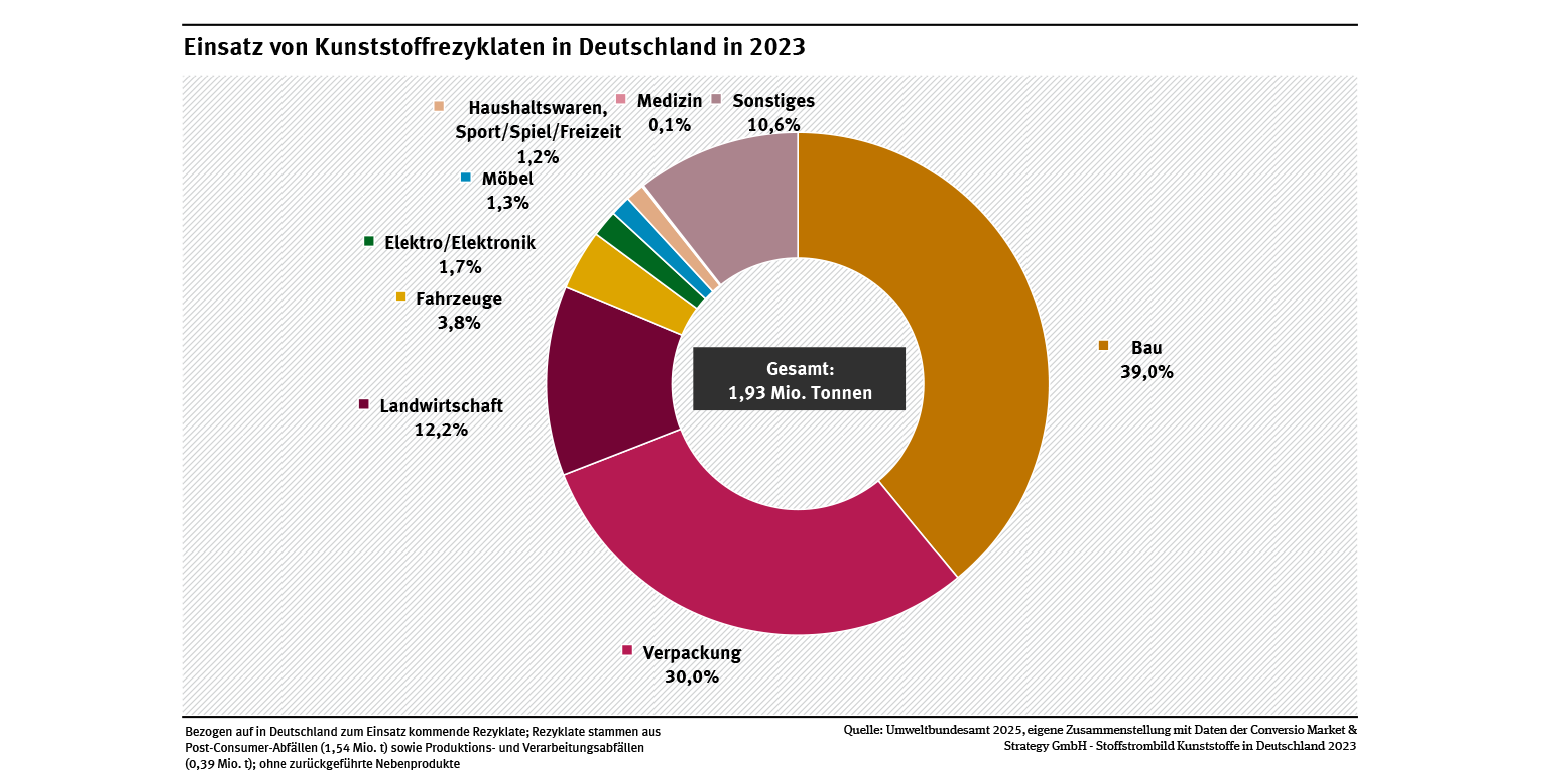
Main applications of recycled plastics (1.93 million metric tons) and reused by-products (0.5 million metric tons) in new products are construction materials and packaging. In 2023, approximately 67% of the recycled materials and by-products used in Germany were applied in these two areas. Of the recycled materials used in plastics processing, 1.54 million metric tons (79.8%) came from post-consumer waste (waste from private and commercial end-use), and 0.39 million metric tons (20.2%) came from production and processing waste.
(Source: Federal Environment Agency)
Use of Recycled Plastics in Germany in 2023: Recycled plastics are in high demand as a raw material, particularly in the construction and packaging sectors.
Source: Material Flow Map for Plastics in Germany 2023 -Facts and Figures on the Life Cycle of Plastics (Conversio)
Problems and Challenges
Among the biggest challenges in plastics recycling are the quality and price of recycled materials compared to virgin materials. The plastics processing industry requires large quantities of recycled plastics that are produced under strictly controlled conditions and at a competitive price.
However, since plastics often need to be tailored to the functional and aesthetic requirements of their intended use, the wide variety of raw materials further complicates the recycling process. This makes it expensive and compromises the quality of the final product.
Innovations & Trends
Currently, plastics recycling is primarily shaped by new technologies, stricter environmental regulations, and the desire for a functioning circular economy.
One important trend is what is known as chemical recycling. In this process, plastics are not merely melted down but chemically broken down into their basic building blocks (monomers). This makes it possible to process even heavily contaminated or mixed plastics that are unsuitable for conventional recycling. Companies such as BASF or Covestro are working intensively on such processes.
Date: 08.12.2025
Naturally, we always handle your personal data responsibly. Any personal data we receive from you is processed in accordance with applicable data protection legislation. For detailed information please see our privacy policy.
Consent to the use of data for promotional purposes
I hereby consent to Vogel Communications Group GmbH & Co. KG, Max-Planck-Str. 7-9, 97082 Würzburg including any affiliated companies according to §§ 15 et seq. AktG (hereafter: Vogel Communications Group) using my e-mail address to send editorial newsletters. A list of all affiliated companies can be found here
Newsletter content may include all products and services of any companies mentioned above, including for example specialist journals and books, events and fairs as well as event-related products and services, print and digital media offers and services such as additional (editorial) newsletters, raffles, lead campaigns, market research both online and offline, specialist webportals and e-learning offers. In case my personal telephone number has also been collected, it may be used for offers of aforementioned products, for services of the companies mentioned above, and market research purposes.
Additionally, my consent also includes the processing of my email address and telephone number for data matching for marketing purposes with select advertising partners such as LinkedIn, Google, and Meta. For this, Vogel Communications Group may transmit said data in hashed form to the advertising partners who then use said data to determine whether I am also a member of the mentioned advertising partner portals. Vogel Communications Group uses this feature for the purposes of re-targeting (up-selling, cross-selling, and customer loyalty), generating so-called look-alike audiences for acquisition of new customers, and as basis for exclusion for on-going advertising campaigns. Further information can be found in section “data matching for marketing purposes”.
In case I access protected data on Internet portals of Vogel Communications Group including any affiliated companies according to §§ 15 et seq. AktG, I need to provide further data in order to register for the access to such content. In return for this free access to editorial content, my data may be used in accordance with this consent for the purposes stated here. This does not apply to data matching for marketing purposes.
Right of revocation
I understand that I can revoke my consent at will. My revocation does not change the lawfulness of data processing that was conducted based on my consent leading up to my revocation. One option to declare my revocation is to use the contact form found at https://contact.vogel.de. In case I no longer wish to receive certain newsletters, I have subscribed to, I can also click on the unsubscribe link included at the end of a newsletter. Further information regarding my right of revocation and the implementation of it as well as the consequences of my revocation can be found in the data protection declaration, section editorial newsletter.
At the same time, mechanical recycling is being further improved. Today, modern sorting facilities use artificial intelligence, sensors, and near-infrared technology to identify plastics more quickly and accurately. This improves the quality of the recycled material.
Another trend is what’s known as “design for recycling.” This means that products and plastic packaging are designed during the development phase to make them easier to recycle later on. This includes, among other things, avoiding material blends that are difficult to separate or problematic dyes.
In addition, digital solutions such as digital product passports are being developed. These store information about a product’s material composition and origin. This enables recycling facilities to make better decisions about how a plastic should be processed.
IN DETAIL
Enzymes: Recycling Heroes
Enzymatic recycling is another method that is currently being developed. Essentially, this process involves using enzymes to break down plastics into their basic chemical building blocks. A major advantage is that it often requires lower temperatures than, for example, chemical recycling.
However, the technology is still under development. So far, it works primarily with certain types of plastic and is still more expensive than many traditional recycling methods. Companies such as Carbios or Ester-Biotech are conducting intensive research into the industrial application of this method.
Measures to Increase Recycling Rates
In Germany, various policy measures are intended to help increase recycling rates and keep more plastics in the circular economy:
One key measure is statutory recycling quotas. Manufacturers and waste management companies are required to recycle a certain percentage of packaging waste. The Packaging Act has been tightened in recent years to ensure that more materials are actually recycled.
In addition, extended producer responsibility will be expanded. This means that companies will be held more accountable for how their packaging is disposed of and recycled. Companies that use packaging that is difficult to recycle will bear higher costs than those with recycling-friendly designs.
Another important approach is promoting the use of recycled materials. The government is discussing minimum quotas for recycled plastics in new products and packaging. This increases the demand for recycled materials, making recycling more economically attractive.
In addition, the deposit system is being expanded. Deposits on single-use bottles and beverage cans are already resulting in very high collection rates. For several years now, the mandatory deposit has also applied to other types of beverage packaging, with the aim of reducing the amount of plastic that ends up in residual waste.
The government is also investing in modern sorting and recycling technologies. Funding programs support companies and research institutions in developing new processes.
The European Union also has a strong influence on German recycling policy. EU regulations, such as the PPWR for packaging or the EU End-of-Life Vehicles Regulation, set recycling targets and ban certain single-use plastics. Germany must implement these rules at the national level.
Conclusion & Outlook
Plastics recycling in Germany is currently undergoing a massive transformation, shaped by strict EU regulations and the shift toward a true circular economy. The market is currently suffering from weak demand for recycled materials and price pressure, which is why future prospects are based on stricter regulations, technological innovations, and “design for recycling” approaches.
And yet: Overall, plastic recycling in Germany is likely to become more technologically advanced, more efficient, and more focused on closed-loop material cycles in the future. For this to succeed, politicians, industry, and consumers all have a role to play.
Sources
[1] https://www.umweltbundesamt.de/daten/ressourcen-abfall/verwertung-entsorgung-ausgewaehlter-abfallarten/kunststoffabfaelle (as of May 28, 2026)
[2] https://www.europarl.europa.eu/topics/de/article/20181212STO21610/plastic-waste-and-recycling-in-the-eu-facts-and-figures (as of May 28, 20206)
Transparency: This text was also created with the help of AI.