At Fakuma 2026, Krauss Maffei will showcase two approaches to more resource-efficient production: the direct processing of recycled materials during extrusion and 0.1-mm thin-film coating for the injection molding process.
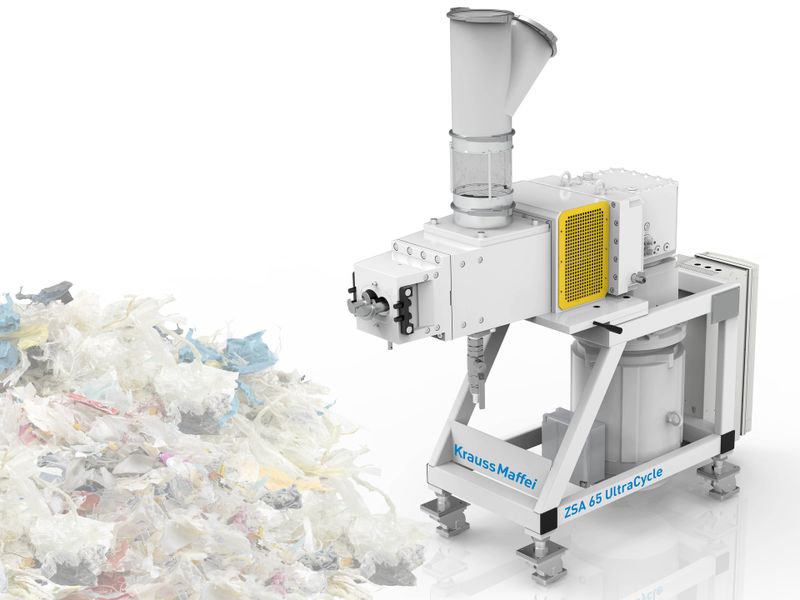
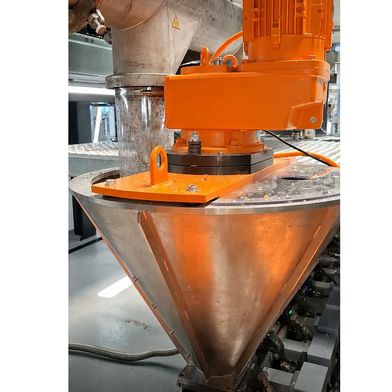
The new ZSA UltraCycle side-feed system from Krauss Maffei Extrusion enables the direct and reliable processing of lightweight and bulky recycled materials, such as plastic flakes and fibers, which were previously considered difficult to feed and not economically recyclable.
(Bild: Krauss Maffei)
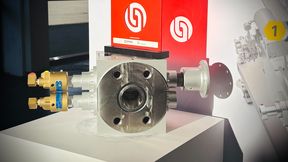
At Fakuma, Krauss Maffei Extrusion is presenting the new ZSA UltraCycle, a side-feed unit for twin-screw extruders developed specifically for recycling. It enables the direct and reliable processing of lightweight, high-bulk materials such as plastic flakes and fibers without additional pre-compaction. The integrated compaction of the material allows multiple process steps to be combined. This simplifies the recycling process, reduces energy consumption and capital expenditure, and can significantly increase the cost-effectiveness of processing.
The ZSA UltraCycle is specifically designed for fluffy recycled materials, which pose challenges for conventional dosing systems due to their low bulk density—sometimes as low as 10 kg/m³—and their high volume. These include, for example, thin-walled flakes, film scraps, or plastic fibers from end-user waste, as well as fibers from textile recycling. Typical materials are PET, (LD)PE, and PP flakes, as well as fibers and fabrics made of PA and polyester. Although the twin-screw extruder used has sufficient processing capacity, the material feed often limits the achievable throughput with these materials. The ZSA UltraCycle creates the conditions necessary to reliably utilize the extruder’s existing processing capacity.
Directly into the process—without any additional pretreatment
The new ZSA UltraCycle compacts lightweight and bulky recycled materials right at the feed point, enabling continuous and reliable feeding into the twin-screw extruder. This eliminates the need for additional pretreatment steps such as compaction or agglomeration. At the same time, material feeding, melting, compounding, degassing, and filtration can be combined into a single, continuous process. This reduces the number of process steps and lowers plant and energy costs.
With the ZSA UltraCycle, we are strategically expanding our product portfolio in the recycling sector.
Philip Cichy, Global Director Sales bei Krauss Maffei Extrusion
“With the ZSA UltraCycle, we are strategically expanding our product portfolio in the recycling sector. Many materials that, due to their low bulk density, could previously only be processed with additional effort can now be integrated more efficiently into the extrusion process. This opens up new opportunities for our customers to make their recycling processes more efficient and cost-effective,” says Philip Cichy, Global Director of Sales at Krauss Maffei Extrusion.
Efficient compaction, flexible auger design
At the heart of the newly developed side-feeding system are two screws, whose special design ensures efficient compaction of the material. This allows even large quantities of light and bulky recycled materials to be reliably conveyed into the feed zone of the ZE BluePower twin-screw extruder without compromising gravimetric metering. The result is consistent throughput, high formulation accuracy, and stable process control.
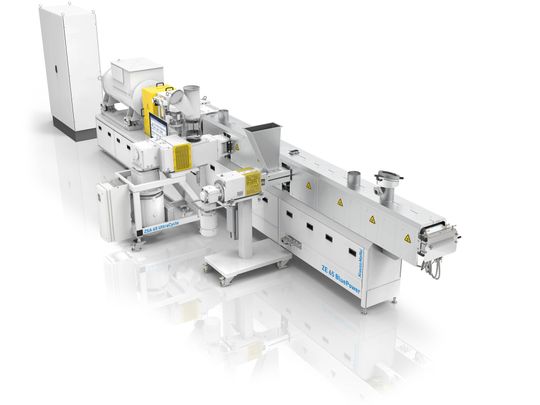
More recycling, fewer process steps: With the ZSA UltraCycle and the ZE BluePower twin-screw extruder, even particularly bulky recycled materials can be processed in a continuous flow from feed to filtration.
(Bild: Krauss Maffei)
The modular screw design also allows for flexible adaptation to different materials and applications. This design also offers advantages when it comes to wear and tear. Individual screw elements can be replaced selectively, rather than having to replace the entire screw. This reduces downtime and lowers maintenance and replacement part costs.
Technology Center Confirms Energy-Saving Potential
Tests conducted at the Technology Center in Laatzen confirm the potential of the new solution. By eliminating additional pre-compaction steps and processing bulky recycled materials directly, energy consumption and operating costs can be significantly reduced. Based on an example throughput of 1,000 kg/h, this results in potential savings of up to 400,000 kWh of electricity, or approximately 60,000 EUR per year, assuming an energy price of 0.15 EUR/kWh.
According to the company, the ZSA UltraCycle makes the processing of lightweight, bulky recycled materials easier, more efficient, and more cost-effective. The new solution is designed to reduce the number of process steps and energy consumption, thereby opening up new possibilities for recycling materials that were previously too difficult to process.
Setting New Standards in ColorForm Technology
The company is consistently advancing the development of ColorForm technology and will also be showcasing two innovations for in-mold painting of thermoplastic components at the trade show in Friedrichshafen. With a newly developed multicolor mixing head, color changes can now be performed fully automatically directly within the production process. At the same time, in collaboration with its long-standing development partner Siegfried Hofmann GmbH, the company has succeeded in reducing the thickness of the polyurethane coating to just 0.1 mm. Both developments enhance the cost-effectiveness and flexibility of the ColorForm process and open up new areas of application for high-quality visible surfaces.
Date: 08.12.2025
Naturally, we always handle your personal data responsibly. Any personal data we receive from you is processed in accordance with applicable data protection legislation. For detailed information please see our privacy policy.
Consent to the use of data for promotional purposes
I hereby consent to Vogel Communications Group GmbH & Co. KG, Max-Planck-Str. 7-9, 97082 Würzburg including any affiliated companies according to §§ 15 et seq. AktG (hereafter: Vogel Communications Group) using my e-mail address to send editorial newsletters. A list of all affiliated companies can be found here
Newsletter content may include all products and services of any companies mentioned above, including for example specialist journals and books, events and fairs as well as event-related products and services, print and digital media offers and services such as additional (editorial) newsletters, raffles, lead campaigns, market research both online and offline, specialist webportals and e-learning offers. In case my personal telephone number has also been collected, it may be used for offers of aforementioned products, for services of the companies mentioned above, and market research purposes.
Additionally, my consent also includes the processing of my email address and telephone number for data matching for marketing purposes with select advertising partners such as LinkedIn, Google, and Meta. For this, Vogel Communications Group may transmit said data in hashed form to the advertising partners who then use said data to determine whether I am also a member of the mentioned advertising partner portals. Vogel Communications Group uses this feature for the purposes of re-targeting (up-selling, cross-selling, and customer loyalty), generating so-called look-alike audiences for acquisition of new customers, and as basis for exclusion for on-going advertising campaigns. Further information can be found in section “data matching for marketing purposes”.
In case I access protected data on Internet portals of Vogel Communications Group including any affiliated companies according to §§ 15 et seq. AktG, I need to provide further data in order to register for the access to such content. In return for this free access to editorial content, my data may be used in accordance with this consent for the purposes stated here. This does not apply to data matching for marketing purposes.
Right of revocation
I understand that I can revoke my consent at will. My revocation does not change the lawfulness of data processing that was conducted based on my consent leading up to my revocation. One option to declare my revocation is to use the contact form found at https://contact.vogel.de. In case I no longer wish to receive certain newsletters, I have subscribed to, I can also click on the unsubscribe link included at the end of a newsletter. Further information regarding my right of revocation and the implementation of it as well as the consequences of my revocation can be found in the data protection declaration, section editorial newsletter.
With the new mixing head, we enable fully automatic color changes directly during the production process.
René Dierkes, Head of Global Multi-Technology-Projects bei Krauss Maffei
“With the new mixing head, we enable fully automatic color changes directly during the production process. This provides maximum flexibility, reduces setup times, and makes the production of variants significantly more cost-effective,” says René Dierkes, Head of Global Multi-Technology Projects at Krauss Maffei.
From Manual to Automatic Color Selection
Until now, changing colors in ColorForm applications has required manual intervention at the mixing head. Color nozzles, color units, or color modules must be replaced. Although the process already operates at high speed, it still requires an interruption in the production flow. The new technology eliminates this step. All required colors remain permanently connected to the mixing head. The system automatically selects the desired color while the remaining materials continue to circulate in the loop. The color change takes place directly within the process—quickly, reliably, and without mechanical retooling.
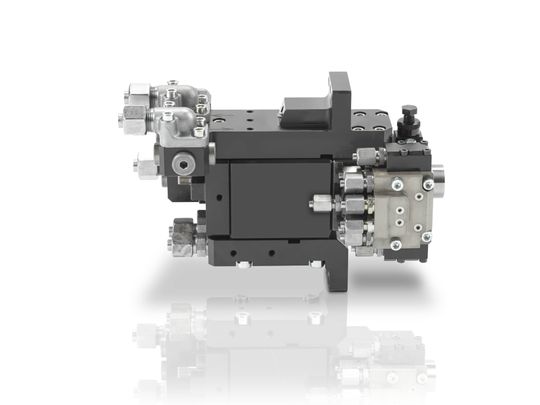
New multicolor mixing head from Krauss Maffei Technology for automated color changes.
(Bild: Krauss Maffei)
New thin-film technology reduces material usage by 80 percent
According to company statements, Krauss Maffei and Siegfried Hofmann GmbH have reached another milestone in reducing the thickness of the PUR coating. The two companies have been jointly developing ColorForm technology since 2008. They have now succeeded in coating thermoplastic components directly in the injection mold with a polyurethane layer just 0.1 mm thick. While ColorForm previously produced high-quality, scratch-resistant surfaces with coating thicknesses of up to 0.5 mm, the new development enables significantly more resource-efficient production while maintaining the same high surface quality. “By reducing the PUR layer thickness from 0.5 to less than 0.1 mm, we’ve achieved a significant technological leap. The resulting material savings of up to 80 percent significantly reduce material costs for each individual component,” says Andreas Bierbaumer, Technology Manager at Krauss Maffei.
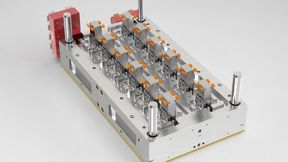
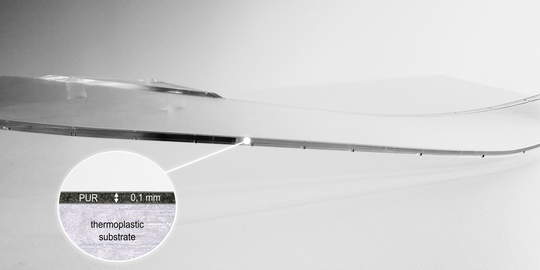
New thin-film technology for a 0.1 mm PUR coating thickness.
(Bild: Krauss Maffei)
Through optimizations to the component clamping system, the sealing system, the pre-molded part, and the mixing head, the PUR layer thickness was reduced to 0.1 mm. This joint development by Krauss Maffei and Hofmann demonstrates that ultra-thin PUR layers can be produced reliably and with high quality directly in the injection mold. “With this development mold, we are demonstrating—together with Krauss Maffei—that such layer thicknesses can be reliably achieved. In terms of design and dimensions, the mold is based on current automotive exterior components such as trim panels or diffusers. At the same time, we have found that surface quality improves and the scrap rate can be reduced,” adds Stefan Hofmann, Managing Director and Owner of Siegfried Hofmann GmbH.
Service
Krauss Maffei at Fakuma 2026: Hall A7, Booth 7303
Want to attend Fakuma for free with PlastXnow? Simply enter the code SUAGL-L28JU on the registration page.